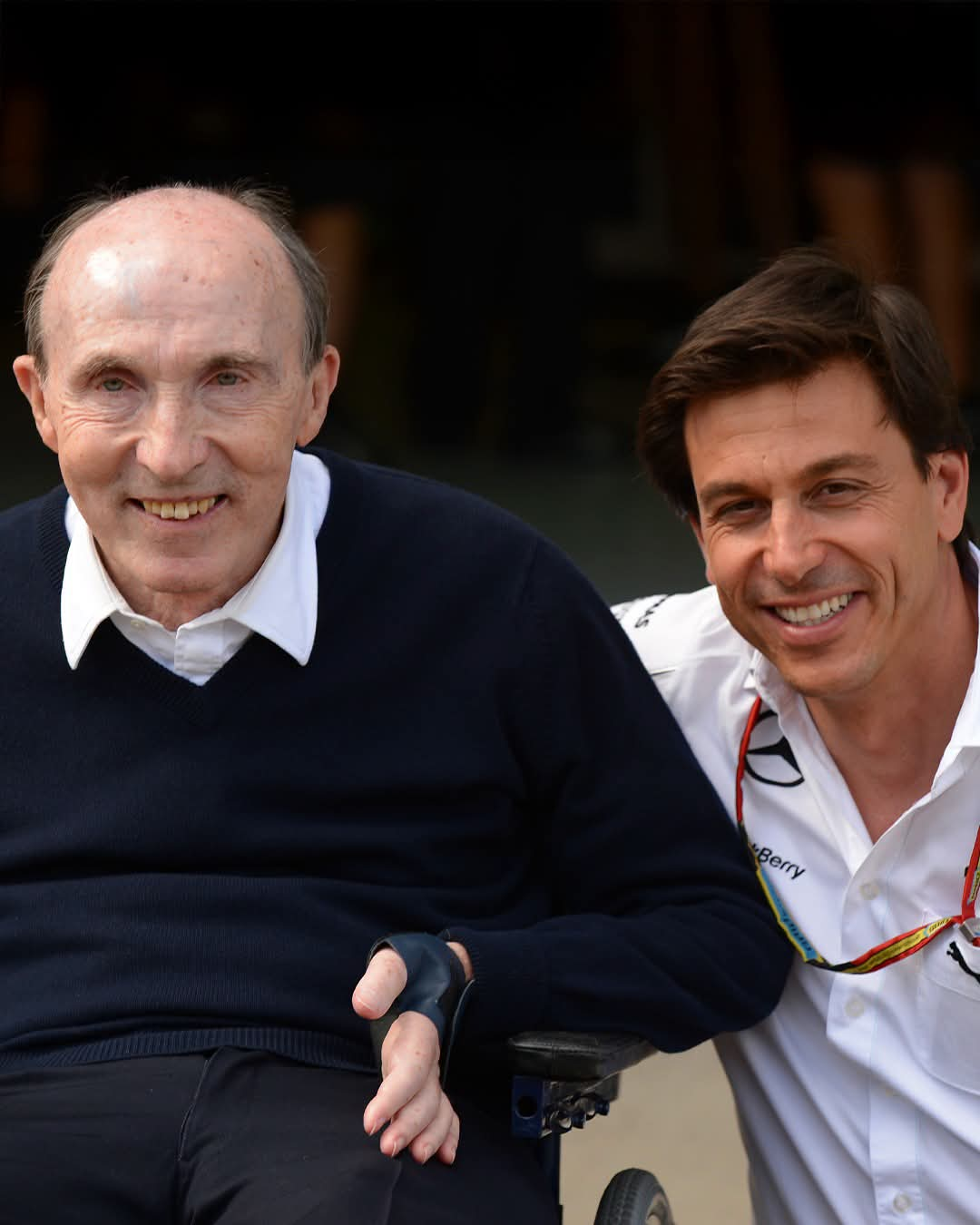
In Formula 1, records are rarely shared for long. Yet one of the sport’s most meaningful milestones now belongs equally to two men from different eras: Toto Wolff and Sir Frank Williams. Both sit on nine World Constructors’ Championships as team principals. No one else in F1 history has reached that number.
The latest title arrived in 2026 when Mercedes clinched the constructors’ crown at the São Paulo Grand Prix, ending a four-year wait and completing a remarkable recovery after the team’s hybrid-era dominance faded. Wolff, who has led the Silver Arrows since 2013, finally drew level with the late Sir Frank Williams, the founder and long-time leader of the team that still carries his name.
Williams Racing itself marked the moment with a simple, classy acknowledgment of the shared achievement. That gesture carried weight. It was not just two rivals’ records colliding. It was a quiet recognition of continuity in a sport that constantly reinvents itself.
WHY THIS RECORD CARRIES SPECIAL WEIGHT IN FORMULA 1
Constructors’ titles measure more than points. They measure the entire organisation: design, strategy, reliability, culture, and the ability to keep winning when regulations, engines, and rival strengths shift. Drivers come and go. Chassis and power units change. The team principal who steers the whole machine through those cycles is rarer.
Sir Frank Williams built his team from near-nothing into a powerhouse that claimed nine constructors’ championships between 1980 and 1997. Those titles spanned Cosworth, Honda, and Renault eras, multiple driver champions, and the unimaginable personal challenge of continuing after his life-altering accident in 1986. The results never stopped coming.
Toto Wolff arrived in a very different F1. Mercedes was already a works team with serious resources, yet it had not won a constructors’ title in the modern era. Under Wolff the team delivered eight consecutive crowns from 2014 to 2021 — still the longest streak in championship history — powered by hybrid supremacy and the partnership of Lewis Hamilton and Nico Rosberg. After the 2022 regulation reset, Mercedes spent years fighting to regain the front. The 2026 title completed the comeback and moved Wolff onto nine.
Matching Williams places both men clear of almost every other team boss. Jean Todt’s eight with Ferrari remains the next closest significant tally. The gap behind is large. That rarity is what makes the shared number matter.
THE 2026 SEASON AND MERCEDES’ RETURN TO THE TOP
Mercedes did not ease into the new formula. Strong early results created a buffer that later, harder races could not erase. By the time the field closed up, the points cushion was enough. At Interlagos, George Russell and Kimi Antonelli brought the cars home in the positions required to make the title official.
The achievement carried extra layers. Antonelli had already secured the drivers’ championship. The constructors’ title completed a double in the first year of major new technical rules. For a team that had spent the ground-effect years searching for the right answers, the recovery was validation of the culture Wolff has repeatedly described: resilience, collective ownership, and refusal to accept prolonged mediocrity.
Wolff’s own reaction was characteristically measured. He called Frank Williams an “unbelievable icon” and admitted he never thought matching that constructors’ tally was possible. He also redirected credit toward the people in the factory who had lived through earlier championships under different ownership structures. The humility was deliberate. In F1, the best leaders understand that titles belong to the organisation long after the principal’s name is attached to them.
LEGACY, CULTURE, AND WHAT THE SHARED RECORD REVEALS
Sir Frank Williams and Toto Wolff operated in different commercial and technical environments, yet certain traits overlap. Both built or sustained high-performance cultures that survived setbacks. Williams did it while fighting personal adversity and shifting manufacturer partnerships. Wolff has done it while balancing the demands of a manufacturer-backed team, shareholder expectations, and the constant regulatory churn of modern F1.
The shared record also highlights how rare sustained excellence remains. Ferrari still leads the all-time constructors’ table by a distance. McLaren has climbed back into double figures. Red Bull enjoyed its own dominant windows. Yet only two individuals have overseen nine titles as the primary team leader. That scarcity underlines the difficulty of staying at the front across eras rather than dominating a single regulation cycle.
For Williams Racing, now operating under different ownership and with Atlassian as title partner, the acknowledgment of the shared record was more than nostalgia. It kept the founder’s achievement visible at a moment when the modern team is still climbing back toward consistent contention. For Mercedes, the ninth title resets the narrative after years of near-misses and public scrutiny. It also strengthens Wolff’s standing as both operational leader and part-owner in an increasingly corporate sport.
IMPACT ON TEAMS, DRIVERS, AND THE WIDER INDUSTRY
Championships change internal dynamics. Staff retention, sponsor confidence, and the ability to attract top engineering talent all improve when a team can point to recent success. Drivers feel the difference in resources and belief. Young talents such as Antonelli gain the platform of a title-winning organisation early in their careers. Veterans see validation of the long rebuild.
On a broader level, the shared record between a classic independent founder and a modern manufacturer team principal illustrates F1’s dual identity. The sport still values the romantic story of the self-made team, yet it is increasingly shaped by industrial-scale operations, complex power-unit programmes, and sophisticated data cultures. Both approaches have produced the same elite number of titles. That balance is healthy for the championship’s long-term appeal.
LOOKING AHEAD: CAN THE RECORD BE BROKEN?
Nine is no longer an unreachable number, but it remains extremely difficult. Future regulation cycles, budget caps, and the growing technical sophistication of the midfield make sustained dominance harder than it was in the 1980s or even the hybrid era. Christian Horner’s Red Bull side has already collected multiple titles. Other current principals will add to their tallies. Whether anyone reaches ten constructors’ crowns as the primary leader is an open question that will define the next decade of team leadership.
Wolff has already spoken about the difficulty of the recent races and the need to keep improving. The 2026 title is not an endpoint. It is proof that the organisation can still win after adversity. Williams, meanwhile, continues its own multi-year project of rebuilding competitiveness while protecting the heritage that produced those original nine titles.
Two men. Nine constructors’ championships each. A record that stands alone. In a sport obsessed with the next race and the next regulation change, the shared milestone offers a rare moment of historical perspective. It reminds everyone that the greatest achievements in Formula 1 are measured not only in points and trophies, but in the ability to keep an entire team performing at the highest level across changing times.