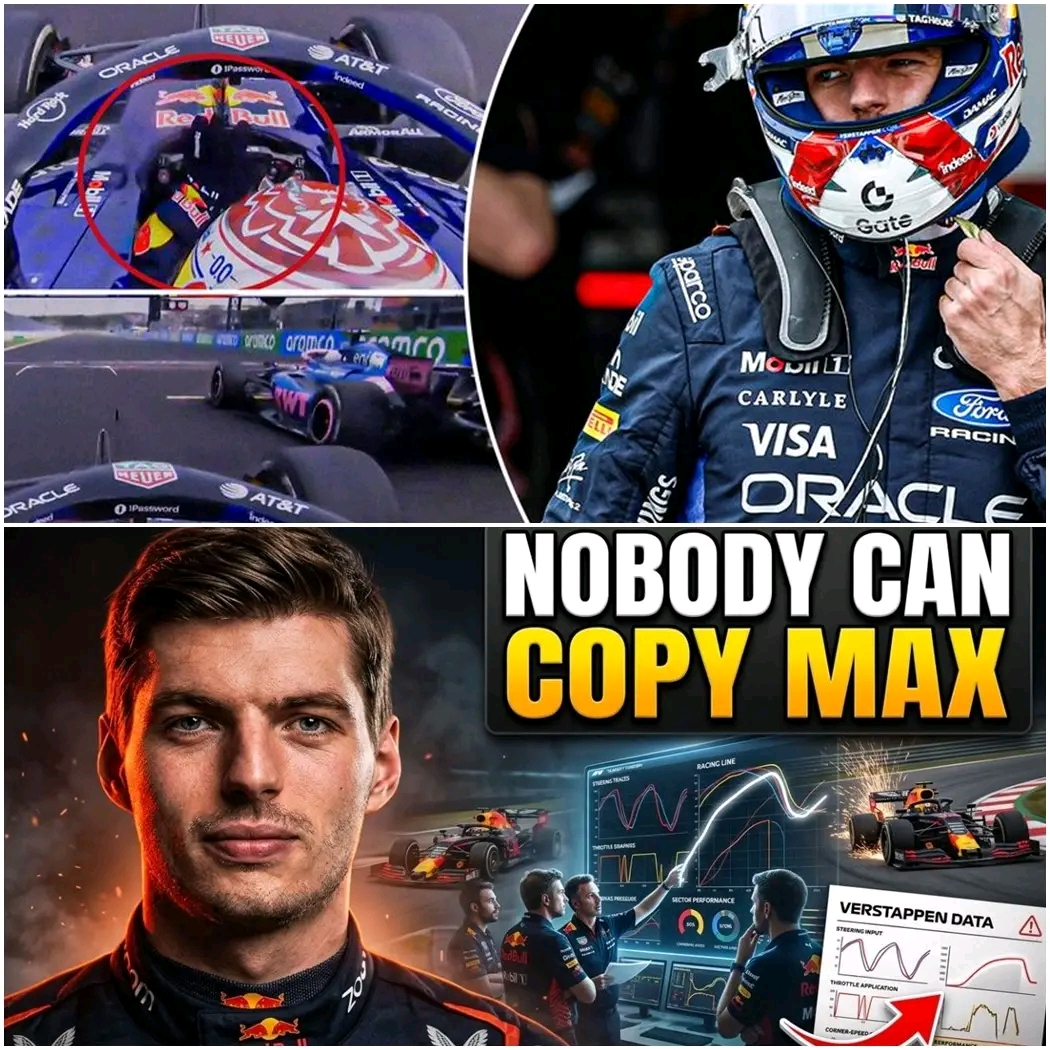
For decades, Formula 1 engineers have relied on one fundamental principle: data reveals everything. Every braking point, steering angle, throttle application, and tire movement is measured, analyzed, and compared. Yet despite the sport’s technological sophistication, one mystery continues to puzzle rival teams and even Verstappen’s own competitors.
Max Verstappen’s driving style appears to break many of the conventional rules that define elite racing.
On paper, some of his inputs look messy, aggressive, and almost counterintuitive. Engineers studying telemetry traces often see abrupt steering corrections, late braking techniques, and moments where the car appears dangerously close to losing control. Yet the outcome is almost always the same: Verstappen finds speed where others cannot.
The question that continues to fascinate Formula 1 is simple: if everyone can see the data, why can’t anyone copy what Verstappen does?
THE DATA TELLS A STRANGE STORY
Formula 1 telemetry is designed to expose every advantage and weakness.
Teams can analyze braking pressure, throttle traces, steering inputs, tire temperatures, and aerodynamic behavior down to astonishing levels of detail. Normally, when one driver discovers a faster technique, teammates and rivals can study the data and gradually adopt similar methods.
With Verstappen, the process is far more complicated.
Many of his telemetry traces reveal aggressive transitions that seem almost too risky for a driver competing at the highest level. Instead of maintaining perfect stability, Verstappen frequently operates in a zone where the car is constantly rotating and balancing on the edge of grip.
To an outside observer, it can look as if he is intentionally making the car nervous and unstable.
Yet that apparent instability is often exactly what allows him to extract more performance.
DRIVING ON THE EDGE OF CONTROL
Modern Formula 1 cars are designed to maximize aerodynamic efficiency. Ideally, drivers want a predictable platform that allows them to attack corners consistently.
Verstappen often takes a different approach.
He appears comfortable with a car that rotates aggressively on corner entry, even if that setup feels uncomfortable or unpredictable to others. By accepting a more responsive rear end, he can point the car toward the apex earlier and begin accelerating sooner on corner exit.
The technique requires extraordinary confidence.
A slight misjudgment can result in oversteer, tire degradation, or even a spin. Most drivers naturally leave themselves a small margin for error. Verstappen seems capable of operating with almost no margin at all.
That ability allows him to unlock lap time that remains inaccessible to many competitors.
WHY TEAMMATES OFTEN STRUGGLE
One of the most fascinating aspects of Verstappen’s dominance is the difficulty experienced by his teammates.
Over the years, several talented drivers have shared a garage with the Dutch star. Many arrived with strong reputations and proven speed. Yet few managed to consistently challenge him over a full season.
The reason may go beyond pure talent.
When a team develops a car around feedback from its fastest driver, the vehicle naturally evolves toward characteristics that suit that driver’s preferences. If Verstappen prefers a sharp front end and a lively rear, engineers may continue refining the car in that direction because it produces results.
The consequence is that teammates often inherit a machine tailored to a driving style that only Verstappen fully understands.
What works brilliantly for him can feel uncomfortable or even unpredictable for others.
THE PSYCHOLOGICAL ADVANTAGE
Driving skill is only part of the equation.
Formula 1 is also a mental battle, and Verstappen’s confidence has become one of his greatest strengths.
When a driver repeatedly succeeds while operating near the limit, trust begins to develop between driver and machine. That trust allows for even greater commitment on future laps.
Verstappen’s rivals face a different challenge.
They may see the data and understand what he is doing, but replicating it requires absolute belief that the car will respond exactly as expected. Without that confidence, drivers naturally hesitate for a fraction of a second.
In Formula 1, fractions of a second can determine the outcome of an entire race weekend.
HOW RED BULL BENEFITS FROM VERSTAPPEN’S UNIQUE SKILLS
Red Bull Racing has enjoyed one of the most successful eras in Formula 1 history, and Verstappen’s driving ability is a major reason why.
His capacity to handle an aggressive setup gives engineers greater freedom when developing the car. Rather than compromising for stability, the team can pursue outright performance knowing Verstappen can exploit the package.
This creates a powerful feedback loop.
The faster Verstappen goes, the more the car evolves around his strengths. The more the car evolves around his strengths, the harder it becomes for competitors to match his pace.
It is a cycle that has helped Red Bull maintain a competitive edge during multiple championship campaigns.
CAN ANYONE LEARN TO DRIVE LIKE VERSTAPPEN?
The simple answer is probably not.
While drivers can study telemetry and mimic certain techniques, the instincts required to control a Formula 1 car at the absolute limit are developed over years of racing experience.
Verstappen’s journey began unusually early. His karting career exposed him to intense competition from a young age, and his rapid rise through junior categories accelerated the development of skills that many drivers spend years refining.
By the time he reached Formula 1, he already possessed an extraordinary feel for vehicle dynamics.
That feel cannot simply be downloaded from a telemetry file.
It is the result of thousands of hours spent understanding grip, balance, and risk.
WHAT THIS MEANS FOR THE FUTURE OF FORMULA 1
As Formula 1 enters a new era of regulations and increasingly advanced technology, Verstappen’s success serves as a reminder that human talent still matters.
Teams can build sophisticated simulations, gather massive amounts of data, and employ hundreds of engineers. But there remains an element of elite driving that technology cannot fully replicate.
The sport’s future stars will undoubtedly study Verstappen’s methods. Some may borrow elements of his approach and become faster because of it.
However, history suggests that true greatness in Formula 1 is rarely copied.
Michael Schumacher had qualities that others could not replicate. Ayrton Senna possessed instincts that data could never fully explain. Verstappen appears to belong in that same category.
FINAL THOUGHTS
The enduring mystery surrounding Max Verstappen is not that teams lack information. In Formula 1, information is everywhere.
The real challenge is transforming that information into performance.
Engineers can show a driver exactly where Verstappen brakes, turns, and accelerates. They can provide every telemetry trace and every performance metric. What they cannot provide is the instinctive feel, confidence, and extraordinary car control that allow Verstappen to operate on the razor’s edge of possibility.
That is why, despite years of analysis and countless hours of data review, Formula 1’s greatest minds still struggle to solve the Verstappen puzzle.
And until someone does, the Dutch champion’s unique approach may remain one of the sport’s most powerful competitive advantages.