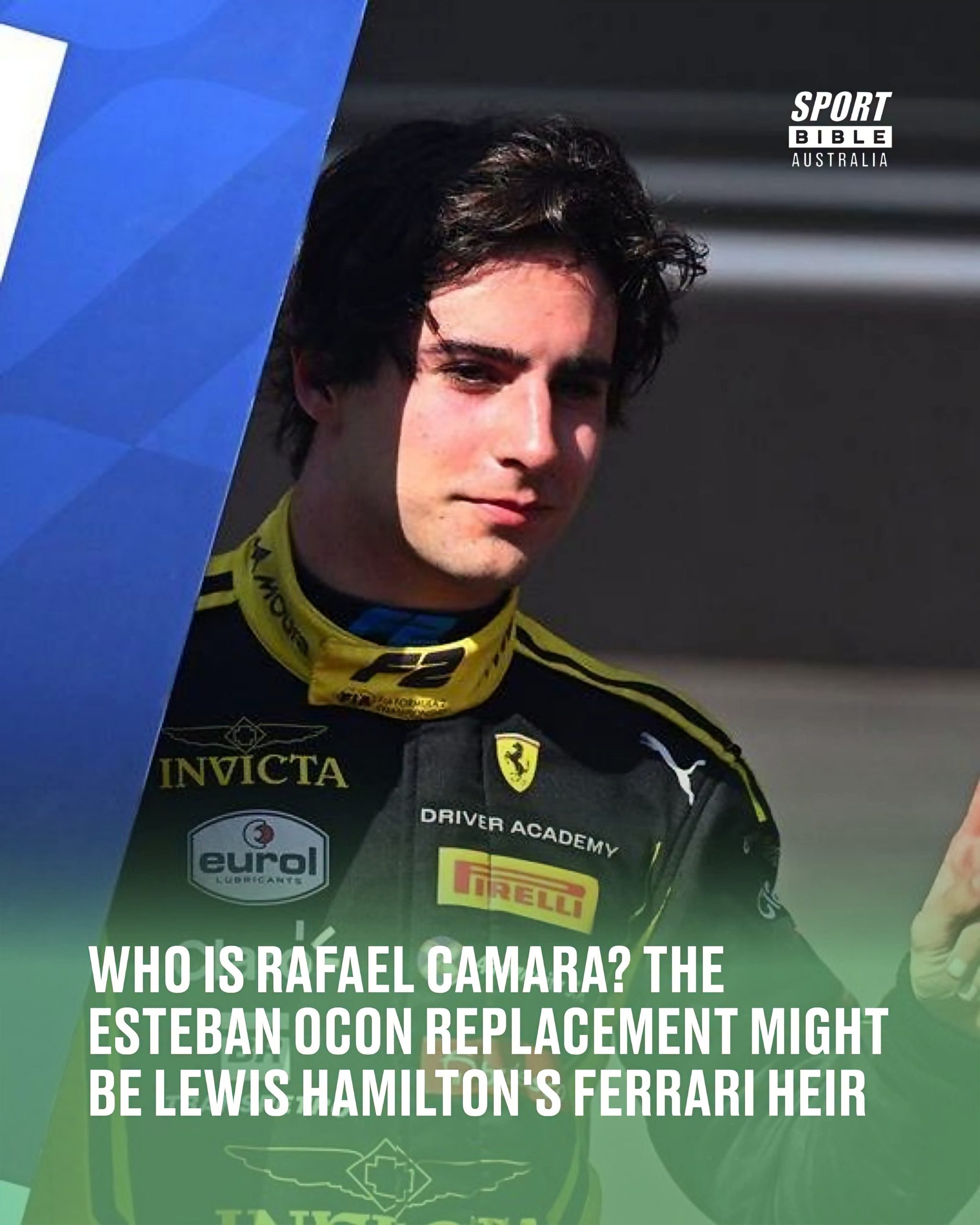
Formula 1 could be witnessing the emergence of its next Brazilian superstar as Rafael Camara prepares to make his unexpected Grand Prix debut at the 2026 Sao Paulo Grand Prix. The Ferrari-backed youngster has been handed a golden opportunity with Haas following Esteban Ocon’s dramatic departure, potentially accelerating his journey towards becoming one of the sport’s most exciting future talents.
The 21-year-old Brazilian arrives at Interlagos with considerable expectations after establishing himself as one of the most successful drivers in the junior categories. Currently leading the Formula 2 championship, Camara has already attracted significant attention from Ferrari, with his development potentially placing him in contention to become Lewis Hamilton’s eventual replacement at the legendary Italian team.
However, his immediate challenge is considerably different from the long-term ambitions surrounding his career. Making an unexpected Formula 1 debut at his home Grand Prix presents an opportunity to demonstrate his potential while navigating the enormous pressure associated with racing in front of passionate Brazilian supporters.
RAFAEL CAMARA’S JOURNEY FROM BRAZILIAN KARTING TO FORMULA 1
Born in 2005, Rafael Camara began building his reputation through karting, winning competitions in Brazil before establishing himself internationally.
His achievements across European karting championships attracted attention from several development programmes, eventually leading him to Ferrari’s prestigious Driver Academy.
Camara impressed Ferrari during its Scouting World Finals at Maranello in 2021, earning a place alongside another highly regarded prospect, Ollie Bearman.
The decision to recruit Camara reflected Ferrari’s interest in identifying young drivers capable of progressing through the demanding motorsport ladder and potentially becoming future Formula 1 competitors.
For a Brazilian racing talent, joining Ferrari’s development programme represented a significant breakthrough. The academy has historically provided opportunities for promising drivers to receive professional support, technical guidance and exposure to competitive environments.
CAMARA’S IMPRESSIVE RECORD IN THE JUNIOR CATEGORIES
Camara’s development has been characterised by consistent progression and championship success.
He began racing in single-seaters during the 2022 Formula 4 UAE Championship, immediately demonstrating the ability to compete for victories. Although a crash at Yas Marina ended his championship challenge, the experience provided valuable lessons during his transition from karting.
His breakthrough arrived in 2024 when he captured the Formula Regional European Championship title with Prema.
The championship victory established him as one of the strongest prospects in European junior racing, demonstrating the consistency and technical understanding required to compete at a higher level.
Camara subsequently moved into Formula 3 for 2025, where he delivered another outstanding campaign.
Four race victories and five pole positions helped him secure the championship against a competitive field featuring several future Formula 1 prospects.
Winning consecutive championships in Formula Regional and Formula 3 significantly strengthened his reputation as a driver capable of adapting quickly to increasingly demanding machinery.
FORMULA 2 SUCCESS PUTS CAMARA ON FERRARI’S RADAR
The Brazilian’s move into Formula 2 for 2026 represented his most important challenge yet.
Formula 2 is widely regarded as the final major stepping stone before Formula 1, with its drivers competing on many of the same circuits while developing experience in complex racing environments.
Camara experienced a difficult opening to his campaign, initially struggling to establish himself among the championship leaders.
However, his fortunes gradually improved following the Spanish round, where he secured an important Feature Race victory.
His subsequent performances demonstrated the consistency required to challenge for the championship, eventually bringing him into direct competition with Nikola Tsolov.
Camara’s Feature Race victory in Baku proved particularly significant, helping him overcome Tsolov and move into the championship lead.
That recovery could become one of the defining moments of his development. Formula 1 teams are interested not only in drivers who win championships but also in competitors capable of responding to difficult periods without losing confidence.
Camara’s ability to recover from a disappointing opening stretch has strengthened the argument that he possesses the maturity required for the next stage of his career.
WHY HAAS CHOSE RAFAEL CAMARA OVER OTHER CONTENDERS
Haas’ decision to promote Camara followed an evaluation process involving several drivers competing for a potential 2027 seat.
Among the candidates were Jack Doohan, Leonardo Fornaroli and Ryo Hirakawa, all bringing different forms of experience and potential to the assessment.
According to Haas team principal Ayao Komatsu, Camara impressed particularly with his ability to understand grip levels and adapt to changing conditions.
The Brazilian reportedly demonstrated an impressive ability to improve his lap times despite changing track conditions, while maintaining composure when the car became more difficult to drive.
That adaptability is particularly valuable in Formula 1, where drivers must constantly respond to tyre degradation, changing temperatures, aerodynamic limitations and evolving track conditions.
Komatsu’s assessment suggests Haas identified qualities beyond outright speed. The ability to understand a car quickly and provide meaningful technical feedback can be equally important when developing a competitive package.
Camara’s promotion also reflects the relationship between Haas and Ferrari, which supplies the American team with power units and maintains a close technical partnership.
ESTEBAN OCON’S DEPARTURE CREATED A GOLDEN OPPORTUNITY
Camara’s Formula 1 debut became possible following Esteban Ocon’s unexpected departure from Haas during the Mexican Grand Prix weekend.
The Frenchman’s exit created immediate uncertainty regarding the team’s driver lineup, forcing Haas to consider alternative arrangements for the remaining races.
Ryo Hirakawa initially stepped into the seat in Mexico, but his commitments elsewhere made him unavailable for the Brazilian Grand Prix.
With Camara already scheduled to join Haas in 2027, promoting the Brazilian early became an attractive option.
Rather than waiting until the next season, the team can now evaluate its future driver under genuine Grand Prix conditions.
For Camara, the opportunity is especially valuable because it provides experience before his first full Formula 1 campaign.
He will have the chance to familiarise himself with the team’s engineering procedures, simulator work, race weekend preparations and communication systems.
Although one weekend cannot completely prepare a rookie for Formula 1, the additional experience could prove important when he eventually begins racing full-time.
INTERLAGOS COULD BECOME A DEFINING MOMENT FOR BRAZIL’S NEXT F1 STAR
Brazil has a particularly strong relationship with Formula 1, shaped by legendary champions such as Ayrton Senna, Nelson Piquet and Emerson Fittipaldi.
The country has also produced memorable Grand Prix victories and passionate supporters who continue to regard Interlagos as one of the sport’s most important venues.
Camara’s arrival therefore carries significance beyond his personal career.
A Brazilian driver competing for a Formula 1 team at his home Grand Prix provides local fans with a new talent to support, potentially creating another important connection between the country and the championship.
However, the occasion also presents considerable pressure.
Interlagos is a demanding circuit featuring elevation changes, unpredictable weather and a technically challenging layout. Its sprint weekend format further reduces opportunities for inexperienced drivers to learn the car before competitive sessions begin.
Camara will need to balance the excitement of his home debut with the practical objective of completing a productive weekend for Haas.
His own comments reflect an awareness of that responsibility, with the youngster emphasising the importance of learning the car and working closely with the team.
COULD RAFAEL CAMARA EVENTUALLY REPLACE LEWIS HAMILTON AT FERRARI?
One of the most intriguing possibilities surrounding Camara’s career is his potential future with Ferrari.
Hamilton joined the Italian team in 2025 after an extraordinary career with Mercedes, bringing seven world championships and considerable experience to the organisation.
However, Formula 1 careers eventually reach their natural conclusions, and Ferrari must continue preparing for the future regardless of Hamilton’s current plans.
Camara represents one of the options the team could consider when planning its long-term driver strategy.
His consecutive junior championships, Ferrari Academy membership and upcoming Haas experience provide a strong foundation for future development.
Nevertheless, it would be premature to assume that he is guaranteed Hamilton’s seat.
Ferrari’s eventual decision will depend on several factors, including Camara’s performance in Formula 1, the development of other academy drivers, the team’s competitive requirements and Hamilton’s own career intentions.
The Brazilian must first demonstrate that he can consistently compete at the highest level before any serious discussion about a Ferrari promotion becomes realistic.
HAAS COULD BECOME THE PERFECT DEVELOPMENT PLATFORM
Camara’s immediate future at Haas could be more important than speculation about Ferrari.
The American team offers him an environment where he can develop without carrying the same expectations associated with driving for a championship contender.
His partnership with Ollie Bearman also presents an interesting opportunity.
Bearman has already established himself in Formula 1, while Camara will be entering the championship with considerable junior success but limited experience of Grand Prix machinery.
Their development could become an important storyline for Haas as it continues building its long-term competitiveness.
If Camara demonstrates strong qualifying performances, consistent race execution and the ability to learn quickly, he could strengthen his position within Ferrari’s wider driver development structure.
Conversely, struggling against an experienced teammate would not necessarily end his ambitions, particularly during his first season.
The most important measure will be how quickly he adapts to Formula 1’s technical and competitive demands.
RAFAEL CAMARA’S FORMULA 1 DEBUT COULD SIGNAL A NEW BRAZILIAN ERA
Camara’s arrival represents another important chapter in Brazil’s relationship with Formula 1.
The country has spent years searching for a new driver capable of establishing a sustained presence at the highest level following the departure of its previous generation of Grand Prix competitors.
With a Formula 2 championship challenge, Ferrari backing and an early Haas opportunity, Camara possesses several ingredients required to build a successful career.
However, Formula 1 remains unforgiving, and junior success does not automatically translate into Grand Prix victories.
His debut at Interlagos will therefore be an important first examination rather than a final verdict on his potential.
If he handles the pressure, learns quickly and delivers encouraging performances, the Brazilian could emerge as one of the most fascinating young drivers to watch during the coming seasons.
For Haas, the opportunity represents a chance to evaluate its future investment. For Ferrari, it offers another glimpse of a promising academy prospect. And for Brazilian fans, it could be the beginning of a new homegrown Formula 1 story.
Rafael Camara has already conquered several junior championships. Now, with the spotlight firmly on him at Interlagos, the next stage of his journey begins.
The question is no longer whether he can succeed in junior motorsport. It is whether he can turn that success into a lasting Formula 1 career — and perhaps one day become Ferrari’s next Brazilian star.