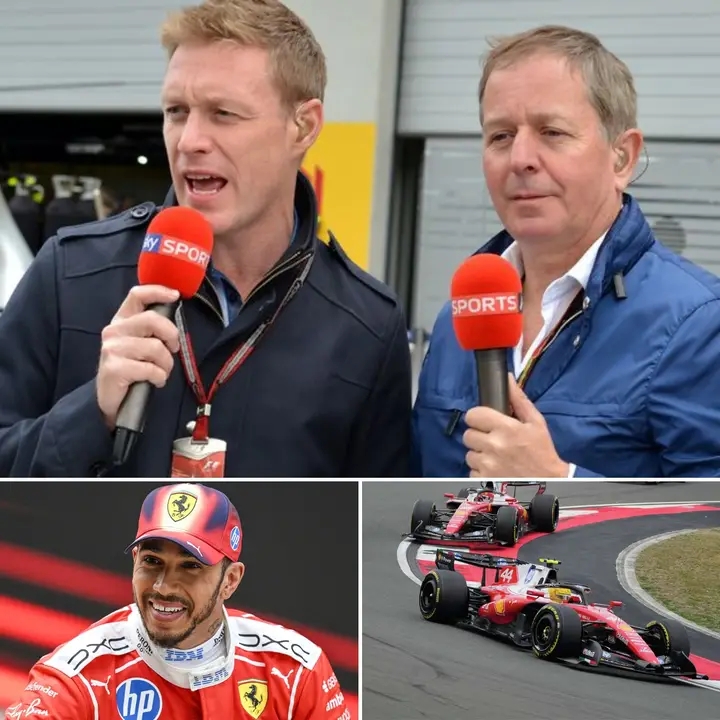
Formula 1 has always been a sport built on speed, innovation, and unforgettable storylines. Few narratives have captured the imagination of fans quite like the suggestion that Lewis Hamilton is returning to the extraordinary level that made him one of the greatest drivers in motorsport history. Veteran broadcaster Simon Lazenby’s recent comments have reignited discussions across the paddock, with many now asking whether Hamilton’s remarkable career is entering another golden chapter rather than approaching its conclusion.
For years, critics argued that Hamilton’s era of dominance had come to an end as younger stars emerged and Formula 1 entered a new technical era. Yet the opening stages of the 2026 season have offered plenty of evidence that writing off a seven-time world champion may have been premature. Hamilton has displayed renewed confidence, exceptional race management, and the relentless determination that defined his championship-winning campaigns.
SIMON LAZENBY’S COMMENTS HAVE REIGNITED THE HAMILTON CONVERSATION
When respected Formula 1 broadcasters praise a driver’s performances, the paddock pays attention. Simon Lazenby’s assessment wasn’t simply about Hamilton producing a few strong laps—it was about recognizing familiar qualities that once made him virtually unbeatable.
Sharp racecraft, intelligent tire management, calm decision-making under pressure, and an ability to maximize every opportunity have all become increasingly visible during the current campaign. Those characteristics have long separated Hamilton from many of his rivals, and their return has naturally fueled speculation that another title challenge could be within reach.
The reaction among fans has been immediate. Social media has become flooded with debates over whether Hamilton can genuinely fight for another championship or whether this impressive form simply reflects his experience rather than a true return to peak performance.
WHY MANY BELIEVED HAMILTON’S BEST YEARS WERE BEHIND HIM
Every great champion eventually faces questions about age and decline. Hamilton has experienced those doubts repeatedly throughout the latter stages of his career.
Formula 1 has welcomed a new generation of exceptionally talented drivers, while technical regulations have transformed how cars are driven and developed. Adapting to those changes has tested every veteran on the grid.
Yet Hamilton has consistently demonstrated one quality that statistics alone cannot measure—adaptability.
Rather than resisting change, he has evolved alongside the sport. His driving style has become increasingly efficient, placing greater emphasis on tire preservation, strategic flexibility, and extracting maximum performance over an entire race distance rather than relying solely on outright pace.
That evolution could prove invaluable over a long championship season.
FERRARI APPEARS TO BE BENEFITING FROM HAMILTON’S EXPERIENCE
Hamilton’s move to Ferrari represented one of the biggest stories in modern Formula 1.
Joining the sport’s most iconic team brought enormous expectations, but it also presented significant challenges. Learning new engineering philosophies, communication methods, and operational procedures is never straightforward—even for a driver with Hamilton’s experience.
However, early signs suggest the partnership is developing in a positive direction.
Hamilton’s technical feedback has long been regarded as one of his greatest strengths. Engineers value drivers who can precisely describe how a car behaves in different situations, allowing upgrades to target specific weaknesses rather than relying on guesswork.
If Ferrari continues improving throughout the season, Hamilton’s experience could become an increasingly valuable weapon in the development race.
EXPERIENCE REMAINS ONE OF HAMILTON’S BIGGEST ADVANTAGES
Modern Formula 1 is about far more than outright speed.
Championships are often decided through strategic judgment, adaptability during changing weather conditions, safety car timing, tire conservation, and avoiding costly mistakes across an entire season.
Hamilton has mastered each of those areas over nearly two decades in Formula 1.
While younger drivers often possess exceptional raw pace, experience frequently becomes decisive during unpredictable races. Hamilton’s calm approach allows him to identify opportunities others might overlook, particularly when races become strategically complex.
That ability continues to separate elite champions from simply fast drivers.
THE TITLE FIGHT COULD BECOME EVEN MORE INTENSE
The 2026 Formula 1 season remains highly competitive, with several teams capable of challenging for victories.
Ferrari, Mercedes, McLaren, and Red Bull all possess the resources to develop their cars significantly as the season progresses. Every major upgrade package has the potential to reshape the competitive order.
Hamilton’s consistency could become his greatest advantage if the leading teams remain closely matched.
Winning a championship isn’t always about collecting the most race victories. Limiting poor weekends, maximizing points finishes, and delivering under pressure often determine who lifts the trophy in the final standings.
Few drivers understand that better than Hamilton.
WHY SIMON LAZENBY’S COMMENTS RESONATED WITH FANS
Hamilton has spent much of his career proving people wrong.
From his spectacular rookie season to multiple championship battles and countless record-breaking performances, he has repeatedly responded to skepticism with results on track.
Lazenby’s comments struck a chord because they echoed something many longtime Formula 1 followers have quietly observed throughout the season: Hamilton doesn’t appear to be racing like someone approaching retirement.
Instead, he looks motivated, energized, and fully committed to chasing more success.
That mindset alone makes him dangerous.
HAMILTON’S LEGACY CONTINUES TO GROW
Hamilton’s achievements already place him among Formula 1’s all-time greats.
His remarkable collection of victories, pole positions, podium finishes, and world championships has reshaped the record books. Yet perhaps his greatest accomplishment has been maintaining elite performance across multiple technical eras.
Very few drivers have remained championship contenders while Formula 1 underwent such dramatic changes in regulations, car design, and competitive balance.
That longevity reflects not only exceptional talent but also relentless commitment to continuous improvement.
WHAT COMES NEXT FOR HAMILTON AND FERRARI?
The remainder of the 2026 season promises to deliver even greater challenges.
Every race weekend will test Ferrari’s ability to develop its car while maintaining reliability. Rivals will continue introducing upgrades, and the championship battle is unlikely to become any easier.
For Hamilton, however, the objective remains clear.
If Ferrari can consistently provide a car capable of fighting near the front, few would be surprised to see the seven-time world champion competing for victories well into the closing stages of the season.
FINAL THOUGHTS
Simon Lazenby’s comments have reignited one of Formula 1’s biggest debates because they challenge a narrative many had already accepted—that Lewis Hamilton’s greatest days were behind him.
Whether Hamilton ultimately secures another world championship remains uncertain. Formula 1 is too competitive and unpredictable to guarantee any outcome.
What appears increasingly clear, however, is that the legendary Briton remains one of the sport’s most complete drivers. His experience, racecraft, technical understanding, and unwavering determination continue to make him a genuine force on the grid.
If his current trajectory continues and Ferrari maintains its development momentum, Hamilton’s pursuit of more Formula 1 history may be far from over. Rather than witnessing the final chapter of an extraordinary career, fans may instead be watching the beginning of one of its most remarkable comebacks.