Oscar Piastri endured one of the most frustrating races of his Formula 1 career at the 2026 Hungarian Grand Prix after a combination of contact with a lapped Carlos Sainz, questionable race circumstances, and a terminal gearbox failure destroyed what had looked like a race-winning performance. The Australian’s emotional team radio messages reflected just how costly the afternoon became, as teammate Lando Norris capitalized on the chaos to secure victory while Piastri walked away empty-handed.
The Hungaroring has often rewarded flawless execution rather than outright speed, and Sunday’s race proved exactly why. Piastri had done almost everything right during the opening stages, only for events outside his control to completely alter the outcome. For McLaren, the race delivered both celebration and disappointment in equal measure.
PIASTRI MADE THE PERFECT START BEFORE DISASTER STRUCK
Although Norris began the race from pole position, Piastri wasted no time asserting himself. The Australian produced an aggressive yet clean opening lap to snatch the race lead, immediately placing himself in prime position to challenge for what would have been one of his biggest victories of the season.
McLaren maintained its long-standing “Papaya Rules,” allowing the leading driver to dictate the race despite Norris believing he possessed superior pace. The team resisted internal pressure to swap positions, choosing instead to let strategy unfold naturally.
For much of the first half of the race, Piastri appeared firmly in control.
COLLISION WITH CARLOS SAINZ CHANGED EVERYTHING
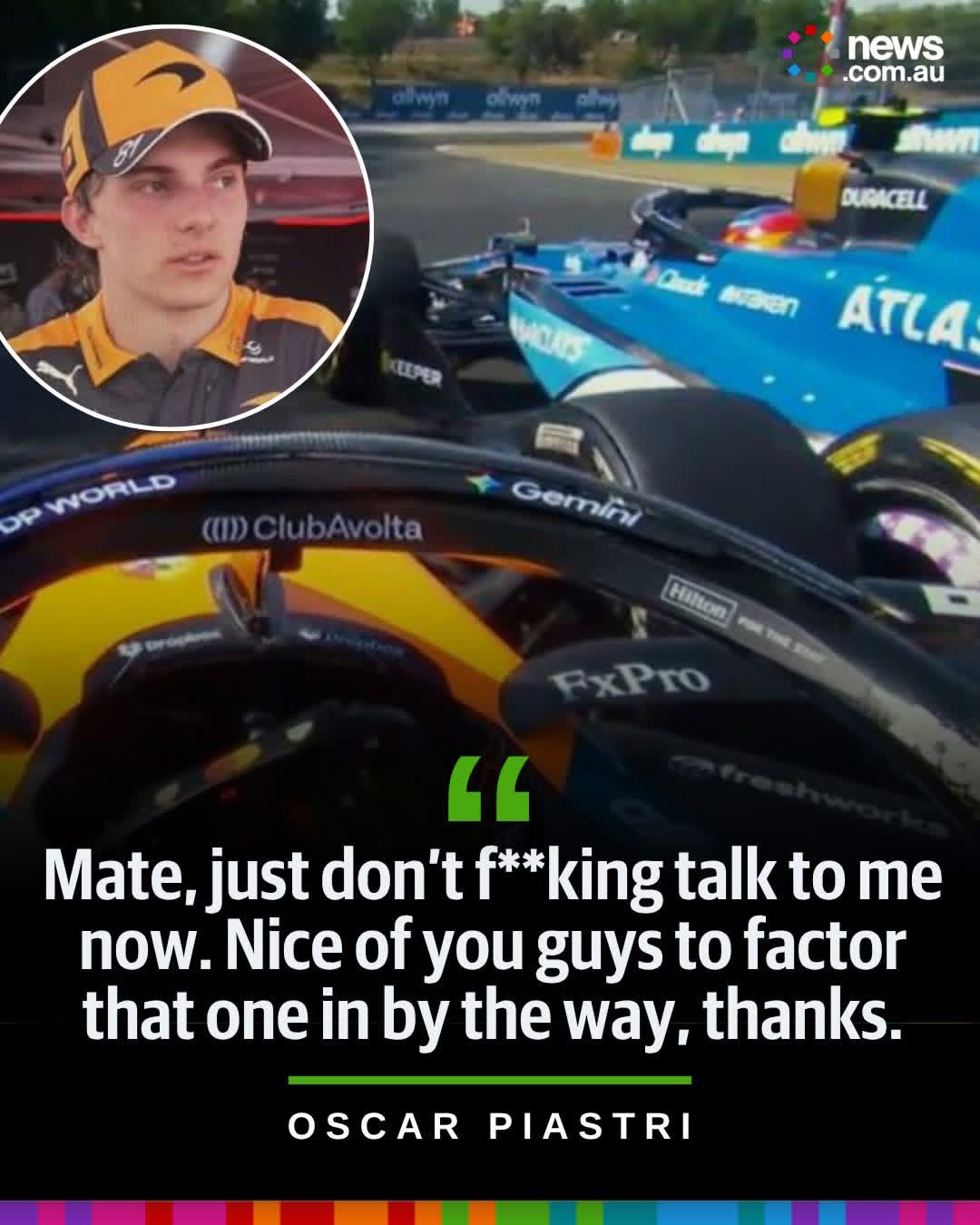
The defining moment came during traffic management as Piastri attempted to lap Williams driver Carlos Sainz.
Instead of a routine overtake, contact between the two cars sent Piastri wide and cost him valuable seconds. The Australian immediately exploded over team radio, venting his frustration after seeing what he believed was a completely avoidable incident.
The FIA later handed Sainz a five-second time penalty for the collision, acknowledging his role in the incident. However, the punishment offered little consolation to Piastri, whose race had already been compromised.
Managing traffic is one of Formula 1’s most underestimated challenges, particularly at the tight Hungaroring where overtaking opportunities are limited. Losing momentum at precisely the wrong moment proved devastating.
McLAREN’S STRATEGY ALSO CAME UNDER SCRUTINY
While emotions were understandably high following the collision, Piastri also questioned the circumstances surrounding his pit strategy.
Emerging into heavy traffic immediately after his stop prevented him from maximizing fresh tyres, while Norris, running a different sequence, benefited from cleaner air and eventually inherited the race lead.
Although McLaren Team Principal Andrea Stella later defended the team’s decisions, insisting Norris earned victory through pace rather than preferential treatment, the timing of events left Piastri visibly frustrated during the race.
After reviewing the race, Piastri himself admitted emotions had influenced his initial reaction, acknowledging that the pit stop timing was not necessarily the team’s biggest mistake.
GEARBOX FAILURE ENDED ANY CHANCE OF RECOVERY
As if losing the lead were not enough, Piastri’s afternoon deteriorated even further when he reported a gearbox issue with just 14 laps remaining.
The mechanical failure forced him to retire, ending any possibility of salvaging points from a race that had once looked destined to produce a podium—or even victory.
Reliability continues to play a decisive role in modern Formula 1, and Piastri’s retirement serves as another reminder that even flawless driving cannot overcome mechanical failures.
For McLaren, losing one car while celebrating victory with another highlighted both the highs and lows that teams can experience during a single Grand Prix.
NORRIS ENDED HIS WIN DROUGHT IN STYLE
While Piastri suffered heartbreak, Norris delivered one of his strongest drives in recent memory.
Once promoted into clean air, the reigning world champion controlled the race comfortably, crossing the finish line more than 15 seconds ahead of Max Verstappen. It marked Norris’ first Grand Prix victory since Brazil last season and demonstrated the impressive pace McLaren possessed throughout the weekend.
Behind him, Verstappen secured a valuable second-place finish for Red Bull, while Mercedes championship leader Kimi Antonelli strengthened his title challenge by finishing third.
THE CHAMPIONSHIP PICTURE CONTINUES TO SHIFT
The retirement proved especially costly for Piastri in the Drivers’ Championship.
Failing to score points for the fifth time this season leaves the Australian seventh in the standings heading into Formula 1’s summer break, while Antonelli continues to build a commanding advantage at the top.
For McLaren, Norris’ victory provides renewed confidence after a challenging start to the campaign, but the team will also leave Hungary wondering what might have been had Piastri enjoyed better fortune.
With half the season still remaining, every point is becoming increasingly significant. Mechanical reliability, strategic precision, and avoiding incidents with slower traffic may ultimately prove just as important as outright speed in deciding this year’s championship.
WHAT THIS MEANS FOR McLAREN MOVING FORWARD
Despite the disappointment, there are positives for McLaren to carry into the second half of the season.
The car demonstrated race-winning pace, both drivers showed they can fight at the front, and the team once again confirmed it possesses one of the strongest overall packages on the grid.
However, Sunday’s race also exposed areas requiring improvement. Better traffic management, flawless operational execution, and bulletproof reliability will be essential if McLaren hopes to consistently challenge Mercedes and Red Bull over the remaining rounds.
For Oscar Piastri, the Hungarian Grand Prix will be remembered as one of the season’s cruelest missed opportunities. Yet if his opening-lap brilliance and raw pace are any indication, another chance to stand on the top step of the podium is unlikely to be far away.