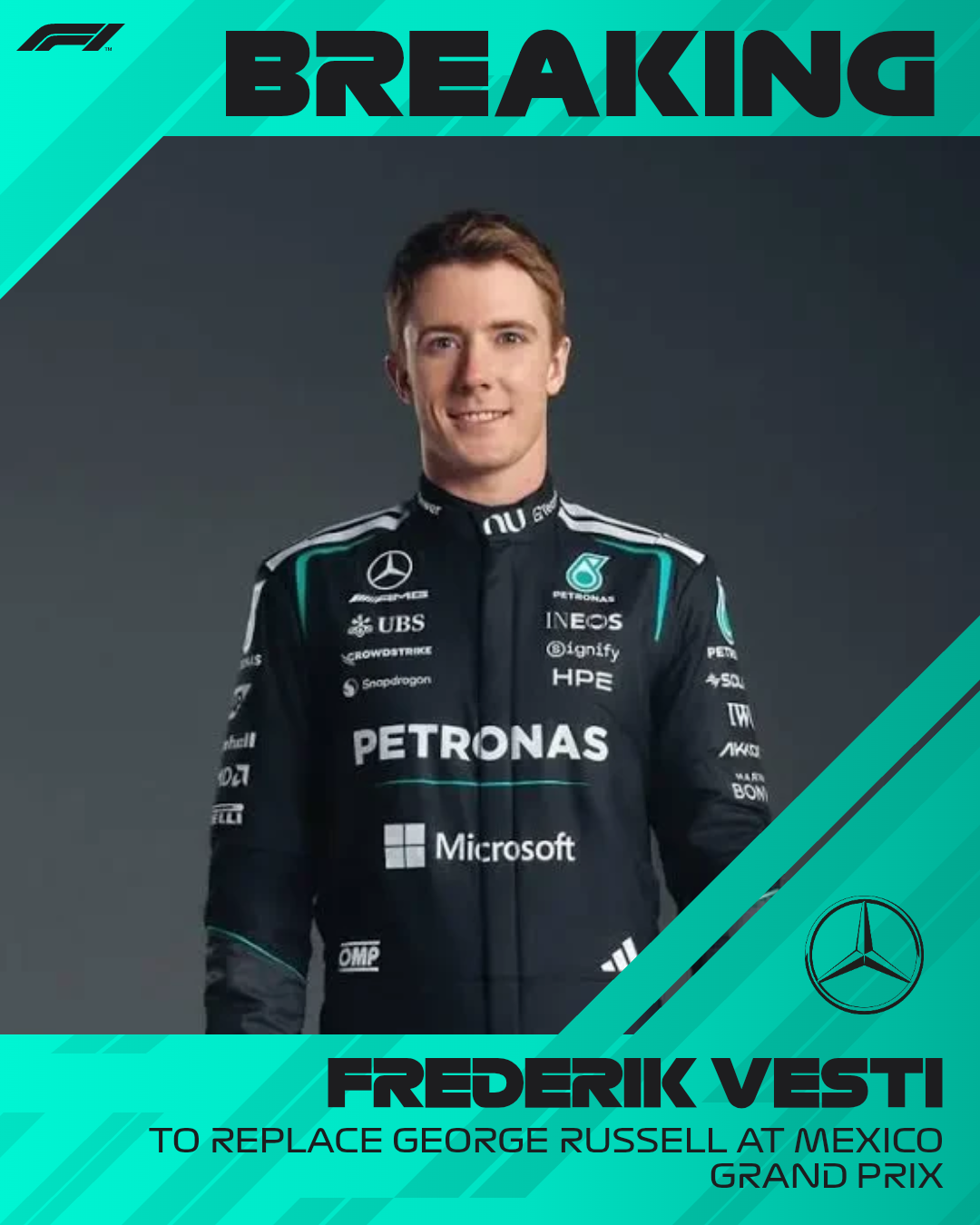
Mercedes will replace George Russell with reserve driver Frederik Vesti for the opening practice session of the 2026 Mexican Grand Prix, as Formula 1’s rookie-driver regulations force the team to make another change to its regular line-up.
Russell, who is currently second in the 2026 Drivers’ Championship, will miss Friday’s first practice session at the Autódromo Hermanos Rodríguez. The decision is not a punishment or an indication that Mercedes has lost confidence in the British driver. Instead, it forms part of the team’s obligation to give young drivers valuable experience in a current Formula 1 car.
Under the regulations outlined in the report, teams must allocate four FP1 sessions during the season to rookie drivers, with each regular race driver required to make way twice. Mercedes has already given Vesti two opportunities in Kimi Antonelli’s car, meaning Russell must now surrender his seat for two sessions to help the team complete its quota.
FREDERIK VESTI GETS ANOTHER FORMULA 1 OPPORTUNITY
Vesti will take the wheel of Russell’s Mercedes W17 in Mexico, marking his first FP1 appearance in place of the British driver this season. The Danish racer has served as Mercedes’ reserve driver since 2024 and has been part of the team’s junior programme since 2021.
The 24-year-old is no stranger to the Mexican Grand Prix weekend. He made his Formula 1 practice debut at the same event in 2023, making his return to the session a significant moment in his development.
Mercedes deputy technical director Simone Resta explained that Vesti’s contribution would help connect the team’s on-track performance with its virtual development work. The team values the feedback reserve drivers provide, particularly when engineers are evaluating car behaviour and comparing real-world performance with simulator data.
Vesti has also expressed his excitement about getting back behind the wheel, noting that his last opportunity to drive the car came in Budapest. With developments introduced since then, the session will give him a chance to assess the latest version of the W17.
WHY GEORGE RUSSELL MUST MISS PRACTICE
Russell’s absence is entirely connected to the rookie-driver requirements. Mercedes needs to ensure that both of its regular drivers fulfil their required number of sessions away from the car, and Vesti’s previous appearances alongside Antonelli mean Russell must now take his turn.
The change also highlights how teams must balance their championship ambitions with Formula 1’s efforts to create opportunities for emerging talent. Although losing a practice session can limit a driver’s preparation time, the rules are designed to give rookies meaningful experience in modern F1 machinery.
With five race weekends remaining in the season, Mercedes could use another event in Brazil, Las Vegas, Qatar or Abu Dhabi to complete Vesti’s remaining required outing in Russell’s car.
For Russell, the priority will be returning to the cockpit for the subsequent sessions and making the most of the remaining preparation time ahead of qualifying and Sunday’s race. With the championship battle intensifying, every opportunity to understand the car could prove important.
MERCEDES KEEP THEIR FOCUS ON THE CHAMPIONSHIP
Mercedes’ decision comes at a crucial stage of the 2026 campaign, with Russell competing near the top of the standings and Lewis Hamilton also involved in the championship picture. Giving Vesti the opportunity is a regulatory requirement, but the team will still need to ensure its race preparations remain on schedule.
The Mexican Grand Prix will therefore provide two important storylines for Mercedes: Vesti’s chance to demonstrate his progress and Russell’s task of recovering the lost practice time when he returns to the car.
Ultimately, Russell’s absence from FP1 should not be mistaken for a change in Mercedes’ driver line-up. It is a temporary substitution driven by Formula 1’s rookie regulations, with the team balancing its competitive objectives against its responsibility to develop future talent.