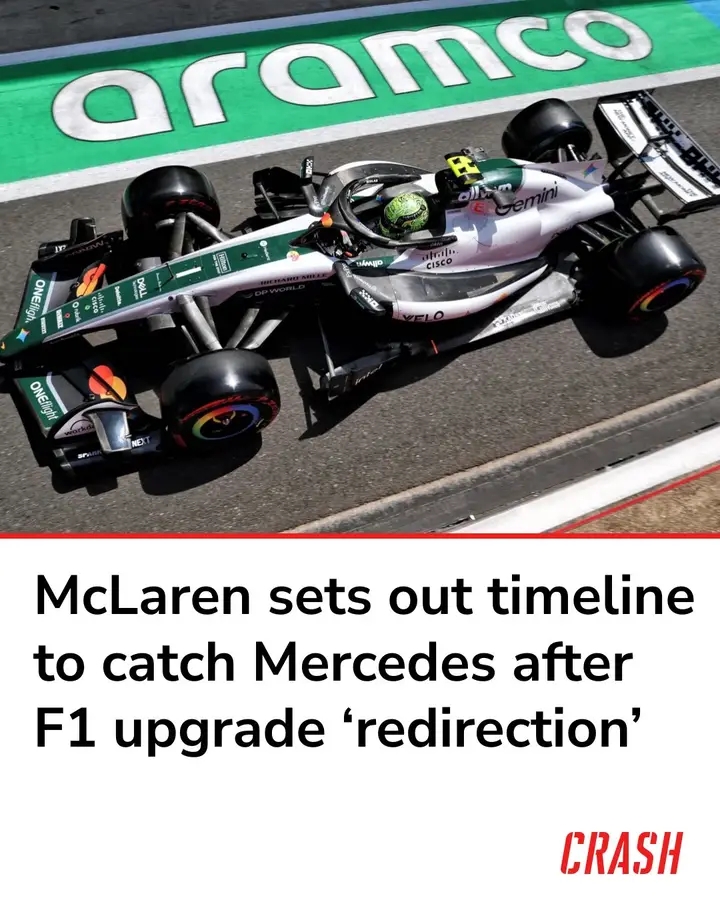
McLaren has finally identified the direction it believes can revive its disappointing 2026 Formula 1 campaign, with team principal Andrea Stella confirming that the reigning champions have shifted their development philosophy and are preparing a series of crucial upgrades over the coming months.
After dominating much of the previous season, McLaren entered 2026 as one of the favorites to defend both the Drivers’ and Constructors’ Championships. Instead, the Woking-based squad has struggled to match the pace of Mercedes and Ferrari under Formula 1’s new technical regulations.
Now, with the championship slipping further away, the team is betting on a fresh aerodynamic concept that it hopes will close the performance gap before the season reaches its decisive stages.
MCLAREN ADMITS EARLY DEVELOPMENT PATH WASN’T GOOD ENOUGH
Formula 1’s 2026 regulations introduced one of the biggest technical resets in decades, forcing every team to rethink its approach to car design.
While Mercedes adapted almost immediately, McLaren discovered that some of its original development concepts weren’t delivering the expected gains.
Rather than continuing down an increasingly unproductive path, Andrea Stella revealed that the team has redirected its aerodynamic development after gaining a better understanding of the new regulations.
That decision, however, comes with an unavoidable delay.
Unlike software updates, Formula 1 upgrades require weeks of design work, wind tunnel testing, CFD simulations, manufacturing, and track validation before reaching the race car.
As a result, the benefits of McLaren’s revised philosophy won’t appear instantly.
HUNGARY COULD MARK THE START OF MCLAREN’S RECOVERY
According to Stella, the first visible improvements should arrive at the Hungarian Grand Prix.
While the initial package may not completely transform McLaren’s fortunes, it is expected to be the first step in a broader development plan stretching through the remainder of the season.
The team is also preparing another significant upgrade package around Formula 1’s summer shutdown.
Splitting improvements before and after the mandatory factory break allows engineers to continue refining the car while maximizing development efficiency under Formula 1’s cost cap and aerodynamic testing restrictions.
If everything works as intended, McLaren hopes to steadily reduce the deficit to Mercedes and Ferrari rather than relying on one dramatic upgrade.
SILVERSTONE EXPOSED THE TRUE PERFORMANCE GAP
Although Lando Norris secured fourth place at Silverstone, the result arguably flattered McLaren’s actual competitiveness.
The British team was unable to challenge the race-winning pace shown by Mercedes and Ferrari throughout the weekend.
Oscar Piastri’s race was effectively ruined after first-lap contact left him outside the points, while Norris extracted nearly everything possible from a difficult car.
Andrea Stella even described fourth place as an overachievement, estimating that McLaren currently trails the front-running teams by roughly half a second per lap.
In modern Formula 1, half a second represents a significant performance deficit, especially considering how closely matched the leading teams usually are.
Closing that gap will require more than small adjustments—it demands a fundamentally stronger aerodynamic package.
WHY THE NEW DEVELOPMENT DIRECTION MATTERS
Perhaps the most encouraging part of Stella’s comments wasn’t the timing of the upgrades but the confidence behind them.
Earlier in the season, McLaren appeared uncertain about which development path offered the greatest long-term potential.
Now, the engineers believe they have identified a clearer route forward.
That clarity is essential because successful Formula 1 development depends on building upgrades that consistently improve performance rather than introducing isolated parts that fail to work together.
A stable development direction also allows engineers to plan future packages more efficiently, increasing the likelihood that every upgrade delivers measurable lap-time gains.
THE CHAMPIONSHIP CLOCK IS TICKING
Even if McLaren’s upgrades perform exactly as expected, time is becoming a major factor.
Mercedes and Ferrari are not standing still.
Both teams continue introducing new components almost every race weekend, meaning McLaren must improve faster than its rivals simply to reduce the existing gap.
The longer McLaren remains behind, the more difficult it becomes to recover lost ground in both championship standings.
Every missed podium and every race where rivals extend their lead increases the pressure on the team’s development programme.
WHAT THIS MEANS FOR LANDO NORRIS
As defending World Champion, Lando Norris entered the season hoping to establish himself as Formula 1’s dominant driver.
Instead, he has frequently found himself maximizing results rather than fighting for victories.
Despite the frustrations, Norris has consistently delivered strong performances, often extracting more from the MCL40 than its outright pace suggests.
Should McLaren’s upgrades deliver the expected improvement, Norris could quickly return to regular podium contention and potentially re-enter the championship battle.
However, the margin for error is rapidly disappearing.
OSCAR PIASTRI NEEDS A CHANGE IN FORTUNE
Oscar Piastri’s season has been defined by missed opportunities and unfortunate incidents.
The Australian has shown flashes of impressive speed, but setbacks such as his Silverstone collision have prevented him from building sustained momentum.
An improved McLaren would give Piastri the opportunity to reset his campaign and challenge consistently at the front once again.
His ability to capitalize on future upgrades could become a major factor in McLaren’s Constructors’ Championship ambitions.
CAN MCLAREN REALLY CATCH MERCEDES?
The answer depends on two factors.
First, McLaren’s revised aerodynamic philosophy must produce genuine performance gains rather than incremental improvements.
Second, Mercedes and Ferrari must not continue pulling away at their current rate.
The encouraging news for McLaren is that Formula 1 has repeatedly shown how quickly fortunes can change under stable regulations.
One successful upgrade package can dramatically alter the competitive order, particularly when teams begin understanding complex new technical rules.
Still, catching Mercedes will require exceptional execution across every department—from engineering and manufacturing to race strategy and driver performance.
FINAL THOUGHTS
McLaren’s decision to redirect its development programme may ultimately define its entire 2026 season.
Rather than stubbornly continuing with an approach that wasn’t delivering results, the team has acknowledged its mistakes and committed to a new technical direction.
The first signs of progress are expected in Hungary, with further upgrades planned around Formula 1’s summer shutdown.
Whether those changes are enough to restore McLaren to the front remains uncertain, but one thing is clear: the next few races could determine whether the defending champions mount an unlikely comeback or shift their focus toward building a stronger foundation for the future.
For Formula 1 fans, the development battle is becoming just as fascinating as the racing itself, and McLaren’s next upgrades may prove to be one of the biggest turning points of the 2026 season.