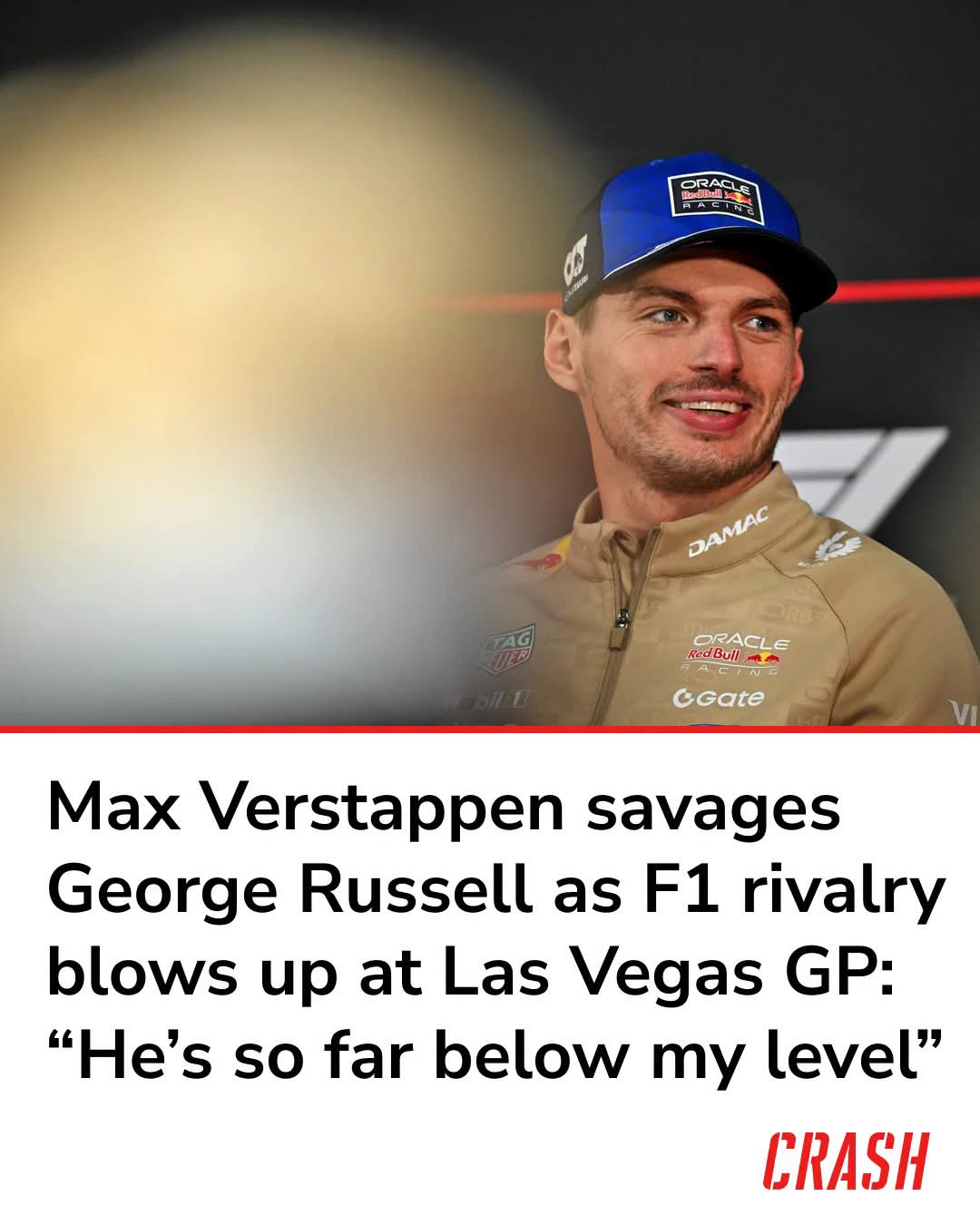
Max Verstappen did not just win the Las Vegas Grand Prix. He used the aftermath to deliver one of the most pointed personal assessments of a rival in recent Formula 1 memory. After George Russell crashed out of contention in the closing stages, the Red Bull driver made clear exactly where he ranks the Mercedes star—and how little the pre-race verbal sparring registered with him.
The comments landed with the force of a late-braking move. Verstappen described Russell as operating “so far below my level” that engaging with the criticism was pointless. He called the Mercedes driver’s crash “karma,” admitted it improved his afternoon when he saw it unfold in his mirrors, and tied the whole episode back to Russell’s habit of talking “a lot next to the track.” The radio reaction when Russell hit the wall—“Haha, well done! My God…”—only sharpened the public cut.
This was not random trash talk. It was the culmination of a weekend that began with contact in final practice and escalated through pointed media remarks.
THE PRACTICE CLASH THAT LIT THE FUSE
Late in FP3 on the Las Vegas Strip, Verstappen passed Russell as both prepared for flying laps. What followed was a classic piece of on-track friction. Verstappen appeared to slow and change direction under braking into Turn 14. Russell dived to the inside. The cars made contact. Verstappen radioed that he had been pushed toward the barrier and later gestured at his rival. Stewards investigated and handed Verstappen a formal warning for an unpredictable change of direction under braking that fell below expected standards. No grid penalty followed.
Russell was not content to leave it there. After qualifying he framed the incident as part of a larger pattern. He argued that while nothing in the rules prohibits overtaking a driver preparing a lap, the practical effect is to “screw” that driver. He claimed Verstappen does it routinely, that most drivers accept it, and that someone needed to stand up to a driver who acts as if he is bigger and better than everyone else.
Verstappen’s initial public response was dismissive: “Nothing happened.” Privately and to Dutch media he indicated he had no interest in wasting time on the matter. The pair still lined up on the front row after Kimi Antonelli’s engine-related grid drop.
RACE DAY AND THE VERBAL FINISH
On race day the two traded the lead at points before Russell’s late error handed Verstappen a clean path to victory. The Red Bull driver converted the opportunity and then, in the press conference, returned to the earlier criticism with interest. The “far below my level” line and the open enjoyment of Russell’s misfortune were not subtle. They were designed to close the conversation on Verstappen’s terms.
The language was characteristically direct. Formula 1 has heard sharper words over the years, but the combination of on-track success and personal ranking made the moment land. Verstappen has never pretended to value off-track narrative management the way some of his rivals do. When he decides a rival is not operating at his level, he tends to say so without the usual diplomatic filter.
WHY THIS RIVALRY KEEPS SURFACING
Verstappen and Russell have history that predates this weekend. Previous incidents, including public barbs after earlier collisions and grid penalties, established a pattern of mutual irritation. Russell has positioned himself as willing to challenge what he sees as Verstappen’s habitual track craft. Verstappen treats those challenges as noise from a driver who has not matched his results.
The dynamic matters because it sits at the intersection of sporting hierarchy and psychological warfare. Verstappen’s four titles and sustained dominance give weight to any ranking he offers. Russell, as a consistent frontrunner and Mercedes’ senior driver in a transitional period, has every incentive to refuse the subordinate role. Their clashes force the rest of the grid and the stewards to confront where the line sits between aggressive preparation for a flying lap and interference.
For Mercedes the episode is awkward. The team is rebuilding competitiveness and managing a young talent alongside an established leader. Public friction with the sport’s most successful current driver risks becoming a distraction if it intensifies. For Red Bull it is largely cost-free. Verstappen’s confidence is a feature of the team’s culture, not a bug.
BROADER IMPACT ON THE SPORT
Moments like this keep Formula 1 culturally sharp. The sport sells speed, technology, and human drama. When two high-profile drivers openly rank each other and celebrate the other’s misfortune, it generates attention that pure race results sometimes cannot. It also tests the limits of driver etiquette and the stewards’ willingness to police practice sessions more tightly.
The “gentleman’s agreement” around not compromising a driver’s preparation lap remains informal. As long as it stays informal, drivers like Verstappen will test its edges and drivers like Russell will call it out. Expect the FIA and the drivers’ association to revisit the topic if similar incidents recur. Broadcast and social metrics will reward the friction in the short term; longer term the sport prefers rivalries that stay competitive rather than corrosive.
WHAT COMES NEXT
The championship picture and the remaining calendar will determine whether this stays a weekend story or becomes a season-long subplot. Verstappen has shown he can compartmentalize and perform. Russell has shown he is willing to escalate verbally when he feels wronged. If Mercedes closes the performance gap, the on-track battles will carry extra edge. If the gap remains, Verstappen’s ranking comments will look increasingly like a settled verdict rather than temporary trash talk.
In pure sporting terms the episode reinforces an old truth: results still do most of the talking. Verstappen left Las Vegas with the win and the last word. Russell left with damage, a damaged result, and a reminder that public challenges to the established order carry risk when the other driver is still the benchmark.
The Strip provided the stage. The practice contact supplied the spark. Verstappen’s post-race assessment supplied the lasting quote. Formula 1 rarely stays quiet for long when egos of this size share the same piece of asphalt. This weekend proved the point again.