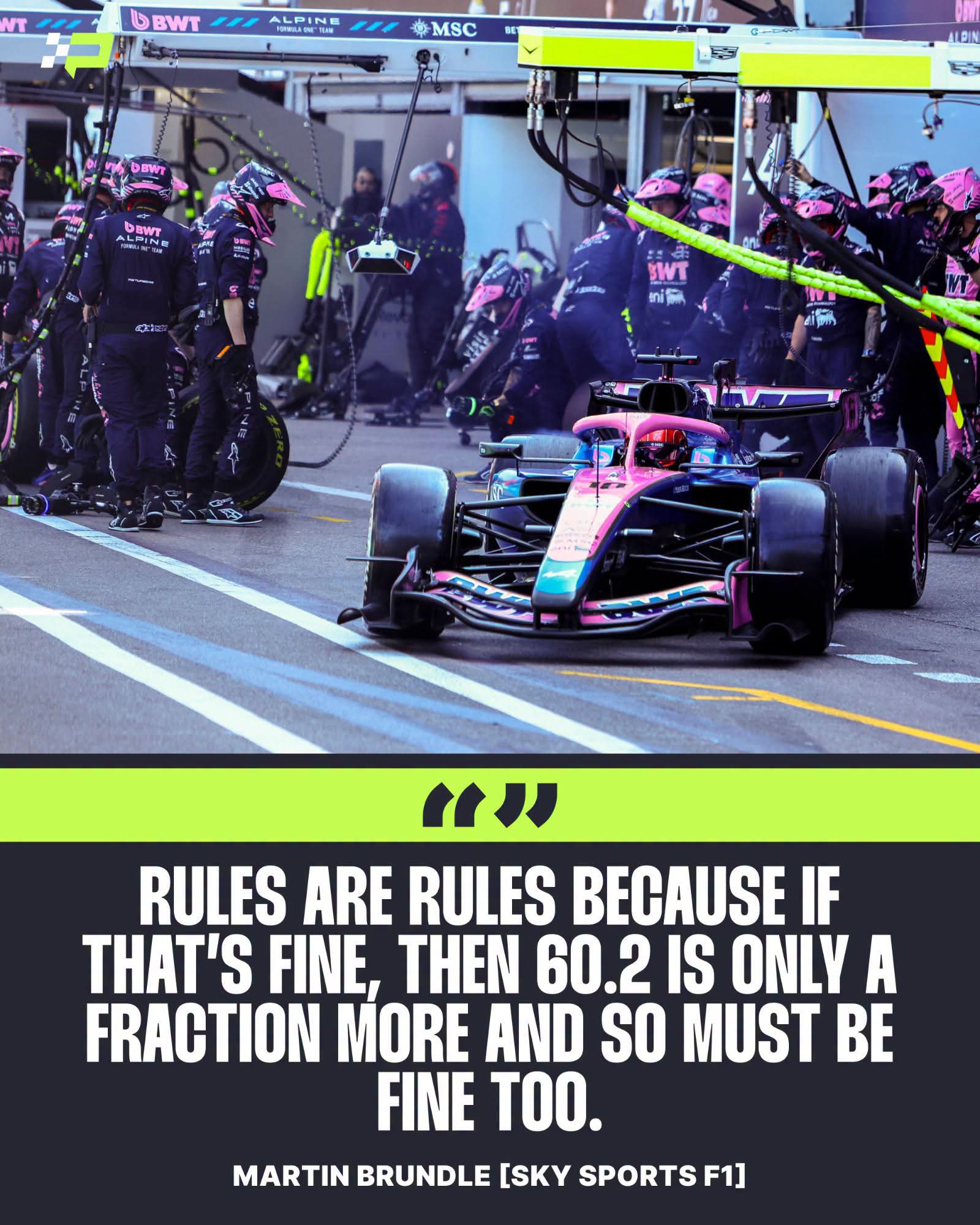
The fallout from the dramatic Monaco Grand Prix continues, and one of the biggest talking points remains the wave of penalties handed out for pit lane speeding violations. While several drivers and teams questioned the severity of the punishments, Sky Sports F1 commentator and former Formula 1 driver Martin Brundle has offered a firm defense of the FIA’s approach, describing the penalties as “necessarily brutal.”
The debate comes after multiple high-profile drivers, including Lewis Hamilton and George Russell, were penalized during a chaotic Monaco weekend. The controversy has reignited discussions about whether Formula 1’s current pit lane monitoring system is fair, especially when some drivers exceeded the limit by incredibly small margins.
WHY PIT LANE SPEEDING IS TAKEN SO SERIOUSLY
Pit lanes are among the most dangerous environments in motorsport. Unlike the race track itself, pit lanes are crowded with mechanics, engineers, officials, and equipment. A minor mistake at racing speed can quickly become a serious safety incident.
That reality explains why Formula 1 has always adopted a zero-tolerance approach toward pit lane speed limits. Drivers may be traveling at over 300 km/h moments before entering the pits, making precision absolutely critical.
Brundle’s argument is rooted in safety rather than punishment. According to the former F1 driver, harsh penalties exist because they act as a powerful deterrent. If teams believed they could gain even a slight advantage by pushing the limits, they would inevitably test the boundaries every race weekend.
THE MONACO CONTROVERSY THAT SPARKED THE DEBATE
Monaco’s unique pit lane layout created major headaches during the race weekend. Several drivers were caught by FIA monitoring systems despite claiming they had not intentionally exceeded the speed limit.
Lewis Hamilton was particularly vocal after receiving a five-second penalty for allegedly exceeding the limit by just 0.1 km/h. The Ferrari driver later suggested the technology used to calculate speed through the pit entry should be investigated.
George Russell’s situation proved even more costly. What initially appeared to be a manageable penalty escalated into a race-ruining setback after confusion during a safety car period, effectively destroying his chances of a strong finish.
The number of incidents prompted widespread discussion throughout the paddock, with some teams questioning whether the system accurately reflected what drivers were doing behind the wheel.
BRUNDLE’S PERSPECTIVE CARRIES WEIGHT
Unlike many commentators, Brundle speaks from direct experience. Having raced in Formula 1 during one of the sport’s most dangerous eras, he understands why safety regulations are often strict.
His stance suggests that while drivers may feel frustrated by penalties measured in tenths of a kilometer per hour, the alternative could be far worse. If officials begin introducing gray areas or tolerance zones, teams could exploit them, leading to progressively faster pit lane entries.
Brundle’s position reflects a long-standing Formula 1 philosophy: safety rules only work when competitors know the consequences are severe.
FERRARI AND MERCEDES LEFT WITH QUESTIONS
Although Hamilton still secured second place in Monaco despite his penalty, Ferrari remains concerned about how the system operates. The team avoided major damage to its result, but future races may not be so forgiving.
Mercedes experienced a far more painful outcome. Russell’s weekend unraveled amid a combination of penalties, strategic confusion, and unfortunate circumstances. For a driver already trailing teammate Kimi Antonelli in the championship battle, every lost point carries enormous significance.
Both teams are likely to continue discussions with the FIA regarding how speed measurements are calculated, particularly at circuits with unusual pit lane configurations.
WHAT THIS MEANS FOR THE CHAMPIONSHIP
The timing of the controversy is particularly important because the 2026 championship battle is entering a critical phase. Kimi Antonelli continues to build momentum at the top of the standings, while rivals such as Hamilton, Russell, and other contenders cannot afford costly mistakes.
A single penalty can transform a podium finish into a points-losing disaster. In a championship where margins are increasingly tight, operational excellence has become just as important as outright pace.
Teams now face a difficult challenge. They must balance maximizing performance while ensuring their drivers stay comfortably within the regulations, even if that means sacrificing tiny amounts of lap time.
COULD THE FIA REVIEW THE SYSTEM?
Despite Brundle’s defense of strict penalties, the FIA may still review how pit lane speeds are measured. The large number of incidents in Monaco raised enough concerns to warrant further discussion.
However, any review is likely to focus on improving clarity rather than reducing penalties. Formula 1’s governing body has consistently prioritized safety, and there is little indication that officials want to soften enforcement.
Instead, teams could receive more detailed guidance on pit lane entry procedures, measurement points, and best practices to avoid future disputes.
THE BIGGER PICTURE FOR FORMULA 1
The Monaco controversy highlights a recurring challenge in modern Formula 1. As technology becomes increasingly precise, even the smallest infractions can carry significant consequences.
For drivers, that can feel frustrating. For officials, it reinforces consistency. And for fans, it creates another layer of drama in a championship already packed with storylines.
Brundle’s comments serve as a reminder that Formula 1’s harshest rules often exist for a reason. While drivers may dislike the consequences, the sport continues to prioritize safety above convenience.
With Barcelona next on the calendar, teams will be eager to leave the Monaco controversy behind. But the debate over pit lane penalties is unlikely to disappear anytime soon, especially if another race sees drivers punished by margins measured in fractions of a kilometer per hour.