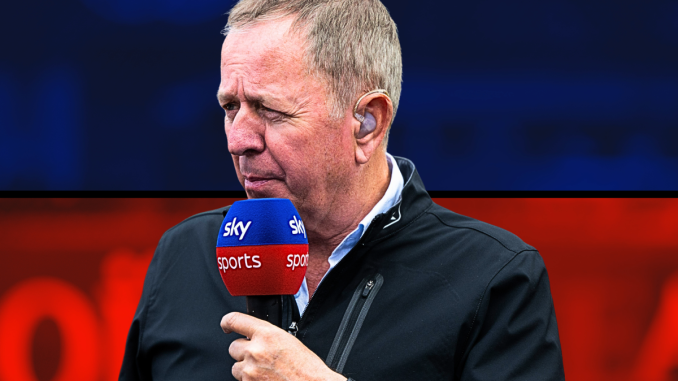
Martin Brundle’s absence from Sky Sports’ Formula 1 coverage at the 2026 Dutch Grand Prix immediately caught the attention of fans, particularly because the former F1 driver has become one of the most recognisable voices in the sport’s television coverage. With Brundle missing from the Zandvoort weekend, speculation naturally followed, but the reality is considerably less dramatic: his absence is part of a planned reduction in his Sky Sports workload rather than an unexpected departure from F1 broadcasting.
MARTIN BRUNDLE’S DUTCH GP ABSENCE WAS PLANNED
Brundle is operating on a reduced schedule during the 2026 Formula 1 season. He has confirmed that his plan is to cover 16 of the 22 Grands Prix on this year’s calendar, compared with the 18 events he attended in 2025.
That distinction is important because headlines suggesting that Brundle has suddenly disappeared from Sky Sports risk creating an entirely different impression. The Dutch Grand Prix was not evidence of a disciplinary problem, an unexpected medical issue or an immediate retirement. Instead, it was one of the weekends outside his agreed schedule.
The arrangement also reflects how demanding modern F1 broadcasting has become. A Grand Prix weekend involves considerably more than simply appearing behind a microphone on Sunday. Broadcasters and analysts are required to travel internationally, attend multiple sessions, prepare technical analysis and remain available throughout an increasingly packed Formula 1 calendar.
WHY BRUNDLE’S ABSENCE FELT SO NOTICEABLE
Although Sky Sports has a deep pool of experienced F1 broadcasters and analysts, Brundle occupies a particularly distinctive position within the coverage.
His credibility comes partly from his own racing career. Brundle competed in Formula 1 for 12 seasons and achieved nine podium finishes before moving into broadcasting. He subsequently worked with ITV and the BBC before becoming a central figure in Sky Sports F1 coverage from 2012 onward.
That history gives his commentary a different dimension. When Brundle discusses a driver’s braking point, racecraft, tyre management or the pressure of a championship battle, he is speaking from direct experience of competing at the highest level.
His famous pre-race grid walks have also become part of the identity of British F1 television coverage. Consequently, when he is missing, viewers notice the difference even when Sky Sports continues to provide a full production with other established analysts.
SKY SPORTS HAS HAD TO ROTATE ITS F1 TEAM
Brundle was not the only familiar Sky Sports personality missing from the Dutch Grand Prix coverage. David Croft and Ted Kravitz were also absent from the Zandvoort weekend, prompting additional discussion among viewers about changes to the broadcaster’s presentation line-up.
However, the broader picture suggests a rotating broadcasting operation rather than the collapse of the established Sky Sports F1 team.
Sky has a large collection of experienced presenters, former drivers, engineers and analysts who can step into different roles across the season. That flexibility becomes increasingly important as Formula 1 continues to operate a long calendar while also introducing more Sprint weekends.
In other words, the absence of one or two familiar personalities does not necessarily indicate a structural problem. It can instead be an efficient way of managing workload while allowing the broadcaster to maintain extensive coverage throughout the season.
THE TIMING OF THE DUTCH GP MADE THE ABSENCE MORE NOTICEABLE
The Dutch Grand Prix was always going to attract enormous attention because Zandvoort hosted its final scheduled Formula 1 race in 2026, while the weekend also featured the circuit’s first Sprint event.
The sporting action was equally significant. George Russell won the Sprint, while Lando Norris secured pole for the Grand Prix. Mercedes driver Kimi Antonelli entered the weekend leading the championship, with Lewis Hamilton and Russell among the drivers attempting to close the gap.
Max Verstappen’s dramatic first-lap retirement in Sunday’s Grand Prix added another major storyline. The Dutchman lost control at the banked section of Zandvoort and hit the wall, bringing out a race stoppage before the event resumed.
Against that backdrop, the absence of one of Sky Sports’ most recognisable personalities was naturally more noticeable than it might have been at an ordinary race weekend.
BRUNDLE IS NOT WALKING AWAY FROM FORMULA 1
The biggest takeaway for fans is that there is currently no compelling evidence that Brundle is preparing to leave Sky Sports’ F1 coverage altogether.
Earlier in 2026, Brundle addressed speculation surrounding his future and made clear that his reduced schedule should not be interpreted as him being pushed out of the commentary team. Reports also noted that speculation about a possible full-time replacement had circulated, but Brundle’s own comments pointed towards a planned workload rather than an imminent exit.
His continued involvement also remains evident in his regular F1 analysis. Before the summer break, for example, Brundle continued to assess the championship battle and argued that the 2026 title fight was far from settled following McLaren’s Hungarian Grand Prix victory.
That is an important distinction. A broadcaster can reduce his number of race appearances without abandoning the sport.
WHAT THIS MEANS FOR SKY SPORTS F1
From Sky Sports’ perspective, Brundle’s reduced schedule could actually represent a sensible long-term strategy.
Instead of expecting one veteran broadcaster to attend virtually every race, the network can distribute responsibilities across a wider group of specialists. That creates opportunities for younger commentators and analysts while allowing established figures such as Brundle to remain involved without carrying the same workload.
It also gives Sky greater flexibility when the calendar becomes particularly demanding. With 22 Grands Prix and multiple Sprint weekends in 2026, maintaining a sustainable broadcast operation requires careful personnel management.
For viewers, there may even be a benefit. Different combinations of former drivers, engineers, presenters and reporters can produce different analytical perspectives rather than relying on exactly the same broadcast formula every weekend.
COULD BRUNDLE’S ROLE BECOME EVEN MORE SELECTIVE?
The most interesting question is what happens beyond 2026.
Brundle’s 16-race schedule is already a modest reduction from his 18 appearances in 2025. That does not automatically mean another reduction is coming, but it demonstrates that his role can evolve without ending altogether.
If the arrangement proves successful, Sky Sports could continue using Brundle selectively for major races while giving other analysts more responsibility at the remaining events.
That would arguably preserve the value of Brundle’s expertise. His presence could become more concentrated around the races where his experience and insight are particularly valuable, while the wider Sky Sports team continues handling the full championship.
WHY MARTIN BRUNDLE STILL MATTERS TO F1 COVERAGE
Formula 1 has changed dramatically since Brundle’s racing career, but his value as a broadcaster comes from precisely that historical perspective.
He understands the sport before the current generation of drivers, has experienced the physical and psychological demands of racing and has witnessed major changes in F1 technology, regulations and commercial growth.
That makes his analysis useful beyond simply describing what happened on track. The strongest F1 television coverage explains why something happened, and Brundle’s racing background gives him a valuable framework for doing that.
His absence therefore changes the character of a broadcast, even when the overall production remains strong.
THE BOTTOM LINE FOR FANS
Martin Brundle’s absence from the 2026 Dutch Grand Prix should not be treated as confirmation that he is leaving Sky Sports or Formula 1 broadcasting.
The available evidence points to a planned 16-race schedule for the 22-round season, meaning some Grands Prix were always going to be covered without him.
For fans who have become accustomed to seeing Brundle at almost every race, the adjustment may take some getting used to. But his reduced workload appears to be a change in frequency rather than an ending.
And with the 2026 championship entering a crucial second half, Brundle’s experience will remain valuable whenever he returns to the Sky Sports F1 commentary box. The bigger story may therefore not be whether Martin Brundle is leaving Formula 1, but how Sky Sports manages to preserve the expertise of its veteran voices while building a broadcasting team capable of covering an increasingly demanding modern F1 calendar.