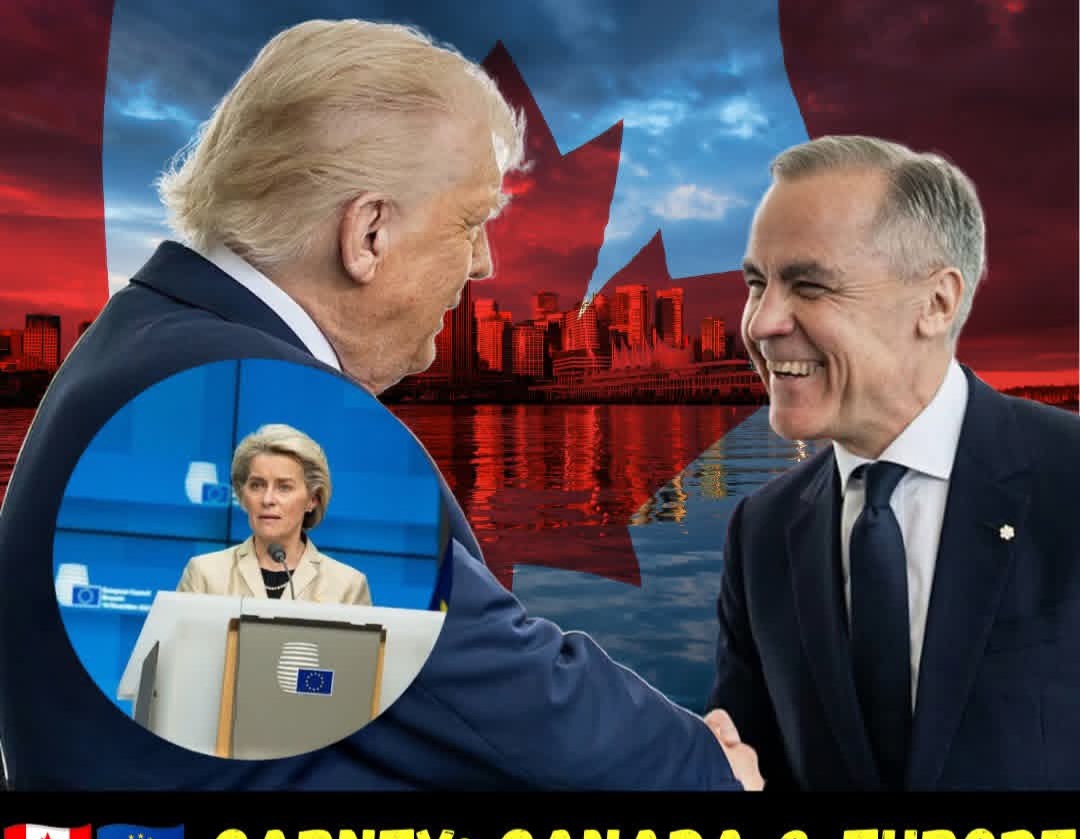
Mark Carney called for closer Canada–Europe ties following Trump’s tariff threat over Canada’s proposed closer relationship with the EU…Carney Calls for Closer Canada-Europe Alliance as Trump Threatens Tariffs
Canadian Prime Minister Mark Carney has called for a much deeper relationship between Canada and Europe, saying closer cooperation could strengthen both sides as uncertainty grows over Canada’s trade relationship with the United States.
Carney made the remarks in an address to the European Parliament in Strasbourg on Thursday, shortly after U.S. President Donald Trump threatened to impose “very serious tariffs” on Europe if the European Union moved ahead with a proposal to give Canada a new form of “associate member” status.
The proposal was put forward by European Commission President Ursula von der Leyen, who said the EU wanted to develop an unprecedented form of partnership with Canada. The concept would go beyond the existing Canada-EU trade relationship and could cover areas including defence, critical minerals, energy, artificial intelligence, digital trade and cooperation in the Arctic.
Carney welcomed the ambition behind the proposal, although he stopped short of formally endorsing the specific term “associate member”. He said Canada was not seeking full membership of the European Union, but argued that the two sides could build a deeper strategic partnership.
“Canada and Europe are each strong. Europe and Canada are stronger together,” Carney said, presenting closer cooperation as a way of increasing resilience rather than creating a new geopolitical bloc.
The Canadian prime minister outlined a broad range of potential areas for cooperation. These include critical minerals, defence manufacturing, energy security, artificial intelligence, computing, space and digital payments. He also proposed closer digital trade and greater opportunities for young Canadians and Europeans to study, work and live across the Atlantic.
The push comes as relations between Ottawa and Washington have become increasingly strained. Trump has imposed tariffs affecting Canada and has repeatedly criticised Canada’s trade policies, while his administration has also spoken about the possibility of Canada becoming the 51st U.S. state. The disputes have encouraged Ottawa to look for ways to diversify its economic and strategic relationships.
Trump responded sharply to the EU’s proposal. He warned that Washington could impose substantial tariffs on European goods or even reduce trade with the bloc if the initiative was pursued. He described the idea of Canada’s closer relationship with the EU as potentially hostile, adding another layer of tension to already difficult transatlantic trade relations.
European officials have stressed that closer cooperation with Canada is not necessarily intended as a confrontation with the United States. The European Commission has described the initiative as an effort to strengthen partnerships and economic security at a time when existing international relationships are changing.
There are also significant questions about what “associate membership” would actually mean. Such a status does not currently exist under EU treaties, meaning any formal arrangement would have to be negotiated and approved by the EU’s member states. Some European governments have expressed support for closer relations with Canada while remaining cautious about the terminology and the practical details.
Canada and the EU already have an extensive trade relationship through the Comprehensive Economic and Trade Agreement, or CETA. The new proposal would therefore represent a broader political and strategic partnership rather than simply another free-trade agreement.
Carney has argued that the objective is to increase Canada’s options rather than sever its long-standing relationship with the United States. He has described Canada and Europe as natural partners with shared interests and values, while emphasising the importance of maintaining Canadian sovereignty.
The next stage is likely to focus on turning the political proposal into concrete agreements. Ottawa and Brussels will need to determine what additional market access, defence cooperation and institutional links could be established, while EU governments will have to agree on the framework.
For Canada, the initiative represents a significant effort to broaden its international partnerships. For Europe, it offers an opportunity to deepen relations with a major democratic economy outside the continent.
Whether the proposed new relationship develops into a formal arrangement remains uncertain. But Carney’s intervention in Strasbourg has made clear that Canada is prepared to pursue a substantially closer partnership with Europe, even as Washington signals that such a move could carry economic consequences.