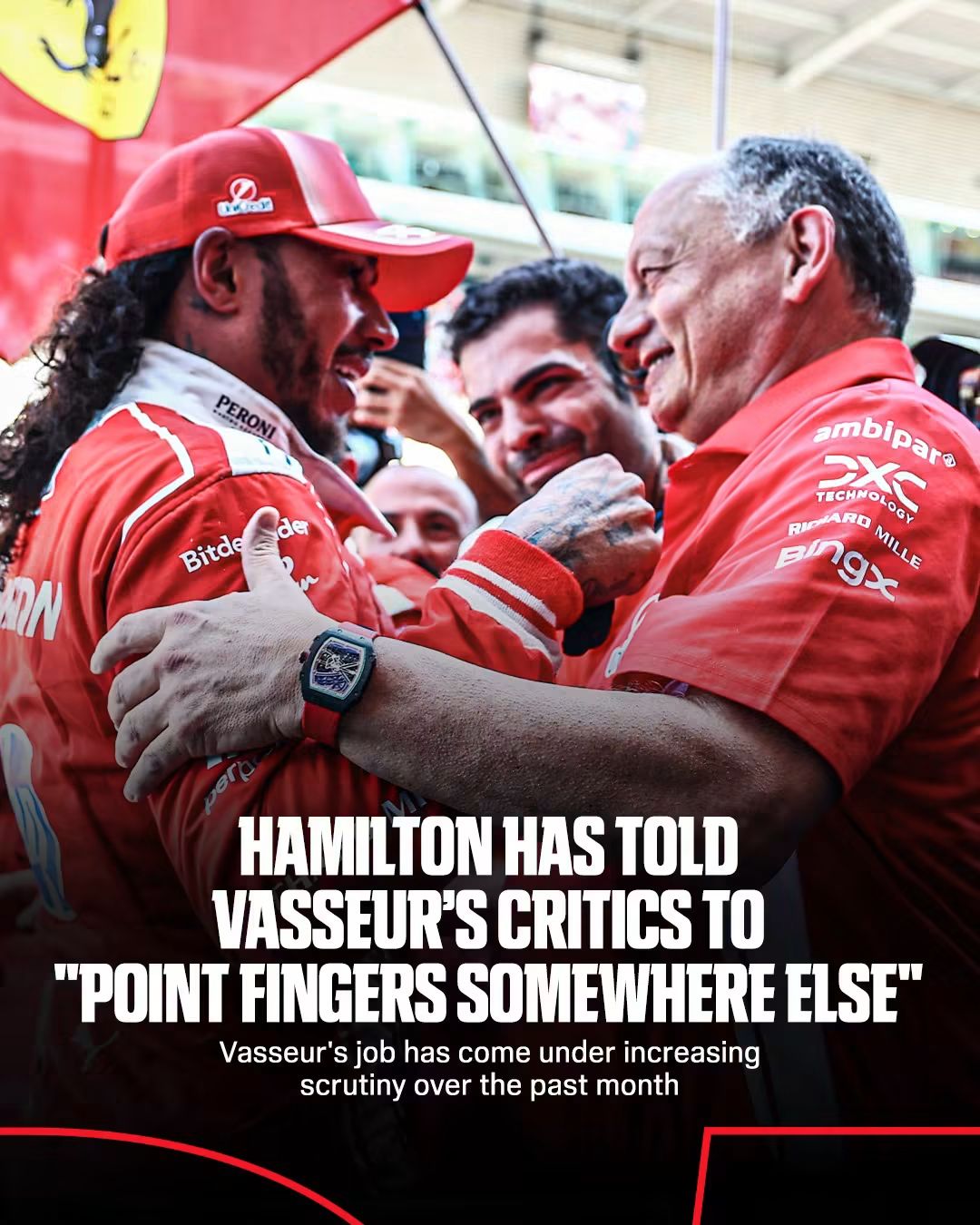
Lewis Hamilton has delivered one of his most forceful public statements since joining Ferrari, launching a passionate defence of team principal Fred Vasseur while making it clear that the Scuderia’s problems run deeper than any single figure. Speaking ahead of the Bahrain Grand Prix in Malaysia, the seven-time world champion pushed back hard against the growing speculation that has surrounded Vasseur’s future and redirected attention toward the layers of leadership above him.
In a sport where team principals often become the public face of both success and failure, Hamilton’s comments cut through the noise with unusual directness. “Ultimately, it’s not a one-man operation,” he said. “If you want to point fingers, point them somewhere else. There are a lot of people above that also are a part of it.” The message was unambiguous: Vasseur stays, Hamilton stays with him, and the search for scapegoats needs to look higher up the organisational chart.
WHY VASSEUR FOUND HIMSELF IN THE FIRING LINE
The pressure on Vasseur has intensified over recent weeks. Reports linked former Red Bull team principal Christian Horner with a potential move to Maranello, creating enough external heat that Ferrari felt compelled to issue a public show of support. That backing came via the team’s head of communications rather than a direct statement from CEO Benedetto Vigna or chairman John Elkann, a detail that did not go unnoticed.
Ferrari’s last constructors’ championship arrived in 2008. The drivers’ title drought stretches back to 2007. In that context, every dip in performance invites intense scrutiny. Under Vasseur the team has climbed to second in the constructors’ standings this season, a clear step forward from the previous year. Hamilton was quick to highlight that progress while arguing that progress alone has not been enough to quiet the critics.
HAMILTON DRAWS A CLEAR LINE ON STRUCTURE VERSUS INDIVIDUALS
Hamilton has long experienced different models of leadership. At Mercedes he worked under Toto Wolff, a team principal with significant ownership and authority that stretched across commercial and sporting decisions. At Ferrari the structure is more corporate and multi-layered. When asked whether Ferrari might benefit from a more Mercedes-style arrangement, Hamilton was careful but revealing.
“There are changes that I would make, but I’m not going to talk about what those are,” he said. “Toto’s in a different position to Fred. The structure’s a lot different.” He stopped short of detailing those preferred changes, yet the implication was clear: the issues Ferrari faces are institutional rather than personal.
This distinction matters. Formula 1 teams succeed when technical, sporting and commercial arms pull in the same direction with minimal internal friction. Hamilton’s comments suggest he believes the current architecture still contains friction points that no amount of hard work from Vasseur alone can fully resolve.
THE UNIQUE PRESSURE OF WEARING THE FERRARI BADGE
Hamilton also addressed the disproportionate media attention that follows Ferrari. Mistakes that pass with limited comment at other teams become magnified when they occur at Maranello. “It’s ten times worse for some reason for Ferrari,” he observed, “but that’s also to be expected. Given that it’s the best brand here, it’s the most iconic by far.”
The human cost of that scrutiny is real. Hamilton noted that negative coverage reaches families and factory staff, creating an atmosphere where people feel they can do little right even while giving maximum effort. His advice to the team was straightforward: stop reading the external noise. Those writing the stories, he argued, are not inside the garage or the design office and therefore lack the full picture.
WHAT THIS MEANS FOR FERRARI’S IMMEDIATE AND LONG-TERM FUTURE
Hamilton’s intervention carries weight for several reasons. First, it publicly locks him into Vasseur’s corner at a moment when unity is essential. Second, it places subtle but noticeable pressure on the corporate hierarchy above the team principal. When a driver of Hamilton’s stature suggests the structure itself requires examination, those higher up the chain cannot easily dismiss the observation.
The timing is also significant. The Bahrain Grand Prix is being staged at Sepang, an unusual venue change that has already drawn attention. In such an environment, internal stability becomes even more valuable. A public defence from the team’s most high-profile driver helps reset the narrative heading into the final stretch of the season.
Looking further ahead, Hamilton’s comments raise legitimate questions about how Ferrari is structured for the next generation of regulations and the continued evolution of the sport. Stability at team principal level has historically helped championship-winning organisations. Constant turnover in that role has been a recurring theme at Ferrari in recent years. Hamilton clearly believes Vasseur represents a better path than yet another reset.
THE BROADER INDUSTRY CONTEXT
In modern Formula 1, team principals increasingly occupy hybrid roles that blend sporting leadership with political and commercial responsibilities. The contrast Hamilton drew with Wolff’s position at Mercedes highlights a genuine structural difference. Ownership stakes create different incentives and different levels of autonomy. Whether Ferrari’s more traditional corporate model can deliver sustained championship contention remains one of the central unresolved questions around the team.
Hamilton’s relationship with Vasseur also adds texture. The two worked together in Formula 2 before being reunited at Ferrari. That history appears to have created a foundation of trust that Hamilton is now willing to defend publicly even when it means directing criticism upward.
The coming races will test whether this public show of solidarity translates into clearer direction on track. For now, Hamilton has drawn a line. Fred Vasseur is staying. The seven-time champion is staying with him. And anyone looking for simple answers about Ferrari’s challenges has been told, in no uncertain terms, to look higher.