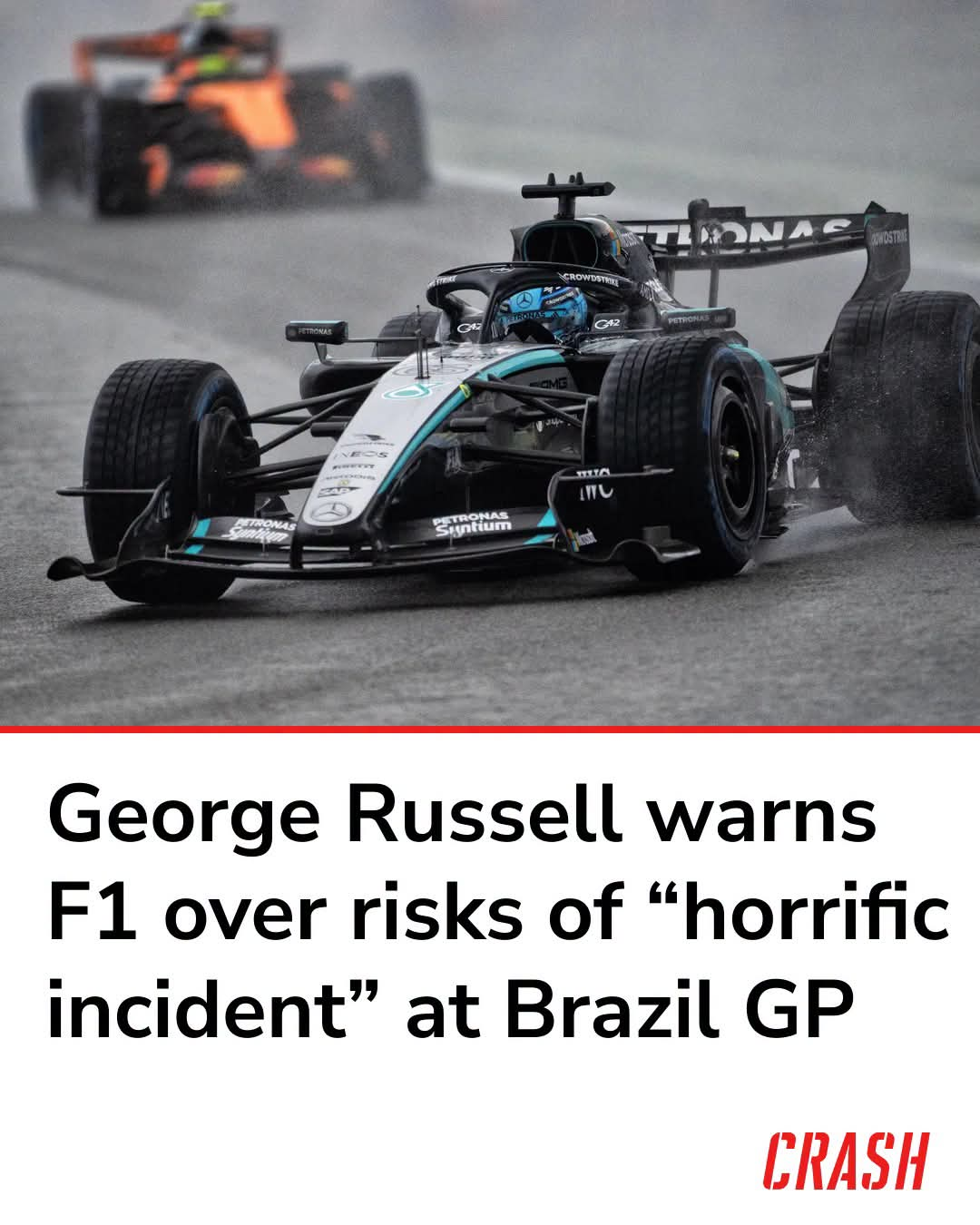
George Russell does not scare easily. The Mercedes driver has carved out a reputation for clinical precision in changeable conditions and has repeatedly shown he thrives when the sky opens at Interlagos. Yet after Saturday’s chaotic qualifying session for the 2026 Sao Paulo Grand Prix, the Briton delivered one of the clearest safety warnings heard on an F1 weekend in years.
Russell described the early stages of qualifying as borderline unraceable. Visibility dropped to zero on the run into Turn 4. He reported wheel-spinning in fifth gear at more than 200 km/h while aquaplaning across standing water. The message was blunt: if those exact conditions returned for the race, the risk of a truly serious accident would be unacceptably high.
“I love driving in the rain here,” Russell said, “but at some point, if that was a race, there was no way we should be driving in that because the chances of seeing a really, really horrific incident are very, very high.”
Isack Hadjar echoed the same concern, stating the Q1 conditions simply would not have been raceable. When drivers who regularly push the limit start talking in those terms, the sport is forced to listen.
WHY THE QUALIFYING CONDITIONS CROSSED A LINE
Interlagos has always been a rain lottery. The short, undulating layout, the altitude, and the sudden Brazilian downpours create one of the most unpredictable weekends on the calendar. In 2026 the new-generation cars added another layer of complexity. Full wet tyres were used in anger for the first time in a meaningful session, yet the combination of heavy standing water and spray still left drivers with almost no forward vision on the straights.
The difference between qualifying and racing is critical. In qualifying the field spreads out. Cars run largely alone. In a race the pack stays bunched, especially under safety car or in the opening laps. One aquaplaning car becomes a stationary obstacle that the drivers behind cannot see until it is too late. That is the scenario Russell was describing.
Formula 1 has improved visibility technology and drainage over the years, but physics still wins. When the water depth exceeds what the tyre grooves can clear at high speed, grip disappears and spray becomes a wall. Russell’s description of spinning the wheels in fifth gear underlines how little traction was available even on the straight.
THE IMPACT ON RUSSELL, MERCEDES AND THE CHAMPIONSHIP PICTURE
Russell qualified second, just 0.204 seconds behind Lando Norris. A five-place grid penalty for an engine change dropped him to seventh. The result still left him optimistic about a wet race. He felt more confident in the wet than the dry and believes his pace, along with Norris’s, was the strongest in the field under those conditions.
That confidence sits against a difficult season. Reliability issues and the emotional weight of watching a teammate claim the title have left Russell searching for momentum. A strong result from seventh in changeable weather would restore belief. It would also help Mercedes secure the constructors’ championship if the points fall the right way.
The team’s strategy call in Q3, when Russell was instructed to abort a promising lap because of traffic and approaching rain, only heightened the frustration. Yet the bigger picture remains the weather. Russell has made it clear he would rather race in the wet than the dry because it maximises his chance of climbing through the order.
WHAT THIS MEANS FOR THE FIA, TEAMS AND THE SPORT
Driver warnings of this clarity put pressure on race control. The FIA must balance the desire to put on a show with the non-negotiable requirement of safety. Red-flagging or delaying a race when conditions mirror Saturday’s Q1 is no longer a difficult call; it is the only responsible one.
Teams face their own calculations. Wet races reward car balance, tyre management and driver confidence more than pure power. Mercedes and McLaren appeared strongest in the rain. Drivers further down the order with less experience in extreme wet conditions face higher risk. The sport’s image also takes a hit every time a high-profile driver publicly questions whether a race should even start.
Historically, Interlagos has produced classics in the wet. It has also produced moments that sit uncomfortably close to disaster. Russell’s comments serve as a reminder that the line between spectacle and unacceptable risk is thinner than many outside the cockpit realise.
LOOKING AHEAD TO RACE DAY AND BEYOND
Forecasts for Sunday remain changeable. If the rain returns at the intensity seen in Q1, expect the race to be delayed or started behind the safety car, with the possibility of further interruptions. If the track is merely damp, the drivers who excelled on Saturday will hold the advantage.
Russell’s warning also feeds into longer-term conversations about wet-weather performance of the current car generation. Visibility, spray and aquaplaning remain unresolved challenges even as the cars themselves become more sophisticated. The sport cannot keep relying on driver bravery alone when the physical limits of the tyres and the circuit drainage are exceeded.
For now the focus stays on Sunday. George Russell has drawn a clear boundary. He loves racing in the rain at Interlagos. He is prepared to attack from seventh if the conditions are merely difficult. He is not prepared to risk a “horrific incident” if the track returns to the state that made even a single flying lap feel like a gamble.
That distinction should guide every decision made by race control. In a sport that sells speed and danger, the drivers are still the ones who must live with the consequences. When they speak this clearly, the only professional response is to listen.