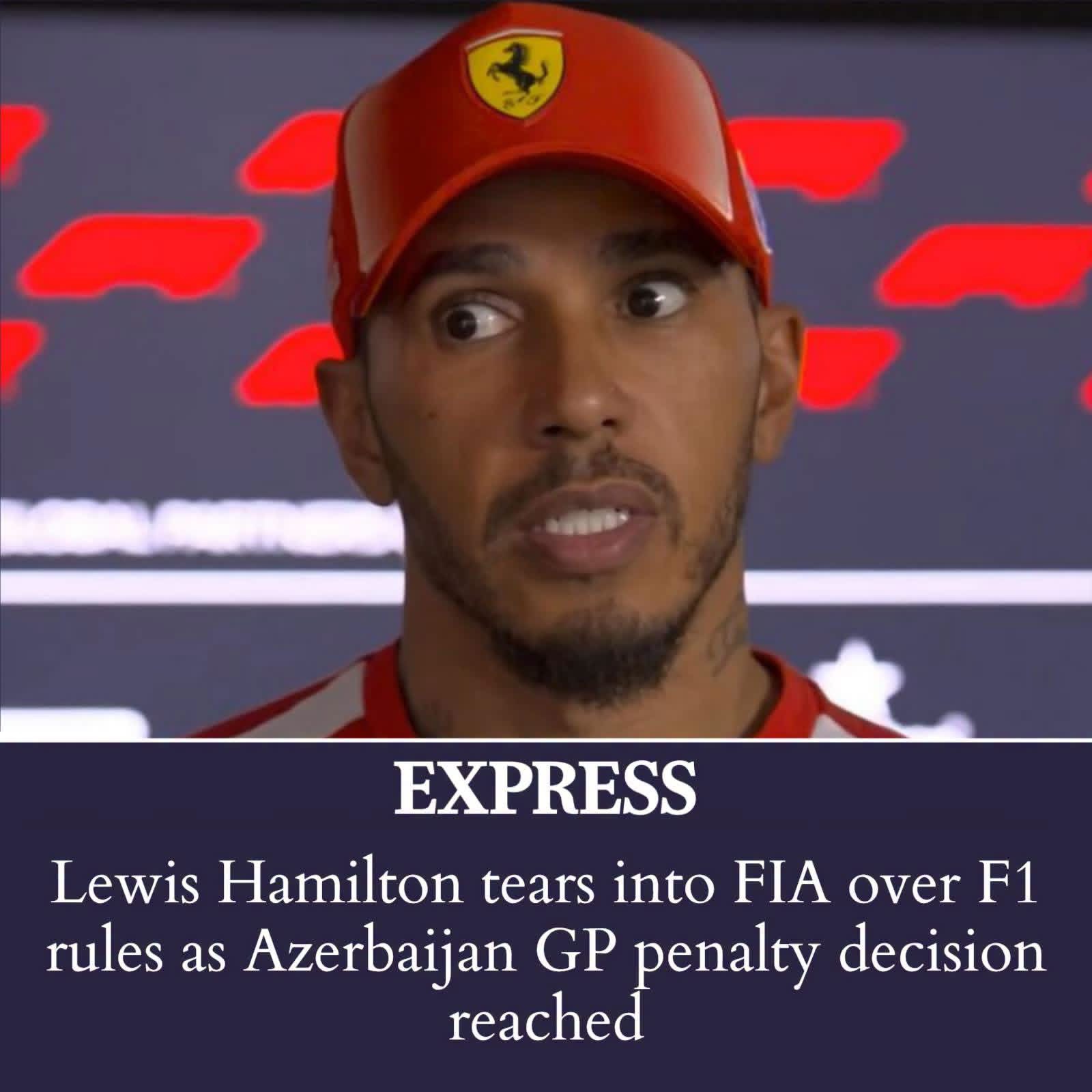
Lewis Hamilton has launched a strong critique of Formula 1’s current regulations after being penalised for impeding Liam Lawson during qualifying for the Azerbaijan Grand Prix. The Ferrari driver accepted that the incident occurred but placed the blame squarely on the rules governing hybrid deployment and the lack of clear guidelines for managing traffic.
Hamilton’s comments in the media pen underlined growing frustration with a system that leaves drivers managing extreme speed differences with limited tools.
WHAT HAPPENED ON TRACK IN BAKU
Toward the end of a flying lap, Lawson came up behind a slow-moving Hamilton and was forced to react. The Racing Bulls driver immediately voiced his anger over team radio, describing Hamilton’s positioning as “so dangerous.”
Stewards subsequently found Hamilton guilty of impeding. The decision added another difficult note to Ferrari’s Azerbaijan weekend.
HAMILTON’S DEFENCE: THE RULES CREATED THE PROBLEM
Hamilton rejected any suggestion of deliberate obstruction and instead pointed to the technical and sporting regulations. He explained that on an out-lap drivers have no battery deployment and are running solely on the internal combustion engine — a deficit he estimated at around 500 horsepower.
“When you do an out lap and when you come around the last corner to start your lap, you have no ‘K’ – no battery deployment – you just have the ICE, basically,” Hamilton said. “So it’s something like 500 brake horsepower less, but there are no guidelines of how big of a gap you have to understand the closing speed that you’re going to have with the guy that’s on their lap.”
He believed a four-second gap was sufficient. Once he committed to the power and reached Turn 18, the closing speed proved far greater than expected and left him with nowhere to go.
“THAT’S NOT THE DRIVERS’ FAULT”
Hamilton was clear that responsibility for the situation sits with the regulatory framework rather than individual drivers. “It was unfortunate, but it gives us good guidelines as to what to change, potentially, for tomorrow. But that’s not the drivers’ fault – that’s what the FIA did with their decisions at the beginning of the year and we’re trying to manage as best we can, as drivers, on track in finding the right gap and not getting in the way of people.”
The comments reflect a wider and recurring complaint in the hybrid era: the enormous performance difference between a car on a preparation lap and one on a hot lap creates hazardous traffic scenarios, particularly at street circuits like Baku where runoff is limited and walls are close.
WHY BAKU AMPLIFIES THE ISSUE
The Azerbaijan Grand Prix circuit is notoriously difficult for traffic management. Long straights, high speeds and a narrow, wall-lined layout leave little margin for error when cars are circulating at vastly different velocities. The combination of the current hybrid rules and Baku’s characteristics made the incident almost inevitable once the gap was misjudged.
Similar frustrations have been voiced by multiple drivers in recent seasons, yet clear, practical guidelines on minimum gaps or out-lap behaviour have remained limited.
THE BIGGER PICTURE FOR F1’S REGULATIONS
Hamilton’s public criticism adds pressure on the FIA to examine whether the current engine and sporting rules are creating unnecessary risk in qualifying. While hybrid technology has delivered impressive efficiency and performance, the side-effect of extreme power differentials on non-flying laps continues to cause problems.
For Ferrari and Hamilton, the penalty is another setback in a challenging season. For the sport, it is a reminder that regulatory decisions made in the name of technical progress can have unintended consequences on track safety and fairness.
Hamilton’s message was unambiguous: drivers are doing their best within the system they have been given. If that system routinely produces dangerous speed mismatches, the responsibility for fixing it lies with those who write the rules.