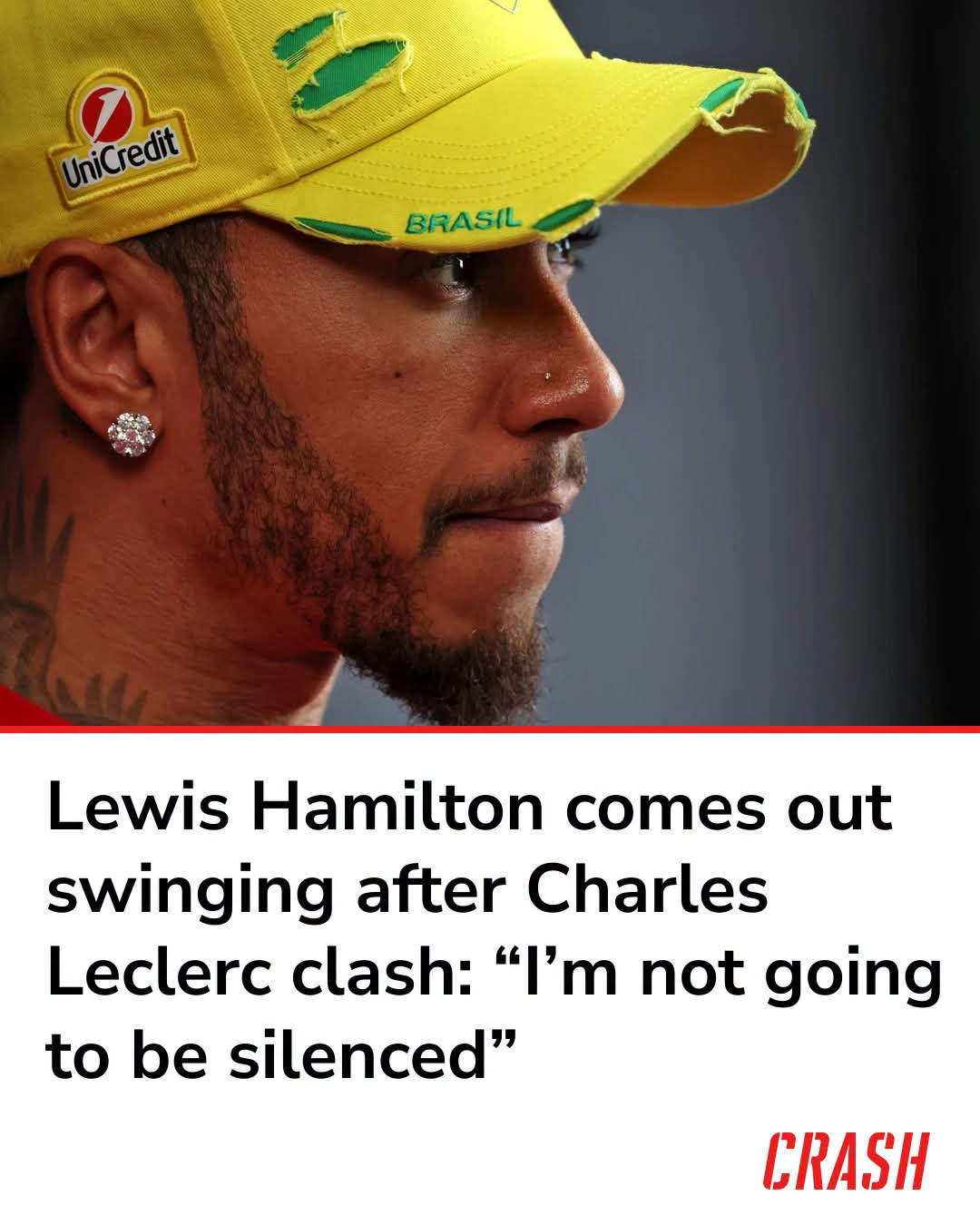
Lewis Hamilton has delivered another defiant message amid the growing tension inside Ferrari, making it clear that he has no intention of apologising for his criticism of Charles Leclerc following their controversial clash at the Mexican Grand Prix. The seven-time Formula 1 world champion insists his comments were genuine, emotionally driven and reflective of what he experienced behind the wheel.
With the Brazilian Grand Prix approaching, the disagreement has become one of the biggest talking points surrounding Ferrari. Hamilton believes his teammate’s aggressive approach cost the team a possible victory and one-two finish in Mexico, while his latest remarks suggest that the incident has exposed a deeper issue that cannot simply be ignored.
More importantly, Ferrari team principal Fred Vasseur is preparing to bring both drivers together for crucial discussions on Friday in Brazil. The meeting could prove significant in determining how the Scuderia manages its two leading drivers for the remainder of the season.
HAMILTON AGREES LECLERC RACES HIM DIFFERENTLY
Hamilton has now openly agreed with suggestions that Leclerc approaches wheel-to-wheel battles against him more aggressively than he does against other drivers.
The question was raised during the media sessions ahead of the São Paulo Grand Prix, following the controversial opening-lap battle in Mexico.
Hamilton’s answer was direct.
“Yes. I see what you see,” the British driver responded.
He then referenced Leclerc’s battle with Max Verstappen in Singapore, suggesting that the Monegasque driver had been in a position to take the lead but eventually backed out of the confrontation.
“In Singapore, he was fully on the inside into Turn 1, he had won the lead, and he backed off. It was definitely different,” Hamilton explained.
He also pointed towards Leclerc’s previous relationships with Ferrari teammates Sebastian Vettel and Carlos Sainz, suggesting that the competitive dynamic was not entirely new.
These comments are particularly significant because Hamilton is no longer describing the Mexico incident as an isolated disagreement. He appears to believe that there is a wider pattern in how Leclerc approaches racing against his teammates.
That is a serious accusation within a team expected to operate with a common objective.
Leclerc is naturally entitled to defend his position and fight for victories, but Ferrari must ensure that both drivers understand the boundaries when they are competing against each other.
THE MEXICAN GRAND PRIX INCIDENT THAT SPARKED THE WAR
The disagreement began during the opening lap of the Mexican Grand Prix at the Autódromo Hermanos Rodríguez.
Hamilton entered the battle ahead of Leclerc, but the Ferrari teammates became involved in an aggressive fight heading into Turn 4.
Leclerc carried too much speed through the corner, went beyond the track limits and emerged ahead of Hamilton. The Monegasque driver did not immediately surrender the position, leaving his teammate furious.
Hamilton subsequently lost ground to Max Verstappen, who went on to win the race.
Leclerc eventually crossed the line in fourth position after receiving a five-second time penalty for leaving the track and gaining an advantage.
Hamilton’s frustration was understandable from a competitive perspective. He believed Ferrari had an opportunity to secure a much stronger result, potentially even a one-two finish, but the battle between its own drivers compromised that possibility.
After the race, he questioned Leclerc’s mentality and suggested that the Monegasque driver had approached the situation with a win-at-all-costs attitude.
The incident has since developed into a much bigger issue, with both drivers facing questions about their relationship and Ferrari’s ability to manage its internal competition.
HAMILTON ADMITS HE IS STILL FRUSTRATED WITH LECLERC
Despite several days passing since the Mexican Grand Prix, Hamilton has admitted that his anger has not completely disappeared.
The 41-year-old believes Ferrari had done an excellent job developing its car and introducing upgrades throughout the season, making the lost opportunity in Mexico even more disappointing.
“Naturally I was frustrated, and I’m still frustrated,” Hamilton said.
He also made it clear that discussions between the drivers and the team remain necessary.
“Conversations need to be had. We will have those when the time permits,” he added.
Hamilton then praised Ferrari’s recent progress, highlighting the team’s strong points-scoring performances over the previous three or four races.
He believes the team’s development work deserved a better outcome in Mexico.
“We could have easily had a one-two, so we definitely have to work towards making sure that doesn’t happen again,” he explained.
This is an important distinction. Hamilton is not simply complaining about losing a position to his teammate. His argument is that the way the battle unfolded prevented Ferrari from maximising its collective result.
For a team with championship ambitions, that is a conversation worth having.
However, Ferrari must also recognise that both drivers are competitive athletes who want to win. Managing those ambitions without allowing them to damage the team’s objectives will be one of Vasseur’s biggest responsibilities.
HAMILTON FIRES BACK AT CRITICISM AND DENIES HIS COMMENTS WERE CALCULATED
Hamilton has also faced criticism from outside Ferrari following his angry radio messages and public comments after the Mexican Grand Prix.
Former Formula 1 driver Ralf Schumacher was among those who questioned his conduct, comparing the British driver’s behaviour to that of notorious American gangster Al Capone.
The criticism added another dimension to the controversy, with Hamilton now having to defend not only his racing position but also the way he expressed his frustration.
However, the Ferrari driver strongly rejected suggestions that his comments were carefully calculated to create headlines or put pressure on Leclerc.
He explained that the emotional intensity of racing makes it difficult for drivers to consider how every radio message might be interpreted by the media.
“I don’t really care how everyone feels about what I’ve said. I wear my heart on my sleeve, and I say how I feel in the moment,” Hamilton stated.
He pointed out that drivers are operating under enormous physical and mental pressure during a race.
“When you’re in the race, your heart rate is like 170. You’re driving 200 miles an hour. You don’t have time to be calculated in what you’re saying and thinking about what the media are going to write about,” he explained.
Hamilton acknowledged that drivers sometimes say things they might regret later, but insisted that he was not reconsidering his comments.
“I’m never going to apologise for being authentic and real. I’m not going to be silenced,” he declared.
He also confirmed that Ferrari had not instructed him to stop speaking about the incident.
The message was unmistakable: Hamilton believes he has the right to express his frustration, regardless of whether his comments make people uncomfortable.
FRED VASSEUR PREPARES CRUNCH TALKS WITH BOTH FERRARI DRIVERS
The biggest development now concerns Ferrari team principal Fred Vasseur, who is expected to sit down with Hamilton and Leclerc on Friday in Brazil.
The discussions could be crucial in preventing the disagreement from becoming a recurring problem.
Vasseur must find a balance between allowing his drivers to compete freely and ensuring that their individual ambitions do not undermine Ferrari’s overall performance.
There is no question that both Hamilton and Leclerc want to win. The challenge is establishing how they should approach situations when they are fighting for the same piece of track.
Ferrari needs clear expectations regarding wheel-to-wheel battles, track limits and instructions during races.
If one driver believes the other has gained an unfair advantage, the team must have a consistent way of handling the situation.
Failing to establish those boundaries could create further resentment, particularly if another controversial incident occurs.
The Friday meeting also provides Vasseur with an opportunity to remind both drivers that Ferrari’s success must remain more important than individual arguments.
But the team principal must be careful. Taking sides too aggressively could damage his relationship with one of the drivers, while refusing to address the disagreement could leave both men frustrated.
FERRARI’S BIGGEST PROBLEM COULD BE WHAT HAPPENS NEXT
The timing of this controversy is particularly important because Ferrari has been showing signs of improved competitiveness.
Hamilton specifically praised the team’s development efforts and highlighted its recent points-scoring form.
That makes the Mexico incident even more frustrating for the organisation.
Ferrari has invested considerable resources in improving its car, and the drivers are expected to convert that progress into strong results.
A team cannot afford to repeatedly lose opportunities because its own drivers are fighting without clear boundaries.
The danger is that the disagreement could begin influencing decisions during future races.
Hamilton may become more cautious when racing Leclerc, or he could become increasingly determined to prove that he will not accept what he considers unfair treatment.
Leclerc, meanwhile, will not want to compromise his own championship ambitions simply because his teammate has expressed dissatisfaction.
Neither outcome would necessarily benefit Ferrari.
The best solution is a clear agreement that allows both drivers to race hard while protecting the team’s wider interests.
BRAZILIAN GRAND PRIX WILL TEST FERRARI’S INTERNAL UNITY
The São Paulo Grand Prix now arrives with considerable pressure surrounding the Ferrari garage.
Interlagos is a circuit that can produce intense racing, and its layout provides opportunities for drivers to attack and defend aggressively.
That makes the relationship between Hamilton and Leclerc particularly important this weekend.
If they find themselves fighting for position again, Ferrari will be under pressure to demonstrate that the Mexico controversy has been addressed.
A clean weekend could help restore confidence and allow the team to concentrate on its competitive objectives.
Another disagreement, however, would raise serious questions about whether the Friday discussions achieved anything.
The attention will also be on how the two drivers interact away from the circuit. Their public relationship, body language and responses to questions could offer clues about whether tensions are easing or becoming more difficult to manage.
Ferrari cannot afford to let the story dominate every race weekend.
HAMILTON HAS SENT HIS MESSAGE, BUT VASSEUR MUST FIND THE SOLUTION
Hamilton’s latest comments have removed any suggestion that he intends to quietly move on from the Mexican Grand Prix incident.
He believes Leclerc races him differently, remains frustrated by what happened and is convinced Ferrari must make changes to prevent a repeat.
His refusal to apologise also demonstrates that he is prepared to stand by his position even when facing criticism from former drivers and outside observers.
However, the responsibility for resolving the situation does not rest entirely with Hamilton or Leclerc.
Vasseur must ensure that both drivers understand their responsibilities and that Ferrari has a consistent approach to managing internal competition.
The Friday meeting in Brazil could therefore become one of the most important moments of Ferrari’s weekend, even before the cars hit the track.
For Hamilton, the objective is simple: he wants to compete fairly and believes Mexico exposed a problem that needs addressing.
For Leclerc, the challenge is to respond through his performance while protecting his position within the team.
And for Ferrari, the priority is ensuring that two talented drivers do not turn a promising competitive campaign into an unnecessary internal battle.
The message from Hamilton is already clear: he will not be silenced. Now the question is whether Vasseur can restore calm before the next confrontation arrives.