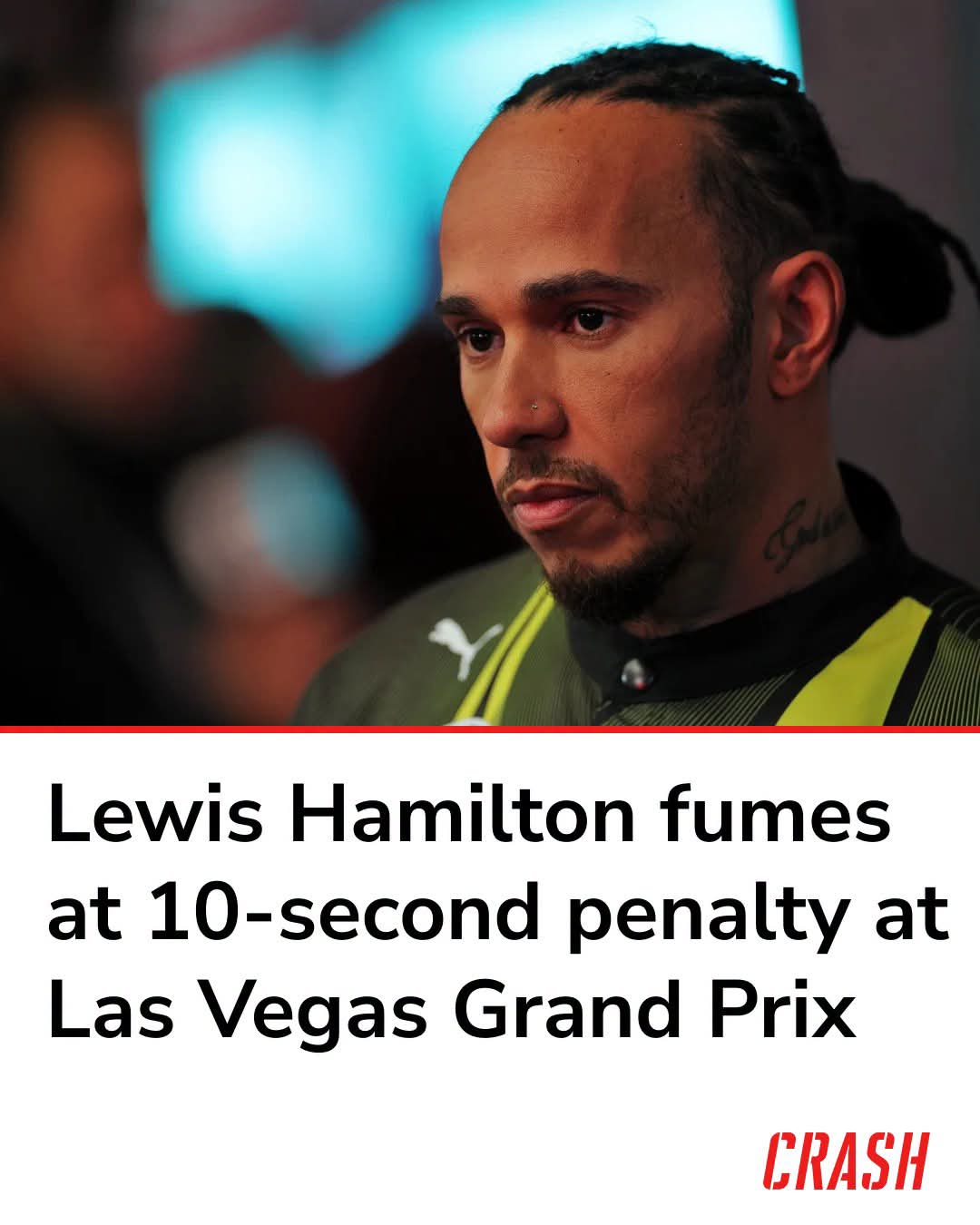
Lewis Hamilton’s night on the Las Vegas Strip turned into another chapter of frustration as the seven-time world champion questioned the fairness of a 10-second time penalty that derailed his early progress. The Ferrari driver made his feelings clear over team radio after stewards ruled he left the track and gained a lasting advantage while fighting McLaren’s Lando Norris. The incident has once again put Formula 1’s stewarding consistency under the spotlight at a critical stage of the 2026 season.
WHAT EXACTLY HAPPENED IN THE NORRIS BATTLE
Hamilton started the Las Vegas Grand Prix from 11th after a disappointing qualifying session that saw both Ferraris eliminated in Q2. He quickly fought his way into the points, mixing it with teammate Charles Leclerc and Norris in a tight midfield scrap for seventh place.
Around lap 12 or 13, the three cars arrived at the tight Turn 7-8 chicane. Norris attempted to pass Hamilton on the left. Stewards determined that Norris had his front axle at least alongside Hamilton’s mirror at the apex and was therefore entitled to the corner under the Driving Standards Guidelines. Hamilton remained alongside but crossed the white line on the exit, cutting the corner while staying ahead. He did not give the position back.
The FIA stewards reviewed video, timing data and onboard footage before issuing the standard 10-second time penalty for leaving the track and gaining a lasting advantage. Hamilton later served the penalty under a safety car period triggered by another incident, dropping from seventh to 14th before beginning a recovery drive that eventually brought him home in seventh.
HAMILTON’S FRUSTRATED RADIO RESPONSE
When race engineer Carlo Santi informed him of the penalty, Hamilton’s reaction was immediate and unfiltered. “Oh that’s b*******!” he said, before adding that turning in would have caused a crash. In a message that was not broadcast on the world feed, he went further and highlighted what he saw as a clear inconsistency.
“Isn’t that interesting? One race where someone is given mitigating circumstances, they give them five seconds and then they give me 10 seconds for avoiding an incident,” Hamilton told the team.
The comment was widely understood as a reference to Charles Leclerc receiving only a five-second penalty for a similar off-track offence in Mexico earlier in the season, when stewards cited mitigating factors. Hamilton himself had previously received a full 10-second penalty for a comparable incident in Mexico in 2025.
WHY THE CONSISTENCY DEBATE MATTERS SO MUCH
Formula 1 drivers have long argued that the application of track-limits and advantage rules can feel arbitrary from race to race. A five-second penalty in one event and a 10-second hit in another for similar circumstances creates uncertainty that affects strategy, risk-taking and race outcomes.
In Hamilton’s case, the timing made the punishment especially costly. Serving the 10 seconds under a safety car amplified the damage, forcing him deep into the pack and requiring a strong recovery just to finish in the points. For a driver still building his relationship with Ferrari and chasing every available result, those lost positions carry real weight in both the drivers’ and constructors’ championships.
The broader industry impact is significant. When high-profile drivers publicly question stewarding decisions, it fuels ongoing discussions about clearer guidelines, more consistent application of the rules, and greater transparency in how “mitigating circumstances” are defined. Fans, teams and commentators repeatedly call for the same standard to apply regardless of who is involved or which race it is.
THE FERRARI TEAM TENSIONS THAT COMPLICATED THE NIGHT
Hamilton’s penalty was only one part of a chaotic evening for Ferrari. Radio messages earlier in the race revealed rising friction between the two drivers as they fought for position among themselves and the McLarens. Hamilton at one point asked the team to tell Leclerc to “back the f*** off” while he tried to catch the cars ahead. Leclerc, for his part, warned that Hamilton needed to be careful with the way he was squeezing.
Later in the race the pair collided, with Leclerc spinning Hamilton. Stewards held Leclerc wholly to blame and handed him a 10-second penalty of his own. Hamilton recovered to seventh while Leclerc finished 10th after the penalty was applied.
The sequence underlines the high-stakes environment inside Ferrari this season. Two highly competitive drivers sharing the same garage inevitably create tension, especially when results have not always matched the team’s ambitions. Managing that dynamic while also dealing with external stewarding decisions adds another layer of complexity for the team leadership.
THE BIGGER PICTURE FOR F1 STEWARDING AND THE 2026 SEASON
Track-limits and lasting-advantage penalties remain among the most debated areas of the sport. The Las Vegas layout, with its narrow streets and limited runoff in places, only heightens the pressure on drivers to stay within the white lines while still racing hard. When space disappears and a driver chooses to avoid a collision by running wide, the question of whether they should be punished for preserving safety versus gaining position becomes especially grey.
Hamilton’s pointed comparison to the Mexico five-second decision will likely keep the conversation alive in the paddock. Drivers want predictability. Teams want to plan strategy knowing the rules will be applied the same way every weekend. The FIA has worked to refine guidelines, yet incidents like this show that subjective judgment still plays a large role.
Looking ahead, expect more scrutiny on how stewards handle similar situations in the remaining races. Clearer public explanations of why one incident receives mitigating circumstances and another does not would help reduce the sense of inconsistency that frustrates drivers and fans alike.
For Hamilton and Ferrari, the Las Vegas weekend was another reminder that strong pace alone is not enough when penalties and internal battles intervene. Hamilton’s recovery to seventh showed resilience, but the 10-second hit and the later contact with Leclerc cost the team valuable points. As the championship battle intensifies, both drivers and the team will need to find a way to race hard without repeatedly putting themselves in the stewards’ crosshairs.
The penalty itself may have been applied according to the letter of the current guidelines. Hamilton’s reaction, however, ensures the debate about fairness and consistency will continue long after the Las Vegas lights fade. In a sport where fractions of a second decide championships, the way those seconds are handed out by the stewards remains one of Formula 1’s most important and unresolved issues.