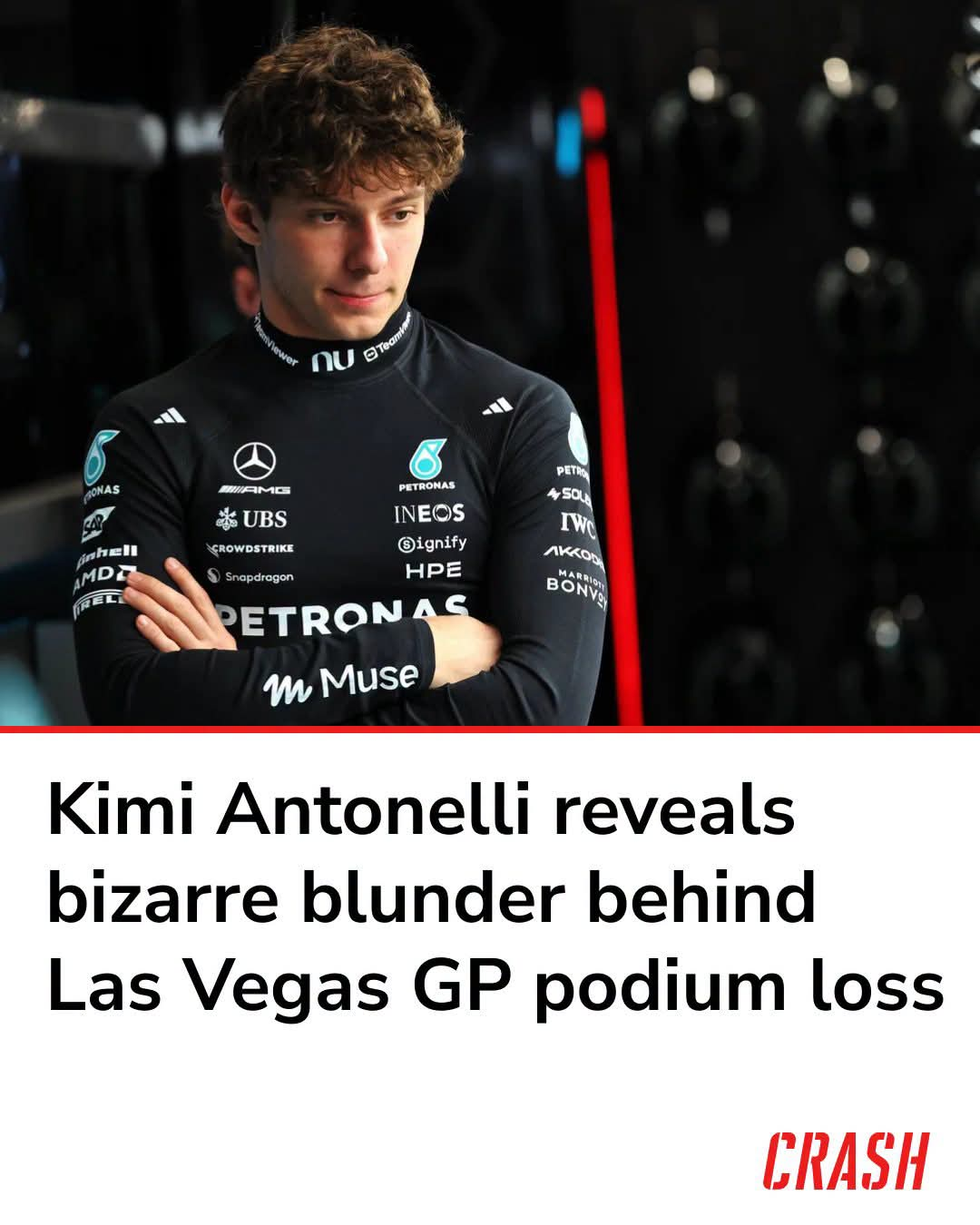
Kimi Antonelli has revealed the crucial mistake that ended his hopes of challenging Max Verstappen for victory at the 2026 Las Vegas Grand Prix, admitting that a decision to lift off the throttle on the final lap triggered an unexpected battery management problem that cost him valuable time.
The Mercedes driver had looked increasingly dangerous during the closing stages of Sunday’s race, positioning himself as Verstappen’s biggest threat after an impressive recovery from sixth on the grid.
However, just when the young Italian appeared ready to launch a decisive attack, his Mercedes suddenly lost electrical power. The resulting loss of performance not only ended his chances of fighting for the win but also allowed both McLaren drivers to overtake him.
Antonelli ultimately crossed the finish line in fourth place, missing out on what could have been a memorable victory.
ANTONELLI’S STRATEGIC BATTLE WITH VERSTAPPEN
The Las Vegas Grand Prix developed into an entertaining tactical contest, particularly during the second half of the race.
Antonelli had started sixth despite setting the fastest qualifying time. A five-place grid penalty following an engine change prevented him from converting his impressive qualifying performance into pole position.
His decision to start on medium tyres rather than softs also presented an additional challenge during the opening stages.
Nevertheless, the Mercedes youngster gradually worked his way back into contention, reaching fourth by lap 17 before becoming involved in the fight for the lead.
As the race progressed, Antonelli began applying pressure to Verstappen, with the two drivers repeatedly exchanging positions.
The nature of the Las Vegas circuit made overtaking particularly dependent on timing, straight-line speed and electrical energy deployment.
Neither driver wanted to surrender the advantage of following another car into the final stages of a lap, creating an unusual tactical battle in which track position was sometimes less important than preparing the perfect overtaking opportunity.
Antonelli understood that attacking too early could leave him vulnerable to a counterattack.
His intention was therefore to remain behind Verstappen until the final lap before attempting to use Mercedes’ remaining electrical energy to make a decisive move.
Unfortunately, that strategy produced an unexpected consequence.
THE BATTERY MANAGEMENT MISTAKE THAT CHANGED EVERYTHING
Antonelli explained that his problems began when he deliberately lifted off the throttle before Turn 14.
The Mercedes driver wanted to remain close to Verstappen while preserving the opportunity to use overtake mode during the final lap.
However, the adjustment triggered an unexpected response from the car’s energy management system.
According to Antonelli, lifting off and subsequently applying the throttle again disrupted the battery harvesting process, leaving him with virtually no electrical energy available when he needed it most.
Explaining what happened, the Italian admitted that the decision ultimately cost him his opportunity to fight for victory.
He revealed that the system was not prepared for the particular throttle adjustment, preventing the car from recovering the energy he expected to have available.
The consequences were immediate.
Antonelli lost almost two seconds along the straight, destroying his momentum and leaving him vulnerable to the approaching McLaren drivers.
Instead of entering the final lap with a realistic opportunity to attack Verstappen, he suddenly found himself defending against two much faster cars.
It was a frustrating conclusion to what had otherwise been an impressive performance.
MCLAREN CAPITALISES AS ANTONELLI LOSES THE PODIUM
The biggest beneficiaries of Antonelli’s battery problem were McLaren’s Lando Norris and Oscar Piastri.
Both drivers capitalised on the Mercedes driver’s sudden loss of speed, moving ahead and securing positions that Antonelli had appeared capable of defending.
Norris finished second behind Verstappen, while Piastri completed the podium in third after recovering from 17th on the grid.
For McLaren, the result represented an important reward for its race execution and the team’s ability to remain competitive throughout a demanding Grand Prix.
For Antonelli, however, the outcome was considerably more disappointing.
He had been involved in a genuine battle for the lead and appeared to have the pace necessary to challenge Verstappen until the final moments.
Instead, one unexpected energy management problem transformed a potential victory challenge into a fourth-place finish.
The incident also demonstrated how quickly fortunes can change in modern Formula 1, where electrical energy management can be just as important as mechanical grip, tyre performance and aerodynamic efficiency.
MERCEDES HAD THE SPEED TO CHALLENGE RED BULL
Despite the disappointing conclusion, Antonelli was keen to clarify that Mercedes did not simply lack the straight-line speed necessary to compete with Red Bull.
The Italian pointed out that Mercedes had deliberately opted for a lower-downforce configuration during the Las Vegas weekend.
Although this made the car more difficult to manage through certain corners, it provided an advantage on the long straights.
Interestingly, the Mercedes W17 recorded a higher top speed during the race than Verstappen’s Red Bull.
Antonelli’s car reached approximately 320.6km/h, compared with 314.3km/h for the Red Bull.
This suggests that Mercedes had the necessary performance to remain competitive in the most important sections of the circuit.
The problem was not necessarily a lack of speed but the inability to deploy the available electrical energy at the critical moment.
Antonelli indicated that Mercedes had something available for the final lap, but his mistake prevented him from taking advantage of it.
That distinction is important because it suggests the team could have challenged Verstappen more aggressively under different circumstances.
A VALUABLE LESSON FOR MERCEDES AND ITS YOUNG STAR
Although Antonelli will understandably be disappointed with the result, the experience could become an important learning opportunity.
Formula 1’s current generation of power units requires drivers to manage several competing priorities simultaneously.
They must balance acceleration, braking, battery harvesting, energy deployment and overtaking opportunities while maintaining tyre performance and controlling their position on the track.
A seemingly minor adjustment can therefore produce consequences that are not immediately obvious from the cockpit.
Antonelli’s decision was based on a reasonable tactical calculation. He wanted to remain behind Verstappen long enough to give himself the best possible opportunity to attack.
The problem was that the car’s energy management system did not respond as he expected.
For Mercedes, understanding precisely why the throttle adjustment disrupted battery harvesting will be important.
The team will want to ensure that similar situations do not compromise future opportunities, particularly when fighting for victories against experienced competitors.
Antonelli also needs to become increasingly comfortable making these decisions under pressure.
His speed is already evident, but consistently converting competitive performances into victories requires mastering the technical details that separate good drivers from exceptional ones.
WHAT THE LAS VEGAS RESULT MEANS FOR ANTONELLI’S FUTURE
One positive from the weekend is that Antonelli demonstrated the ability to recover from difficult circumstances.
Starting sixth after a grid penalty, he worked his way into contention and eventually became Verstappen’s principal challenger.
That performance should not be overshadowed by the final-lap mistake.
At this stage of his development, competing directly with established drivers such as Verstappen represents another important milestone.
The Italian has already demonstrated that he possesses the pace, confidence and racecraft required to compete at the front.
However, the Las Vegas incident highlights an area where additional experience could make a significant difference.
As Formula 1 becomes increasingly dependent on sophisticated energy management systems, drivers who understand precisely when to deploy, conserve and recover electrical power will enjoy a considerable advantage.
Antonelli’s ability to learn from this experience could prove particularly important in future championship battles.
THE BIGGER PICTURE: FORMULA 1’S ENERGY MANAGEMENT BATTLE
The incident also highlights an increasingly important aspect of modern Formula 1.
Speed alone is no longer enough to guarantee success.
Drivers must understand how to manage the complicated relationship between electrical deployment, battery recovery and overtaking opportunities.
The Las Vegas Grand Prix provided a particularly interesting example because the long straights encouraged drivers to think several corners ahead.
Remaining behind an opponent could sometimes provide a strategic advantage, but only if the driver managed the available energy correctly.
Antonelli attempted to execute precisely that strategy.
His mistake demonstrated how difficult it can be to calculate the perfect moment to sacrifice speed in preparation for a later attack.
For teams, this creates another layer of engineering and strategic complexity.
Mercedes, Red Bull and McLaren must ensure their drivers understand not only how much electrical energy is available but also how their driving inputs influence the system’s ability to recover and deploy that energy.
Small mistakes can have enormous consequences when the margins between victory and defeat are measured in fractions of a second.
FINAL VERDICT: ANTONELLI HAS THE SPEED, BUT THE DETAILS MATTER
Kimi Antonelli’s Las Vegas Grand Prix disappointment will undoubtedly hurt, particularly because he had a genuine opportunity to challenge Max Verstappen for victory.
His fourth-place finish does not tell the full story of what happened.
The Mercedes youngster had recovered impressively from his grid penalty, demonstrated competitive pace and positioned himself perfectly for a final-lap attack.
Unfortunately, an attempt to preserve his overtaking advantage triggered an unexpected battery management problem that effectively ended his challenge.
There is no question that Antonelli will want another opportunity to fight for victory under similar circumstances.
The encouraging news for Mercedes is that its young driver demonstrated enough speed to challenge one of Formula 1’s strongest competitors.
The next step is improving the technical decision-making that can determine the outcome of races at the highest level.
If Antonelli takes the right lessons from Las Vegas, this disappointment could become an important part of his development.
One thing is certain: he had the speed to challenge Verstappen, but in modern Formula 1, having the speed is only half the battle. Knowing exactly when to use your energy can make the difference between winning a Grand Prix and watching victory disappear on the final lap.Sources: