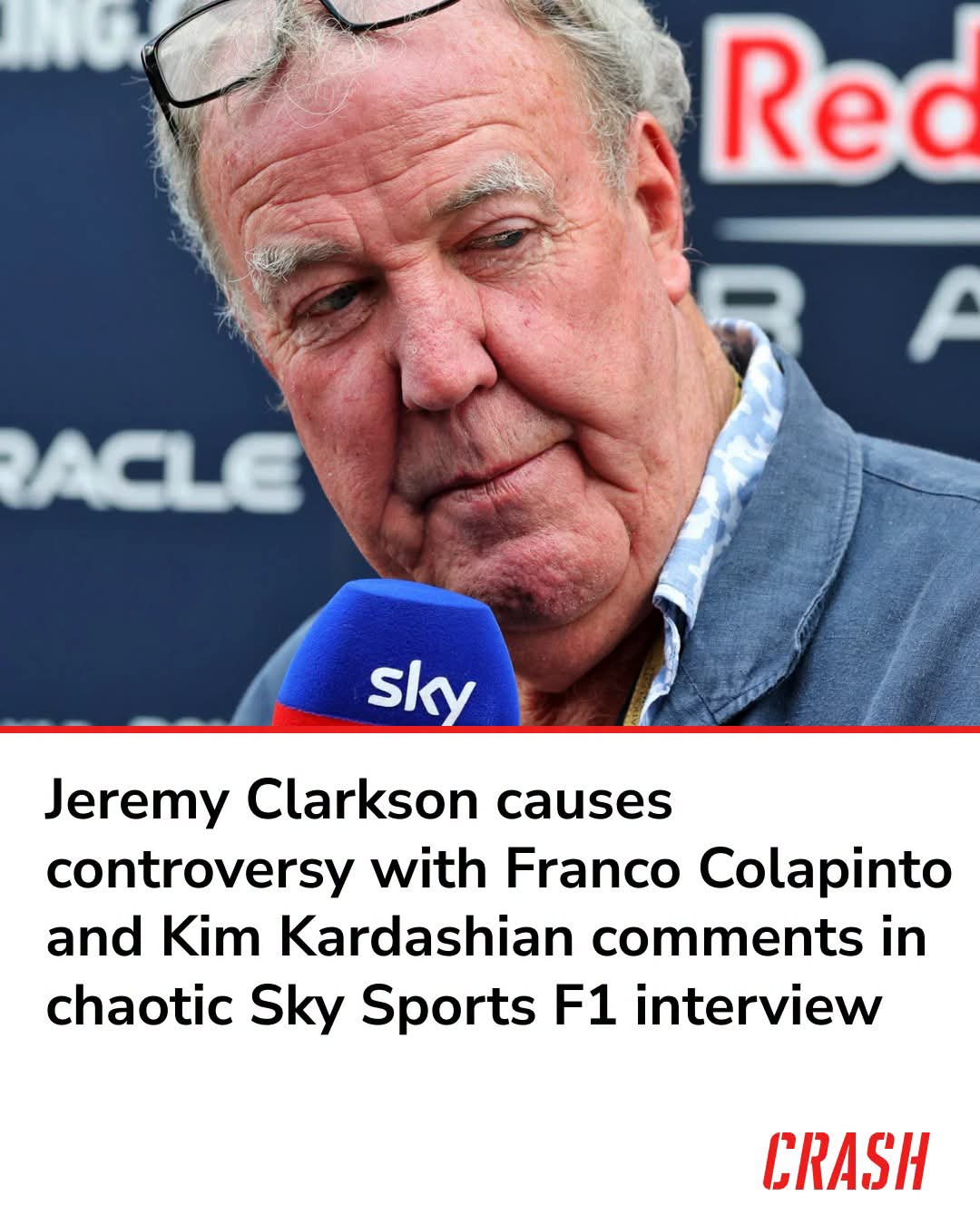
Jeremy Clarkson rarely does quiet. The former Top Gear host and Clarkson’s Farm star turned a routine paddock appearance at the 2026 United States Grand Prix into the weekend’s biggest talking point. Guest of the Alpine team at the Circuit of the Americas, Clarkson sat down with Sky Sports F1’s Martin Brundle, Naomi Schiff and Simon Lazenby and delivered two remarks that lit up social media: a pointed crack about Franco Colapinto’s grid penalty “for being Argentinian” and a dismissive take on Kim Kardashian’s presence in the sport.
The comments were classic Clarkson — blunt, nostalgic and deliberately provocative. But in 2026 Formula 1, where young drivers from new markets carry heavy national expectations and celebrity culture is tightly woven into the show, the fallout was immediate and revealing.
WHAT CLARKSON ACTUALLY SAID ABOUT COLAPINTO
Colapinto starts Sunday’s race with a 10-place grid drop after Alpine fitted a fourth control electronics unit this season, exceeding the three allowed under the regulations. Asked about Alpine’s prospects in Austin, Clarkson went straight to the young Argentine:
“Franco’s got a grid penalty for being Argentinian. Probably. Well, I’d give him one for that. But anyway, that’s just because of what happened when we went there.”
The reference was unmistakable. In 2014, Clarkson and the Top Gear team filmed a special in Patagonia. The Porsche he drove carried the number plate H982 FKL. Many Argentines read it as a coded jab at the 1982 Falklands War (known in Argentina as the Malvinas conflict). Protests erupted, the crew was forced to abandon the trip early, and the episode became one of the most controversial in Top Gear history. Twelve years later, Clarkson was still referencing it while standing next to Alpine’s own driver.
Martin Brundle chuckled and shook his head. Online, the reaction was far less amused.
ALPINE AND COLAPINTO’S CAMP RESPOND
Alpine moved quickly. Without naming Clarkson, the team issued a clear statement:
“We’re aware of the comments made in a recent TV interview from a guest of the team in Austin. We would like to reiterate that these are personal views and do not align with the team’s values of promoting kindness and respect. Franco is our driver and has our full support.”
Colapinto’s manager, Jamie Campbell-Walter, was more direct on X: “Jeremy Clarkson’s comments about Franco’s nationality were completely unacceptable. There is no place for remarks like this in Formula 1, regardless of who makes them or whether they were intended as a joke.”
The episode lands at a sensitive moment for Colapinto. The 23-year-old has already asked fans to stop directing abuse at his mechanics and engineers, saying the online hostility “crossed a few lines lately.” Adding a high-profile nationality dig from a guest of his own team only amplifies the pressure.
THE KIM KARDASHIAN DETOUR
Clarkson did not stop at Colapinto. When Lazenby asked whether his heart had melted watching Brundle finally interview Kim Kardashian in Singapore (after she had blanked the former driver in Monaco), Clarkson was characteristically unimpressed:
“I wasn’t watching that. Because I’m sort of not interested in Kim Kardashian if I’m honest. So I edited that bit out. No, I’m not interested. Why would I be interested in Kim Kardashian? I’m here to watch Formula 1, not Kim Kardashians. And all the cameras go, ‘Oh, Kim Kardashian’s here!’ Why do I care?”
The remark captured a real tension in modern F1. The sport has courted celebrity attendance for years — it brings eyeballs, social media reach and a certain glamorous sheen. Yet a significant portion of the traditional fanbase, and personalities like Clarkson, still bristle when the cameras linger on non-racing stars. Kardashian’s relationship with Lewis Hamilton has made her a regular grid presence; Clarkson’s blunt rejection of that reality felt like a throwback to an earlier, more insular era of the sport.
WHY THIS MOMENT MATTERS BEYOND THE SOUND BITES
On the surface this is just another Clarkson controversy. Dig deeper and it touches several live wires in current Formula 1.
First, the growing presence of Latin American talent. Colapinto is not just another young driver; he is Argentina’s first full-time F1 racer in a generation and a genuine national hero. National pride runs deep. A casual nationality-based joke from a high-profile British broadcaster, made while he was a guest of Colapinto’s team, was always going to land differently in Buenos Aires than it did in the British media.
Second, the responsibility that comes with guest access. Alpine invited Clarkson because of long-standing local ties — their Enstone factory sits near his Oxfordshire farm, and he has spoken warmly about the team as “our local team.” Hosting high-profile personalities is good for atmosphere and media coverage. It also carries risk. When those guests speak on live television wearing the team’s hospitality badge, the association is unavoidable, even if the team later distances itself.
Third, the broader conversation about what F1 wants to be. The sport is deliberately expanding its cultural footprint. Celebrity guests, fashion collaborations, and influencer presence are part of the growth strategy under Liberty Media. Clarkson’s “I’m here to watch Formula 1, not Kim Kardashians” line will resonate with fans who feel the sport is diluting its core product. At the same time, dismissing the new audience risks alienating the very people the commercial side is trying to attract.
IMPACT ON THE ATHLETES AND THE TEAM
For Colapinto the timing is awkward. He already faces a difficult race from the back of the grid. Adding an off-track controversy that questions his nationality, even in jest, creates an unnecessary distraction. Young drivers in F1 operate under intense scrutiny; national heroes even more so. The episode reinforces why teams and managers spend so much energy protecting drivers from external noise.
For Alpine the episode is a mild public-relations headache rather than a crisis. Their statement was swift and supportive of the driver. Still, it is a reminder that guest invitations come with messaging risk. In a sport where every weekend is a global media event, loose comments travel far.
Clarkson himself will almost certainly shrug it off. Controversy has been part of his brand for decades. The question is whether F1 teams will grow more cautious about which high-profile personalities they put in front of live microphones.
PREDICTIONS AND THE BIGGER PICTURE
Expect the story to dominate social media through the rest of the Austin weekend and then fade once the race lights go out. Colapinto will almost certainly address it with characteristic calm if asked; he has shown maturity beyond his years in handling both praise and criticism. Alpine will keep the focus on the track. Clarkson will move on to the next farm drama or car review.
Longer term, this moment may quietly influence how teams manage paddock guests. The sport is more global, more diverse, and more sensitive to national identity than it was in the Top Gear era. What once played as edgy British banter now risks being read as tone-deaf or worse.
Formula 1 has always thrived on strong personalities. Clarkson remains one of the biggest. But the paddock he walked into in 2026 is different from the one he knew in the 2000s and 2010s. The sport is richer, broader and more carefully curated. Moments like this test how well the old guard and the new reality can share the same microphone.
In the end, the real story is not that Jeremy Clarkson said something provocative. It is that Formula 1 still has not fully decided how much of the old chaotic energy it is willing to tolerate in service of the new, carefully managed global product. That tension is not going away any time soon.