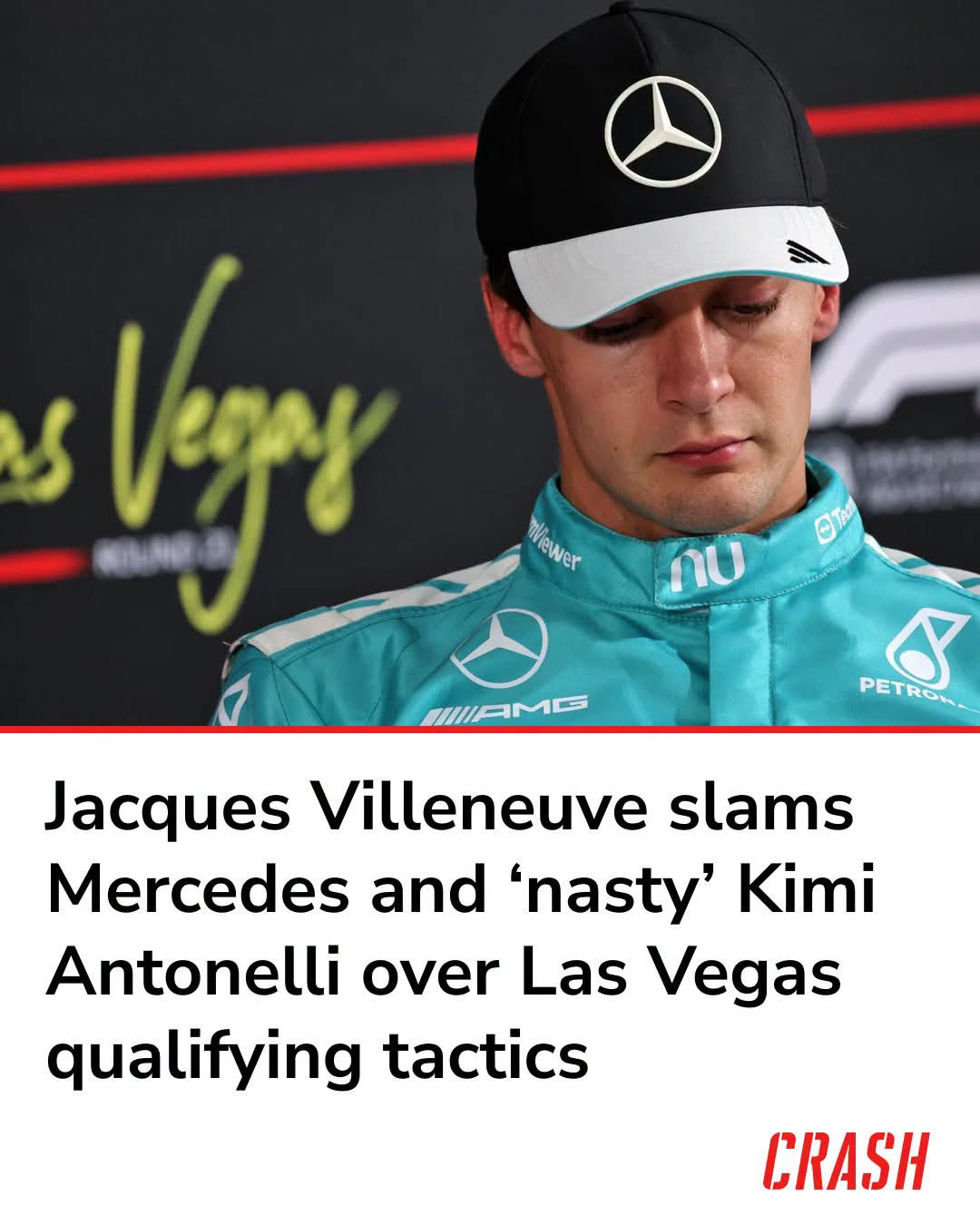
Jacques Villeneuve never minces words, and the 1997 Formula 1 world champion delivered another sharp assessment after qualifying for the Las Vegas Grand Prix. The Canadian accused Mercedes of failing to support George Russell and labelled Kimi Antonelli’s approach “a little bit nasty” after the newly crowned champion appeared unwilling to provide his teammate with a helpful tow.
In a session that produced a classic Sin City twist, Antonelli posted the fastest time in Q3. A five-place grid penalty for an engine change drops him to sixth, handing pole position to Max Verstappen. Russell qualified third and will start alongside the Red Bull driver on the front row. Yet the post-session conversation quickly shifted from lap times to team tactics and internal priorities.
WHAT ACTUALLY UNFOLDED ON THE LAS VEGAS STRIP
The final Q3 runs exposed the value of a well-timed slipstream on the long, high-speed sections of the Las Vegas circuit. Antonelli maximised the benefit of traffic ahead of him and delivered a strong lap. Russell improved on his final attempt but could not match the ultimate pace.
Mercedes team principal Toto Wolff later suggested Russell had been in a strong position, roughly four seconds behind the car ahead. Villeneuve rejected that framing on Sky Sports F1. He argued the team had not actively organised support for Russell and that the gap Russell found was largely of his own making. More pointedly, Villeneuve claimed Antonelli deliberately avoided positioning himself in a way that would assist his teammate, even though the Italian already knew a grid penalty would prevent him from starting on pole.
Jamie Chadwick, working the same broadcast, backed the view that the run order should have placed Russell behind Antonelli for the final push. The suggestion was clear: with the championship already decided, the team could have prioritised the driver still fighting for second in the standings.
WHY THIS CRITICISM CARRIES EXTRA WEIGHT
Villeneuve’s comments land at a sensitive moment for Mercedes. Antonelli has dominated the 2026 season and secured the drivers’ title with races to spare. Russell, once viewed as the natural successor after outperforming Lewis Hamilton in multiple campaigns, has spent much of the year in the younger driver’s shadow. The hierarchy inside the team has visibly shifted. Antonelli is widely regarded as Toto Wolff’s long-term project. Russell has had to recalibrate his status accordingly.
In that context, the decision not to engineer a clearer tow for Russell feels more significant than a simple strategic misstep. Las Vegas is a circuit where slipstream gains can decide pole. With Antonelli already carrying a penalty, the cost of helping Russell was low. The failure to do so invites questions about whether the team’s focus has fully moved toward protecting and developing its new champion at the expense of optimising every opportunity for the other car.
THE CHAMPIONSHIP AND TEAM IMPACT
Russell remains in a tight battle with Verstappen for second place in the drivers’ standings. Starting on the front row in Las Vegas gives him a genuine chance to score heavily and keep pressure on the Red Bull driver. A stronger qualifying result, potentially pole had the tow materialised, would have strengthened that position further.
For Mercedes the constructors’ title is already secure. The final races become an opportunity to gather data, test components and manage driver relationships heading into a new regulations era. Yet public criticism from a respected former champion highlights lingering friction. Drivers notice when support appears selective. Engineers and strategists notice when external voices question the team’s priorities. Over a long season these small signals can influence morale, radio communication and the willingness of drivers to fully buy into team orders.
Antonelli’s perspective also deserves consideration. Having locked up the title, he is entitled to push for personal results and prepare for future campaigns. Playing his own game is not inherently wrong. The optics change when that individual approach coincides with a teammate who still has championship points to fight for and when the team elects not to intervene.
LOOKING AHEAD TO THE RACE AND BEYOND
Sunday’s race on the Las Vegas Strip will test whether the qualifying tension carries over. Russell starts from second with a clear shot at victory or a strong podium. Antonelli begins from sixth and will need a strong first stint and effective strategy to climb. Verstappen starts from pole and will be difficult to pass if he converts the position cleanly.
Beyond this weekend the episode feeds a larger narrative about Mercedes’ internal balance. Russell needs strong results in the remaining races to protect his standing and market value. Antonelli needs to demonstrate continued professionalism and team-mindedness even after securing the title. Wolff and the leadership group must manage both drivers carefully as attention turns toward 2027.
Villeneuve’s assessment was characteristically blunt. Whether one agrees with every word, the underlying issue is real. In a sport defined by fine margins, the difference between organised support and leaving a driver to fend for himself can shape grid positions, race outcomes and the atmosphere inside a championship-winning team. Las Vegas simply made that reality highly visible under the bright lights of the Strip.