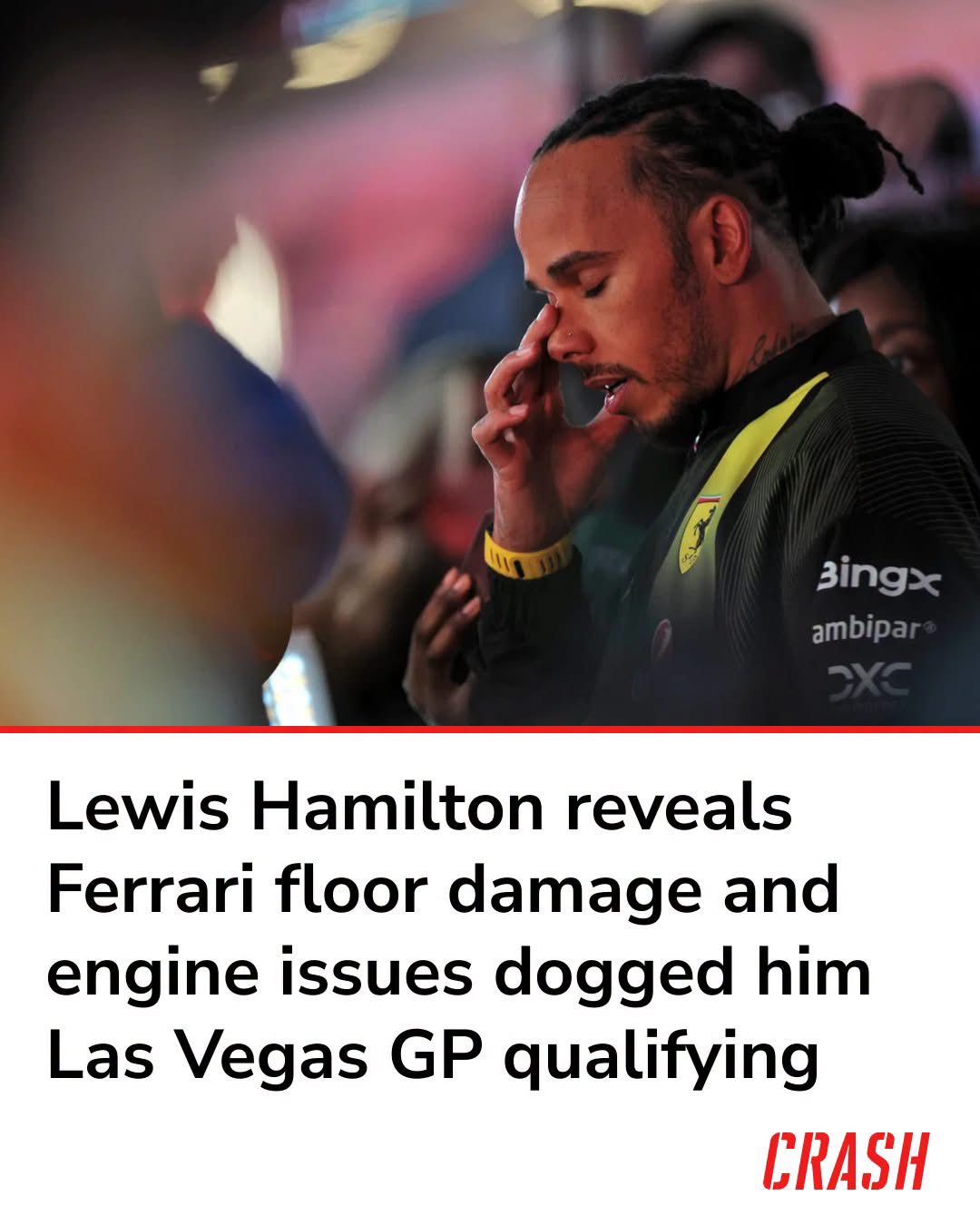
Lewis Hamilton’s difficult 2026 Formula 1 campaign has suffered another frustrating moment after the seven-time world champion revealed the technical problems that compromised his qualifying performance at the Las Vegas Grand Prix.
The Ferrari driver could only manage 12th place after struggling with a lack of grip throughout the session, missing out on Q3 by just 0.167 seconds. However, the result was not simply a case of failing to extract enough performance from the SF-26.
Hamilton revealed that floor damage and problems with energy deployment affected his Ferrari, leaving him with additional challenges during an already difficult qualifying session.
The situation also exposed a wider problem for Ferrari, with Charles Leclerc finishing 11th. For the first time since the 2025 Emilia-Romagna Grand Prix at Imola, neither Ferrari driver managed to reach Q3.
HAMILTON REVEALS TWO MAJOR FERRARI PROBLEMS
Hamilton entered qualifying hoping to produce a stronger performance, despite expecting Ferrari to struggle on Las Vegas’s long straights.
The circuit presents a particular challenge because its combination of high-speed sections, heavy braking zones and low-grip conditions demands a well-balanced car.
Hamilton admitted that he had been optimistic before qualifying, believing the Ferrari would be competitive enough to challenge for a place in the top ten.
However, the problems he encountered made that objective considerably more difficult.
Floor damage affected the car’s performance, while issues involving energy deployment created another complication. In modern Formula 1, electrical energy management is an important part of lap-time performance, particularly on circuits where drivers spend significant periods accelerating along long straights.
When a driver cannot deploy energy as expected, it can compromise acceleration and make it harder to compete with rivals who are extracting maximum performance from their power units.
Combined with the lack of grip Hamilton experienced, those problems left him unable to produce the lap needed to secure a Q3 appearance.
FERRARI SUFFER DOUBLE BLOW AS LECLERC ALSO STRUGGLES
Hamilton was not the only Ferrari driver left disappointed.
Leclerc finished 11th, narrowly ahead of his teammate, meaning both cars were eliminated before the final qualifying shootout.
For a team with Ferrari’s history and expectations, failing to reach Q3 with either car represents a significant disappointment.
The result is particularly frustrating because Ferrari entered the weekend with the opportunity to challenge for a stronger starting position.
Instead, the team found itself struggling to extract performance from the SF-26 when it mattered most.
There is also an important distinction between the two drivers’ situations. Hamilton identified specific technical problems affecting his car, while Leclerc’s elimination added to the overall disappointment for the team.
Ferrari will need to examine the data carefully to establish whether the problems were isolated to Hamilton’s car or part of a wider performance issue.
WHY FLOOR DAMAGE IS SUCH A BIG PROBLEM IN FORMULA 1
Floor damage can have a major effect on a modern Formula 1 car because the underfloor plays an important role in generating aerodynamic downforce.
The floor helps control airflow beneath the car, creating the aerodynamic performance that allows drivers to maintain speed through corners.
Even relatively small damage can disturb that airflow and reduce the car’s ability to generate consistent downforce.
For Hamilton, who was already struggling with grip, any loss of aerodynamic performance would have made qualifying even more difficult.
The problem becomes especially frustrating when a driver is fighting for fractions of a second. Hamilton missed Q3 by only 0.167 seconds, meaning even a relatively small performance loss could have influenced the final result.
However, the precise amount of time lost through the damage has not been established from the available information.
ENERGY DEPLOYMENT ADDS ANOTHER HEADACHE FOR FERRARI
The second issue involving energy deployment is equally important.
Formula 1 power units combine conventional engine performance with electrical energy, and teams must carefully manage how that energy is harvested and deployed throughout a lap.
On a circuit such as Las Vegas, where long straights place considerable importance on acceleration and top speed, energy management can influence qualifying performance.
A driver who cannot deploy energy effectively may lose valuable time against competitors with a more efficient system.
Hamilton’s difficulties therefore involved more than simply finding grip around the circuit. He was also dealing with a power-unit-related performance problem that potentially limited his ability to maximise the Ferrari’s speed.
Ferrari will need to investigate the circumstances behind the issue before determining whether it could affect the remainder of the weekend.
CAN HAMILTON RECOVER IN THE LAS VEGAS GRAND PRIX?
Despite the disappointing qualifying result, Hamilton’s race weekend is not necessarily over.
Starting 12th leaves him with work to do, but the Grand Prix could provide opportunities to recover positions depending on tyre strategy, race pace, safety cars and the performance of the cars ahead.
Las Vegas can also produce unpredictable conditions, making race execution particularly important.
However, Ferrari cannot afford to ignore the technical problems identified during qualifying. The team must establish whether the floor damage can be repaired and whether the energy deployment issue can be resolved before the race.
Hamilton will need a cleaner and more competitive car if he is to challenge for meaningful points.
FERRARI NEED ANSWERS AFTER ANOTHER FRUSTRATING WEEKEND
The biggest concern for Ferrari is that both drivers failed to reach Q3, turning qualifying into another difficult moment for the Italian team.
Hamilton’s explanation provides some clarity about why his own session went wrong, but it also places pressure on the engineers to understand the extent of the problems.
With the 2026 championship approaching its final stages, every remaining opportunity to secure strong results matters.
Ferrari need reliability, aerodynamic consistency and effective energy management if they are to avoid further disappointments.
For Hamilton, the immediate priority is putting the qualifying frustration behind him and finding a way to recover during the Grand Prix.
The seven-time champion has the experience to manage difficult races, but even the most accomplished driver cannot overcome every technical limitation from inside the cockpit.
Las Vegas has already exposed weaknesses in Ferrari’s performance. Whether the team can correct them before Sunday’s race will determine how damaging this qualifying setback ultimately becomes.