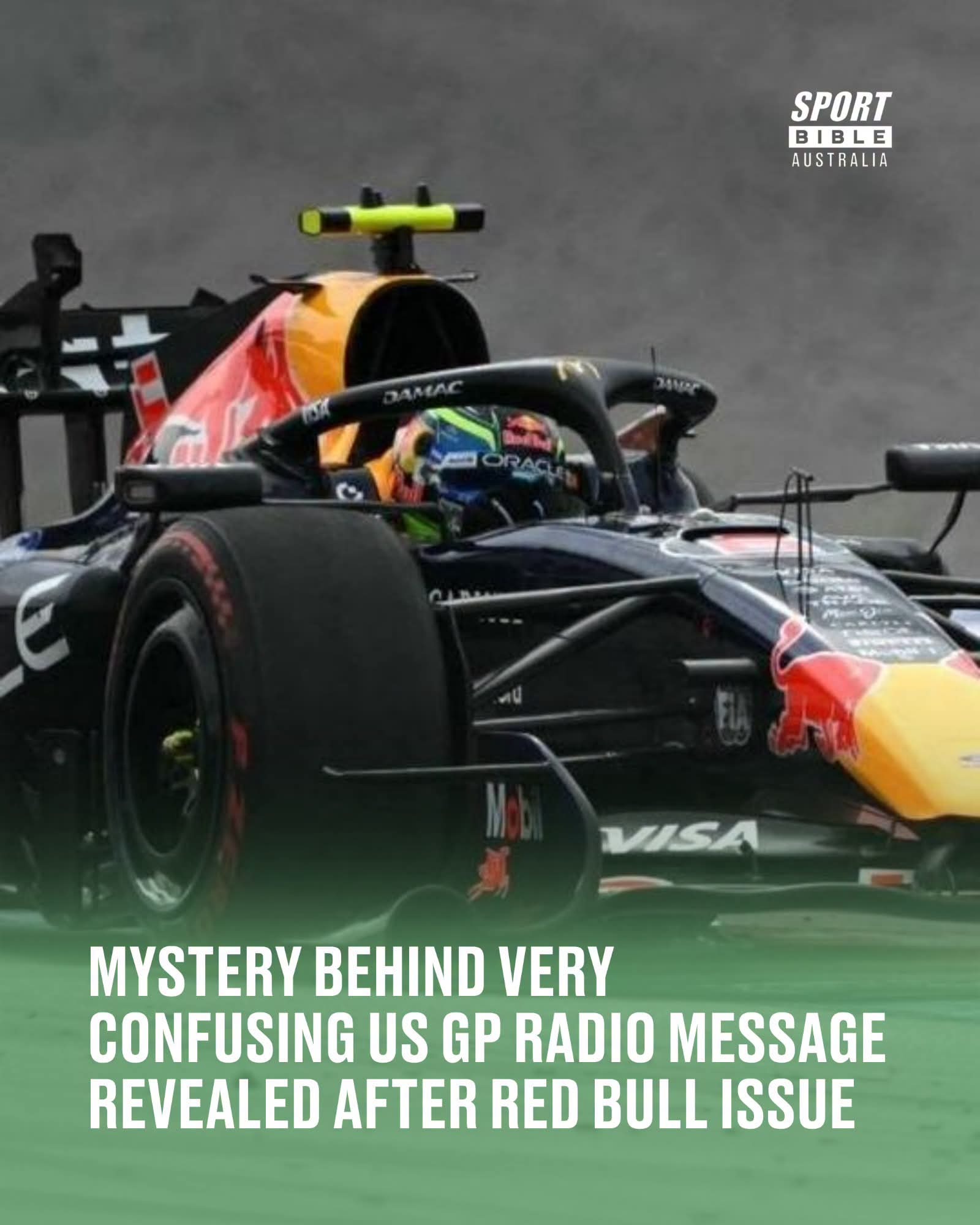
Isack Hadjar has revealed how communication problems and an overlooked cockpit setting contributed to a frustrating United States Grand Prix, exposing another weakness Red Bull Racing must address if it hopes to improve its performance.
The Frenchman finished sixth at the Circuit of the Americas, an impressive result on paper, but his race was complicated by radio difficulties and a throttle-map setting that reportedly remained unchanged after his pit stop. The combination cost him valuable time during his second stint and left him struggling to extract the maximum performance from his car.
Hadjar’s difficulties also added to Red Bull’s growing list of concerns after Max Verstappen experienced similar communication problems during the Austin weekend. While the team continues to investigate the radio issue, Hadjar’s experience suggests that seemingly small operational mistakes can have significant consequences during a tightly contested Formula 1 race.
WHY ISACK HADJAR WAS FRUSTRATED WITH RED BULL
Hadjar’s frustration became apparent after his first pit stop, when he questioned the decision to put him on the hard tyres for his remaining stint.
According to Motorsport.com, radio problems meant Hadjar was communicating with race engineer Richard Wood while exiting the pit lane. During that process, he reportedly failed to change the throttle-map setting on his steering wheel, leaving the car operating with a setting that was not appropriate for the stint.
The consequence was more serious than a simple inconvenience. Reports indicated that Hadjar had to apply approximately 40 per cent throttle before the pedal responded as expected, making it more difficult to control the car consistently.
In Formula 1, throttle response is particularly important when drivers accelerate out of corners. Applying power smoothly helps maintain traction and limits unnecessary wheelspin, which can increase tyre wear and reduce performance over a stint.
Hadjar was already trying to manage the hard tyres, and the additional complication made his task considerably more difficult.
HADJAR CLAIMS HE WAS LOSING A SECOND PER LAP
The Red Bull driver explained that poor radio reception prevented him from hearing important messages from the team while he was in the pit lane.
“I have poor radio coverage,” Hadjar said. “I can’t hear what’s happening in the pits. Then I leave the pits with the wrong map, and then I’m losing a second a lap, every lap, on that hard tyre.”
If accurate, a loss of around one second per lap represents a substantial disadvantage in Formula 1. Over a long stint, that deficit can quickly undermine a driver’s position, particularly when rivals are running at competitive pace.
The problem also illustrates how communication failures can create a chain reaction. A driver who cannot hear instructions may miss an important setting adjustment, leaving the car in a compromised state before the next phase of the race has even begun.
Hadjar’s comments suggest that the issue was not simply about whether the hard tyres were the right strategic choice. The car’s settings and the driver’s ability to communicate with his engineer also affected how effectively he could use those tyres.
RED BULL’S RADIO PROBLEMS ARE BECOMING A BIGGER CONCERN
Hadjar’s experience was particularly concerning because Verstappen had also been affected by communication difficulties during the United States Grand Prix.
When problems affect more than one driver within the same organisation, the team must determine whether the cause lies with individual equipment, car systems, the circuit environment or another part of its communication setup.
Red Bull team principal Laurent Mekies acknowledged that the team had not fully understood why the issue was occurring.
“If we were understanding it we would have solved it,” Mekies said, explaining that the team was still struggling to identify the source of the problem.
His comments underline the challenge facing Red Bull. Radio communication is a fundamental part of modern Formula 1, allowing drivers and engineers to coordinate strategy, respond to changing conditions and make adjustments during a race.
Even a brief interruption can have consequences when a driver needs immediate guidance. If the problem persists, it can undermine confidence and make an already demanding race more difficult to manage.
Red Bull will therefore need to identify the cause and establish a reliable solution before the same issue affects another race weekend.
HADJAR SAYS RED BULL COULD BE FIGHTING FOR PODIUMS
Despite his frustration, Hadjar believes Red Bull has the potential to achieve better results if the team resolves its operational problems.
“At the moment, it’s the little things we can’t do,” he explained, pointing to the radio difficulties and the team’s clutch problems at race starts.
He added: “We fix these two, we might be on the podium.”
The comment is significant because it reflects Hadjar’s belief that the team’s difficulties are not necessarily the result of a fundamental lack of speed alone. Instead, he sees several recurring problems preventing Red Bull from converting its potential into stronger results.
The team’s clutch issues have reportedly affected starts for both Hadjar and Verstappen, while communication problems have introduced another source of uncertainty.
However, Hadjar’s podium suggestion remains his assessment rather than proof that Red Bull would have finished in the top three without those issues. Race results depend on multiple factors, including rivals’ pace, tyre strategy, traffic and the timing of safety-car interventions.
Even so, his comments highlight the importance of eliminating preventable mistakes. At the front of Formula 1, small performance losses can separate a podium finish from a position further down the order.
LEWIS HAMILTON OVERTAKES HADJAR AFTER SECOND PIT STOP
Hadjar eventually finished sixth, 34 seconds behind race winner Andrea Kimi Antonelli. However, he was unable to hold off Ferrari’s Lewis Hamilton, who overtook him shortly after Hadjar made his second pit stop on lap 38.
Hamilton’s fresher tyres helped him attack, while Hadjar was dealing with the consequences of a difficult stint. The overtake demonstrated how quickly the competitive picture can change when one driver has a tyre advantage and another is struggling to maximise performance.
Hamilton potentially had an opportunity to challenge Verstappen for third place in the closing stages, but a virtual safety car was deployed after Valtteri Bottas suffered an engine failure on lap 52. The neutralisation ultimately limited Hamilton’s opportunity to make further progress.
For Hadjar, sixth place was still a useful result, but the circumstances left questions about what might have been possible with a cleaner race.
RED BULL MUST FIX THE SMALL PROBLEMS BEFORE THEY BECOME BIGGER
Red Bull’s challenge now extends beyond finding more outright pace. The team must also improve the reliability of its communication systems, address its reported clutch problems and ensure that important cockpit settings are handled correctly during pit stops.
Hadjar’s Austin experience demonstrates how several small complications can combine to undermine a driver’s performance. A radio problem can lead to a missed instruction, an incorrect setting can affect throttle response, and the resulting loss of time can leave a driver vulnerable to rivals.
These issues are especially costly for a team competing against Mercedes and Ferrari, where the margins between positions can be narrow.
Red Bull has the opportunity to learn from the United States Grand Prix, but the team’s response will matter more than the frustration expressed afterwards. Mekies and his engineers need to establish why the radio problems are happening and introduce measures that prevent similar mistakes.
Hadjar’s sixth-place finish showed that he could still secure points despite the difficulties. His message, however, was clear: Red Bull cannot afford to keep losing performance through problems that should be within the team’s ability to investigate and resolve.
If the team addresses these weaknesses, Hadjar believes a podium could become a realistic target. Until then, Red Bull risks allowing avoidable operational issues to overshadow the performance it is capable of delivering.