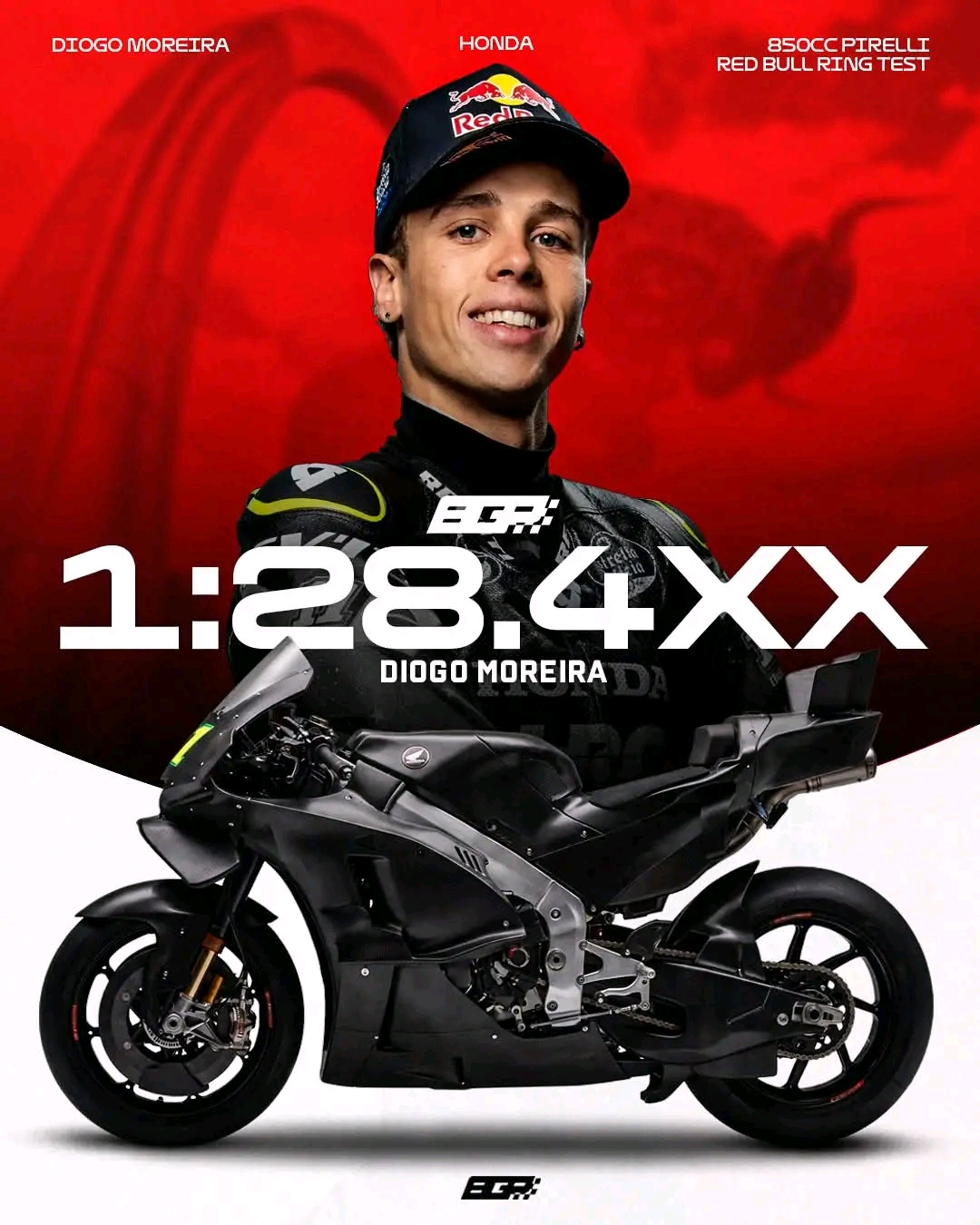
Honda enjoyed an encouraging test in Austria, topping the 850cc Pirelli test with a radical new front-fairing aerodynamic design…Honda Leads 850cc Pirelli Test in Austria with Radical New Aero Design
Honda has made an encouraging start to the development of its next-generation MotoGP machinery, emerging at the front of the timesheets during the latest 850cc Pirelli test in Austria.
The Japanese manufacturer used the session to evaluate several development components, with particular attention focused on a radical new front-fairing aerodynamic design. The unconventional bodywork immediately attracted attention in the paddock, offering an early glimpse at Honda’s approach to the technical challenges presented by the upcoming 850cc era.
While testing lap times must always be considered in context, Honda’s performance provides a positive indication for a manufacturer determined to make progress with its future project. The Austrian session allowed Honda to gather valuable information while also comparing its latest aerodynamic ideas against existing concepts.
Radical aerodynamic approach
The front fairing was the most visible element of Honda’s test programme. Aerodynamics have become an increasingly important part of MotoGP development, influencing everything from braking stability and cornering behaviour to acceleration and rider confidence.
Honda’s new design appears to be aimed at controlling airflow around the front of the motorcycle while generating the aerodynamic characteristics required by the smaller-capacity engine regulations.
The 850cc formula will bring a number of technical changes to MotoGP. Manufacturers will need to rethink their approach to engine performance, chassis balance, electronics and aerodynamics. As a result, testing unusual solutions now could provide valuable information before the new technical regulations become fully established.
For Honda, the Austrian test was therefore about much more than chasing the fastest lap.
Engineers will have been collecting data on how the motorcycle responds under heavy braking, how stable it remains through high-speed corners and how the aerodynamic package influences the behaviour of the tyres.
Pirelli tyre development adds another dimension
The involvement of Pirelli adds another important element to the testing programme. Tyre performance will be crucial to the success of the new generation of MotoGP machines, and manufacturers need to understand how their aerodynamic concepts interact with the tyres.
Additional aerodynamic load can alter the way a motorcycle behaves throughout a lap. While greater stability can be beneficial under braking and corner entry, engineers must also ensure that the bike remains agile and predictable for the rider.
Honda’s engineers will therefore be studying much more than headline lap times. Data collected over longer runs, tyre degradation and rider feedback will all help determine whether the new fairing concept deserves further development.
The fact that Honda finished the test at the top nevertheless provides an encouraging reference point.
Austria offers a demanding test
The Red Bull Ring in Austria provides a useful environment for testing the new machinery. The circuit features heavy braking zones, long acceleration sections and several fast corners, placing different demands on the motorcycle’s aerodynamic and mechanical performance.
A motorcycle that performs well in Austria needs to be stable during braking while also delivering strong acceleration and maintaining confidence through the faster sections.
That makes the circuit a useful laboratory for manufacturers experimenting with new aerodynamic concepts.
Honda’s performance suggests that the latest package is already capable of producing competitive performance, although a single test cannot provide a definitive picture of the competitive order.
Manufacturers frequently use testing sessions for different purposes. One rider may be concentrating on qualifying-style performance, while another could be completing long runs or evaluating experimental components. Fuel loads, tyre choices and engine settings can also have a significant influence on lap times.
As a result, Honda’s position at the top of the timesheets should be viewed as an encouraging development rather than proof of where the manufacturer will stand once the new regulations are fully implemented.
A crucial period for Honda
The test comes at an important time for Honda as it continues to develop its future MotoGP strategy. The manufacturer has been exploring different technical solutions as it looks to improve its competitiveness, and the arrival of the 850cc regulations represents a fresh opportunity.
Developing a new motorcycle from the ground up allows Honda to incorporate lessons learned from its current machine while also responding to the demands of the new rules.
The radical front fairing demonstrates that Honda is willing to experiment. Not every prototype component tested in MotoGP eventually reaches the final race machine, but even unsuccessful concepts can provide valuable information.
Honda will now have to analyse the Austrian data carefully before deciding which elements of the package should move into the next stage of development.
Further testing will be particularly important as engineers determine whether the aerodynamic gains seen in Austria can be reproduced across different circuits and conditions.
For now, however, Honda has plenty of reasons to be encouraged.
Leading the 850cc Pirelli test while introducing an eye-catching aerodynamic concept gives the manufacturer an interesting starting point for the next phase of development. The Austrian session may only be one step in a long testing programme, but it has provided Honda with valuable data and an early indication that its new approach could have potential.
With the 850cc era bringing a major technical reset to MotoGP, Honda’s willingness to explore radical solutions could make its development programme one of the more closely watched as preparations continue.