George Russell’s sensational pole position for the 2026 Austrian Grand Prix has survived intense scrutiny after the FIA ruled that the Mercedes driver complied with yellow flag regulations during the closing moments of qualifying. What initially looked set to become one of the biggest controversies of the Formula 1 season has instead become a fascinating case study in how modern FIA regulations are interpreted.
The decision immediately sparked debate throughout the paddock and among fans, especially after Max Verstappen’s dramatic crash appeared to unfold directly in Russell’s path. While many expected the Mercedes driver to lose his fastest lap, race control ultimately determined that he had reduced his speed sufficiently under a single yellow flag, allowing him to keep pole position.
VERSTAPPEN’S CRASH TRIGGERED A DRAMATIC FINISH
Qualifying reached its climax when Max Verstappen launched one final attempt to challenge the Mercedes drivers for pole. The Red Bull star was showing impressive pace through the opening sectors before disaster struck.
Entering the fast Turn 9 right-hander, Verstappen suddenly lost control of his RB22 after a violent snap of oversteer. The reigning world champion spun heavily into the barriers, instantly bringing out local yellow flags and throwing the remainder of the session into chaos.
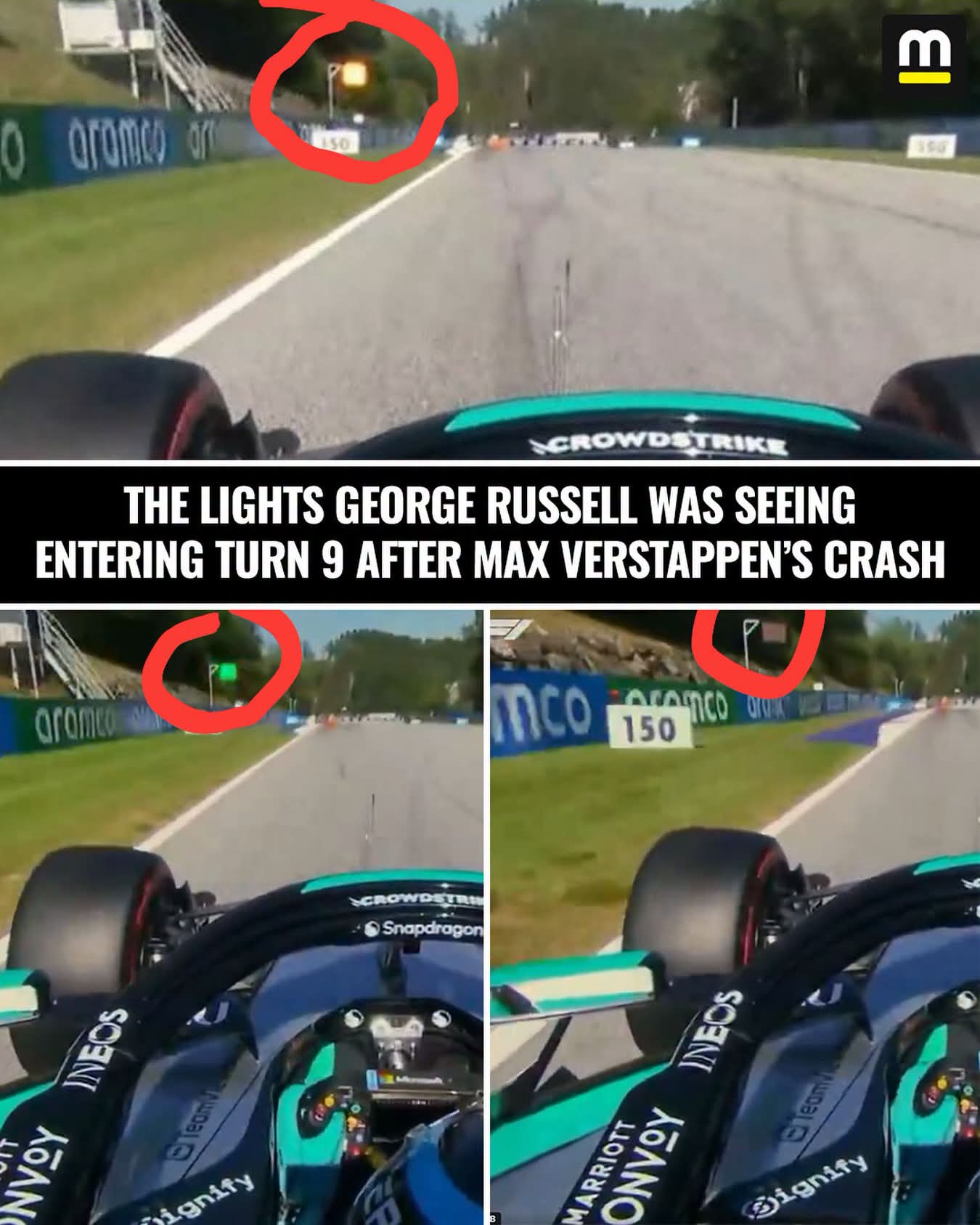
Russell was only seconds behind the accident scene and had already committed to his flying lap. Instead of abandoning the attempt, he lifted off the throttle as he approached the incident before accelerating once he had safely passed the danger zone. Moments later, he crossed the finish line with a stunning lap of 1:06.113, beating Ferrari’s Charles Leclerc by more than two tenths of a second.
WHY THE FIA DECIDED NOT TO PENALIZE RUSSELL
Immediately after qualifying, Russell’s lap came under review for a possible yellow flag infringement. However, the FIA quickly concluded there was no breach of the regulations.
Telemetry showed that Russell lifted significantly before entering Turn 9, sacrificing roughly one-and-a-half tenths compared to his previous attempt. Under the 2026 Formula 1 Sporting Regulations, drivers encountering a single yellow flag must clearly reduce speed and be prepared to change direction.
Crucially, the rules do not require drivers to abandon their lap entirely if only a single yellow is displayed. They simply need to demonstrate a noticeable reduction in speed.
After comparing Russell’s data with his earlier laps, race officials determined he had fulfilled that requirement. As a result, no investigation was launched and his pole position remained intact.
THE DIFFERENCE BETWEEN A SINGLE AND DOUBLE YELLOW
Much of the confusion surrounding the incident stemmed from the distinction between single and double yellow flags.
A single yellow requires drivers to reduce speed while remaining alert to potential hazards ahead. If officials are satisfied that a driver has clearly lifted or braked, they may continue their lap.
A double yellow, however, carries much stricter requirements. Drivers must slow dramatically, be prepared to stop if necessary, and cannot legitimately improve their lap time through that sector. Any competitive lap under double yellows would almost certainly be deleted.
The Verstappen accident was still being managed under a single yellow when Russell arrived at Turn 9, which ultimately proved decisive in the FIA’s ruling.
ANTONELLI’S DECISION ADDED TO THE CONFUSION
Mercedes teammate Andrea Kimi Antonelli reacted very differently to the yellow flags.
Believing he had encountered a double yellow, the championship leader immediately abandoned his lap and returned to the pits, sacrificing what could have been another front-row start.
Mercedes team principal Toto Wolff later explained that Antonelli had mistakenly interpreted the marshal signals.
According to Wolff, Russell correctly recognized that only a single yellow was being displayed, executed the required lift, and then continued pushing once he had safely cleared the incident. Data from the team’s telemetry confirmed that Russell’s reduction in speed met the FIA’s expectations.
MERCEDES CONTINUES ITS IMPRESSIVE MOMENTUM
The ruling capped another outstanding qualifying performance for Mercedes, whose pace has steadily improved throughout the 2026 campaign.
Russell’s pole position follows another strong weekend for the Silver Arrows, while Antonelli’s consistency continues to keep him firmly at the top of the Drivers’ Championship. The team now appears to possess one of the fastest packages over a single lap, a major turnaround compared to the uncertainty that surrounded Mercedes during the opening races of the season.
Starting from pole also gives Russell a valuable opportunity to reduce the gap to Antonelli in the championship, with every point becoming increasingly important as the title battle intensifies.
WHAT THIS MEANS FOR THE AUSTRIAN GRAND PRIX
Although the FIA has officially closed the matter, the debate is unlikely to disappear anytime soon. Fans, rival teams, and former drivers remain divided over whether the current interpretation of single yellow regulations offers enough protection during qualifying sessions.
Ferrari, however, will take confidence from locking out second and third on the grid with Charles Leclerc and Lewis Hamilton, while Verstappen faces another recovery drive after his costly qualifying crash.
The race itself now promises multiple storylines. Russell must convert pole into victory, Ferrari has a genuine opportunity to challenge Mercedes on race pace, Antonelli will attempt to protect his championship lead from fourth, and Verstappen will once again try to fight his way through the field.
If Saturday’s qualifying drama is any indication, Sunday’s Austrian Grand Prix could become another pivotal chapter in what is rapidly developing into one of Formula 1’s most competitive and unpredictable seasons.