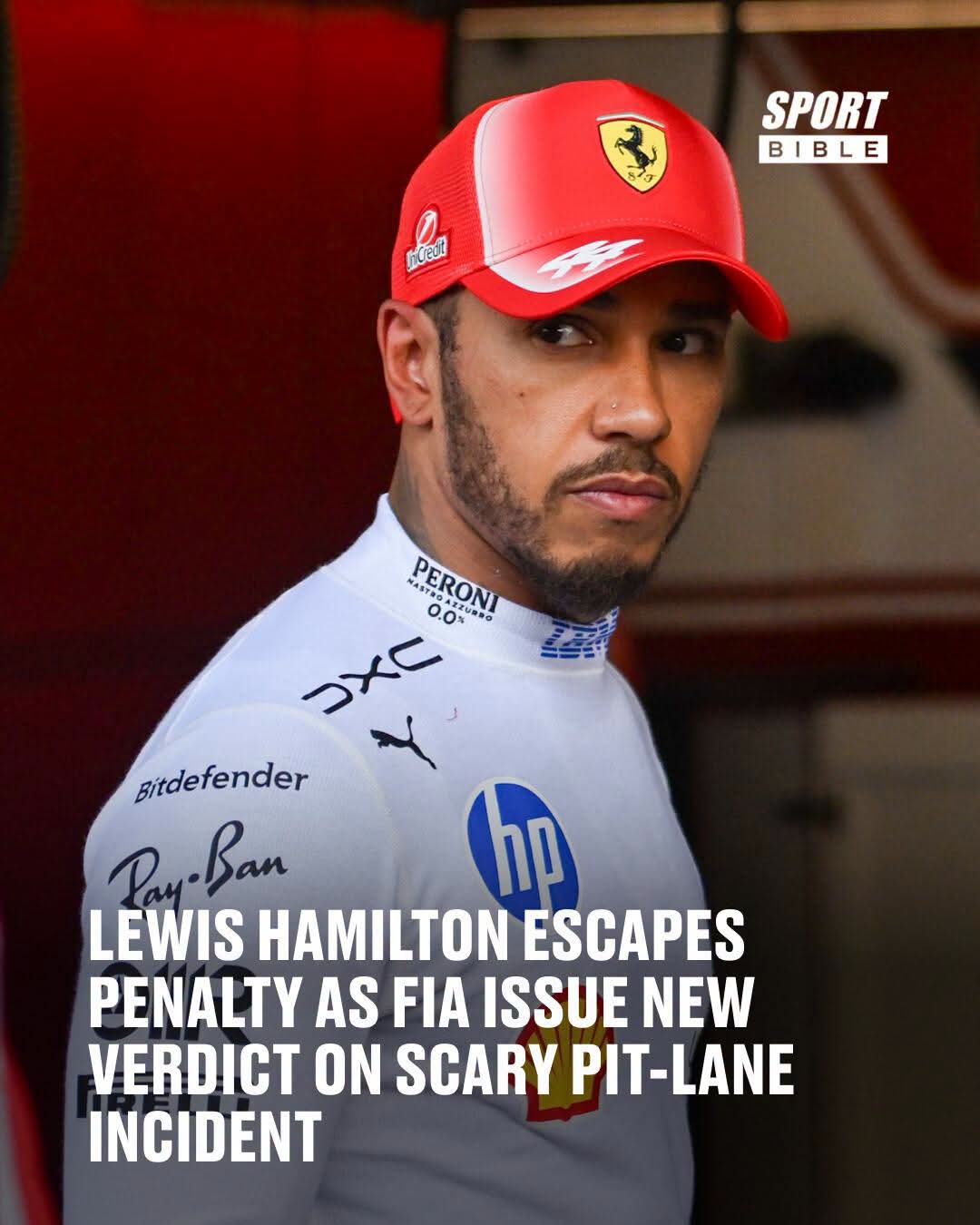
The Belgian Grand Prix delivered no shortage of controversy, but one question dominated Formula 1 discussions after the chequered flag: why was Lewis Hamilton penalised while Charles Leclerc escaped punishment despite both Ferrari drivers being involved in contact at the same corner?
The FIA has now released detailed explanations for both decisions, shedding light on the contrasting rulings that shaped the outcome of one of the most dramatic races of the 2026 Formula 1 season. While many fans initially viewed the incidents as similar, the stewards concluded that key differences in positioning, racing rights, and available space justified two completely different outcomes.
With the Drivers’ Championship entering a critical phase, those rulings could prove influential in determining the destination of the 2026 world title.
HAMILTON’S OPENING-LAP COLLISION CHANGED THE CHAMPIONSHIP PICTURE
The biggest talking point came within seconds of the race beginning.
Lewis Hamilton and George Russell found themselves battling wheel-to-wheel through the Kemmel Straight before arriving at the Les Combes chicane. As both drivers fought aggressively for position, Hamilton’s Ferrari developed significant understeer mid-corner, causing his front-left wheel to make contact with Russell’s Mercedes.
The collision spun Russell into the gravel trap, forcing the Mercedes driver into an immediate retirement and ending what had been another crucial opportunity to score championship points.
For Hamilton, however, the race continued—but not without consequences.
After reviewing multiple camera angles, telemetry, steering traces, and onboard footage, the FIA issued the Ferrari driver a five-second time penalty for causing the collision.
WHY THE FIA FOUND HAMILTON RESPONSIBLE
According to the FIA’s official explanation, George Russell had established sufficient overlap before entering the corner, giving him the right to racing room alongside Hamilton.
Although Hamilton acknowledged Russell’s position and attempted to avoid contact, the stewards determined that his Ferrari failed to maintain adequate separation after suffering front-end grip loss.
Importantly, the FIA did not accuse Hamilton of making an aggressive or reckless move.
Instead, officials accepted that the collision resulted from genuine understeer rather than intentional contact.
That distinction ultimately reduced the punishment.
Normally, causing a collision of this nature could result in a 10-second penalty. However, because the incident occurred on the opening lap—when cars are tightly packed, grip levels remain lower, and visibility is compromised—the stewards treated those circumstances as mitigating factors and reduced the sanction to five seconds.
LECLERC’S INCIDENT WITH PIASTRI TOLD A DIFFERENT STORY
Only a few laps later, another Ferrari found itself at the center of controversy.
Charles Leclerc came together with McLaren’s Oscar Piastri while defending into the same Les Combes complex.
Bodywork flew from Piastri’s McLaren during the contact, immediately prompting another FIA investigation.
Unlike Hamilton’s case, however, Leclerc received no penalty.
The reason came down to positioning.
After reviewing the evidence, the FIA concluded that Piastri had not achieved sufficient overlap before the braking zone. His front axle remained behind Leclerc’s front axle, meaning the McLaren driver had not earned the same entitlement to space that Russell had established against Hamilton earlier in the race.
The FIA also ruled that Leclerc followed the normal racing line rather than deliberately forcing Piastri toward the edge of the circuit.
Because neither driver made an abnormal movement, the resulting contact was judged to be an unavoidable consequence of two cars occupying converging racing lines.
WHY THE TWO INCIDENTS WERE NOT TREATED THE SAME
At first glance, both Ferrari drivers appeared to have been involved in almost identical incidents.
However, Formula 1 stewarding is heavily dependent on precise positioning at corner entry.
In Hamilton’s case:
Russell had achieved significant overlap.
Hamilton was required to leave sufficient space.
Contact occurred because Hamilton could not maintain separation.
In Leclerc’s case:
Piastri had not established enough overlap.
Leclerc retained the right to the racing line.
Contact occurred without deliberate crowding or avoidable movement.
Those technical differences formed the basis of two very different verdicts.
While many fans questioned the apparent inconsistency immediately after the race, the FIA insists both decisions were made using the same interpretation of the International Sporting Code and Formula 1’s driving standards guidelines.
THE PENALTY MAY HAVE COST HAMILTON MORE THAN FIVE SECONDS
Although Hamilton managed to continue racing, the five-second sanction complicated Ferrari’s race strategy during a weekend where every championship point carried enormous significance.
The Belgian Grand Prix already represented one of Hamilton’s toughest weekends after his practice crash on Saturday forced Ferrari mechanics into an overnight rebuild.
Despite recovering strongly during qualifying and race day, the penalty prevented Ferrari from executing a completely clean strategy while allowing rivals to remain within striking distance.
Adding further uncertainty, Hamilton also faced post-race scrutiny over a potential unsafe release during his pit stop, highlighting how quickly a promising race weekend can become increasingly complicated.
THE TITLE RACE IS BECOMING MORE INTENSE
The Belgian Grand Prix once again demonstrated how small incidents can dramatically reshape a championship battle.
George Russell’s retirement significantly damaged his title hopes, while championship leader Andrea Kimi Antonelli capitalized by strengthening his advantage at the top of the standings.
Ferrari, meanwhile, continues applying pressure in both championships as Hamilton and Leclerc consistently extract more performance from the SF-26.
With several races still remaining—including Hungary, Zandvoort, Monza, Singapore, and Las Vegas—every stewarding decision will attract even greater scrutiny as the fight for both world championships intensifies.
CONSISTENCY WILL REMAIN A MAJOR TALKING POINT
Whether fans agree with the FIA’s interpretation or not, the Belgian Grand Prix has once again reignited debate over stewarding consistency in Formula 1.
Hamilton’s five-second penalty, Leclerc’s clean verdict, and Russell’s retirement have all become part of one of the season’s most controversial afternoons.
For the FIA, explaining these decisions transparently is essential as the championship reaches its decisive phase.
For Ferrari and Mercedes, however, the focus quickly shifts to the next race—where avoiding further controversy may prove just as important as finding outright speed.