The FIA has officially confirmed three post-race penalties following the 2026 Brazilian Grand Prix, with Charles Leclerc becoming the biggest casualty after Ferrari’s difficult weekend at Interlagos. The stewards’ decisions have altered the final classification, pushing the Monegasque further down the standings while leaving Kimi Antonelli and Oliver Bearman’s finishing positions unchanged.
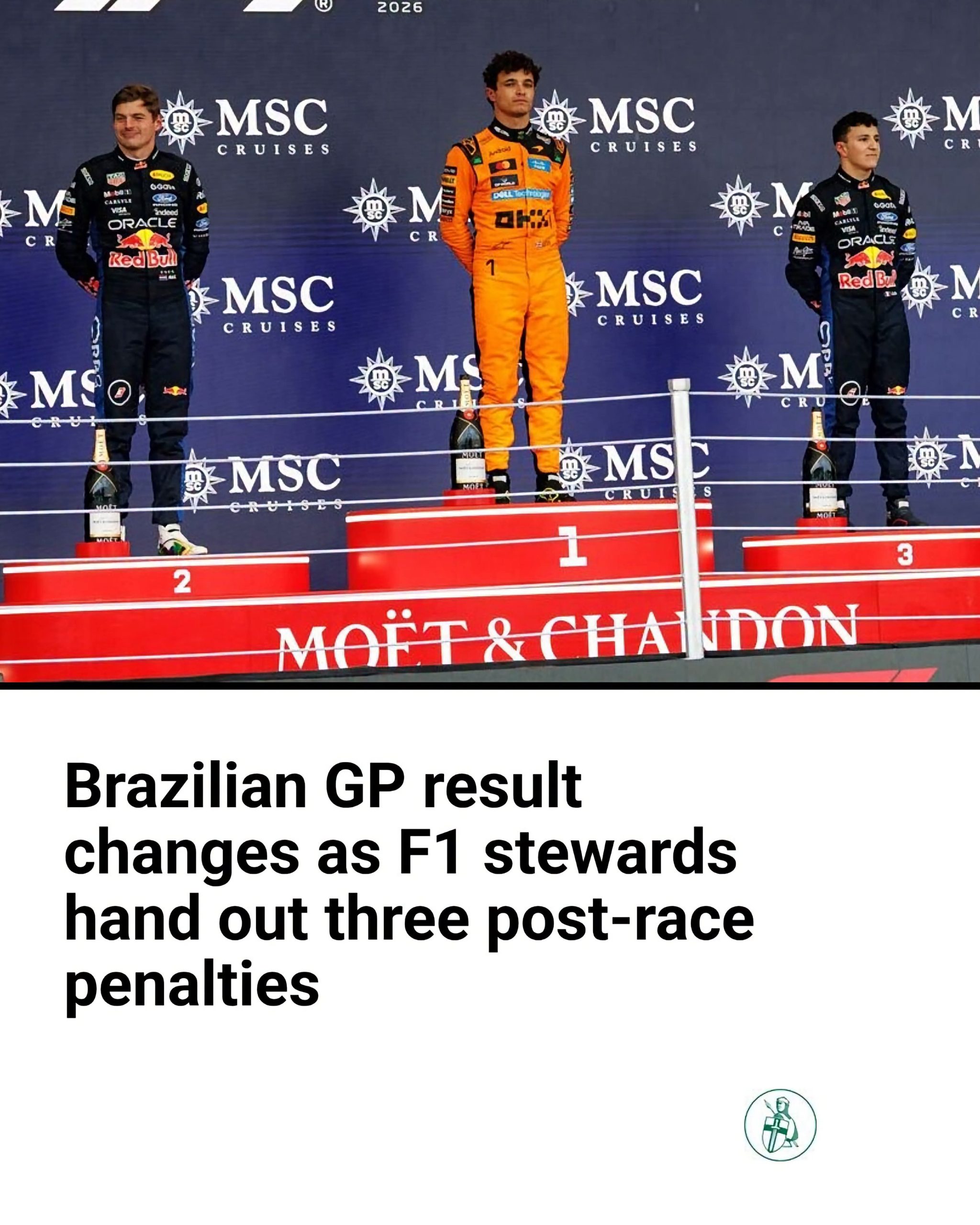
Lando Norris secured another important victory in Brazil, continuing his impressive late-season form, while Max Verstappen delivered one of the performances of the weekend by recovering from 21st on the grid to finish second. Isack Hadjar completed the podium, giving Red Bull a memorable double podium despite Verstappen’s difficult starting position.
However, the post-race investigations ensured that the final results were not entirely settled when the chequered flag fell. Ferrari, Mercedes and Haas all found themselves involved in decisions that highlighted the importance of racecraft, pit-lane safety and the FIA’s driving standards guidelines.
CHARLES LECLERC PENALTY CHANGES BRAZILIAN GP CLASSIFICATION
Charles Leclerc has been handed a five-second time penalty after the FIA stewards determined that he was responsible for a collision with Liam Lawson during their battle for seventh position.
The incident occurred late in the Brazilian Grand Prix as the Ferrari driver attempted to overtake the Racing Bulls competitor. Although the contact was relatively minor, the stewards concluded that it had an impact on the subsequent fight between the two drivers.
Lawson initially maintained his position after the contact, but the stewards determined that the damage and disruption caused by Leclerc’s manoeuvre allowed the Ferrari driver to close the gap and eventually complete the overtake several corners later.
The official decision explained that Lawson had the right to the corner under the driving standards guidelines, meaning Leclerc was responsible for taking the necessary steps to avoid contact.
Ferrari argued that the incident was minor and had no obvious sporting consequence. However, the stewards disagreed after examining the sequence of events.
They concluded that Leclerc benefited from the contact because it disrupted Lawson’s momentum and allowed the Ferrari driver to get closer before completing the pass.
Consequently, the five-second penalty dropped Leclerc from seventh to eighth in the final classification, promoting Lawson into seventh place.
FIA EXPLAINS WHY LECLERC WAS FOUND RESPONSIBLE
The stewards’ decision provides an important explanation of how Formula 1 officials evaluate collisions during close racing.
A contact does not necessarily need to cause extensive damage or force a driver to retire before it can attract a penalty. What matters is whether a competitor was responsible for the incident and whether the contact produced an unfair sporting advantage.
In Leclerc’s case, the FIA acknowledged that the collision was minor but determined that it had a direct influence on the battle for position.
The stewards explained that Lawson’s car was disrupted by the contact, allowing Leclerc to close in and eventually overtake him.
This distinction is particularly important because Formula 1 drivers frequently argue that minor contact is simply part of racing. While that can sometimes be true, the regulations still require competitors to respect another driver’s right to the corner.
Leclerc’s penalty demonstrates that the FIA is prepared to examine the consequences of contact beyond the immediate moment of impact.
For Ferrari, the decision represents another frustrating outcome in a season where strategic mistakes, reliability concerns and racing incidents have repeatedly complicated its championship ambitions.
KIMI ANTONELLI RECEIVES FIVE-SECOND PIT-LANE PENALTY
Kimi Antonelli was also penalised following an unsafe release during a pit stop at Interlagos.
The Mercedes driver was sent back into the fast lane while Franco Colapinto was approaching the same section of the pit lane.
Although Antonelli was entitled to travel alongside cars in the fast lane, the stewards determined that the situation became potentially unsafe when the Mercedes driver momentarily lost control on the slippery surface.
Antonelli had to take action to avoid a collision, creating a dangerous situation involving both competitors.
The FIA therefore handed him a five-second time penalty.
Fortunately for Mercedes, the punishment did not change Antonelli’s finishing position. The Italian rookie retained fifth place in the final classification, preserving the result of another strong weekend.
The incident nevertheless highlights the risks associated with pit-lane releases, particularly during races affected by changing weather conditions.
Teams must ensure that drivers can safely rejoin the pit lane without creating unnecessary danger for competitors approaching from behind.
OLIVER BEARMAN ALSO PENALISED AFTER UNSAFE RELEASE
Oliver Bearman received the third post-race penalty after the stewards investigated another unsafe release in the pit lane.
The Haas driver was found to have been released into the path of Charles Leclerc, creating a potentially dangerous situation during the Ferrari driver’s approach.
Bearman was handed a five-second time penalty, but the sanction did not affect his final position.
He remained classified in 17th place, ahead of Sergio Perez.
The decision reinforces the FIA’s continued focus on pit-lane safety, particularly when teams are attempting to gain valuable seconds during tyre changes.
Unsafe releases can have serious consequences because drivers entering or leaving the pit lane have limited opportunities to react when another car suddenly appears in their path.
Although neither Antonelli nor Bearman suffered a major consequence from their respective incidents, the FIA’s decisions send a clear message that teams must remain responsible for safe pit operations.
FERRARI’S BRAZILIAN GP DISASTER BECOMES EVEN WORSE
The penalty involving Leclerc adds another disappointing chapter to Ferrari’s Brazilian Grand Prix weekend.
The Scuderia arrived at Interlagos hoping to deliver a competitive performance, but its race was overshadowed by a series of setbacks involving both drivers.
Leclerc had initially crossed the finish line in seventh position, while Lewis Hamilton finished ninth after a difficult afternoon that included a late pit-stop controversy.
Hamilton’s race was particularly frustrating because the British driver had demonstrated impressive pace despite starting from the back of the grid. His early progress suggested Ferrari could potentially recover valuable points, but tyre difficulties and a costly strategic situation eventually limited his result.
Leclerc’s penalty now means Ferrari loses another position in the final classification, while Lawson receives an important reward for his determined performance.
The result also underlines how difficult it has become for Ferrari to consistently convert race pace into strong finishes.
Every lost position matters significantly in the constructors’ championship, especially when rivals are delivering more reliable performances across both cars.
MERCEDES SECURE CONSTRUCTORS’ TITLE DESPITE PENALTIES
Despite Antonelli’s pit-lane penalty, Mercedes had already achieved the most important objective of its Brazilian Grand Prix weekend.
The team secured the 2026 Formula 1 Constructors’ Championship, ending a title drought that began after its last championship success in 2021.
George Russell finished fourth, while Antonelli crossed the line fifth before his penalty was applied. Their combined results were sufficient to confirm Mercedes’ position at the top of the constructors’ standings.
The championship represents a major achievement for Toto Wolff and the Mercedes organisation, which has successfully rebuilt its competitive strength after several difficult seasons.
Antonelli’s contribution has been particularly significant, with the young Italian delivering consistent performances throughout the campaign and already establishing himself as one of Formula 1’s leading drivers.
The title also demonstrates the importance of having two competitive drivers capable of consistently collecting points, even when one encounters difficulties during a race weekend.
While the Brazilian Grand Prix did not produce a dominant Mercedes victory, the team’s overall championship achievement remained firmly intact.
FINAL BRAZILIAN GP RESULTS AFTER FIA PENALTIES
The post-race decisions changed the classification in one important area, with Lawson moving ahead of Leclerc.
The revised top 10 following the penalties are:
1. Lando Norris
2. Max Verstappen
3. Isack Hadjar
4. George Russell
5. Kimi Antonelli
6. Oscar Piastri
7. Liam Lawson
8. Charles Leclerc
9. Lewis Hamilton
10. Nico Hulkenberg
Antonelli’s five-second penalty and Bearman’s five-second penalty did not change their respective finishing positions.
FIA DECISIONS ADD ANOTHER TWIST TO BRAZILIAN GP FALLOUT
The Brazilian Grand Prix delivered an exciting race, a remarkable Verstappen recovery and a championship celebration for Mercedes, but the post-race penalties have ensured that the event continues to generate discussion.
Leclerc’s punishment is particularly significant because it directly changed the finishing order and rewarded Lawson for his efforts during the final stages of the race.
Meanwhile, the penalties issued to Antonelli and Bearman highlight the importance of pit-lane safety, even when incidents do not result in collisions or major damage.
For Ferrari, the latest decision adds to an increasingly frustrating season and raises further questions about its ability to consistently deliver clean, competitive weekends.
With the championship battle continuing to develop, every position gained or lost could prove important in the final races of 2026.
The FIA’s latest rulings have therefore done more than simply adjust the Brazilian Grand Prix classification. They have also provided another reminder that Formula 1 results are not always final when the chequered flag falls.