Williams arrived at the 2026 British Grand Prix hoping its latest upgrades would provide a much-needed boost in the increasingly competitive Formula 1 midfield. Instead, the Grove-based team endured one of its most disappointing weekends of the season, leaving Silverstone without a single point and facing fresh questions about the direction of its car development.
Alex Albon openly accepted responsibility for an opening-lap collision that ruined his race, while Carlos Sainz expressed growing concern that Williams is falling behind its closest rivals despite introducing new parts. The result highlighted a worrying trend for a team that entered the season expecting to fight regularly in the midfield but now finds itself struggling to stay competitive.
ALBON ACCEPTS FULL RESPONSIBILITY FOR EARLY INCIDENT
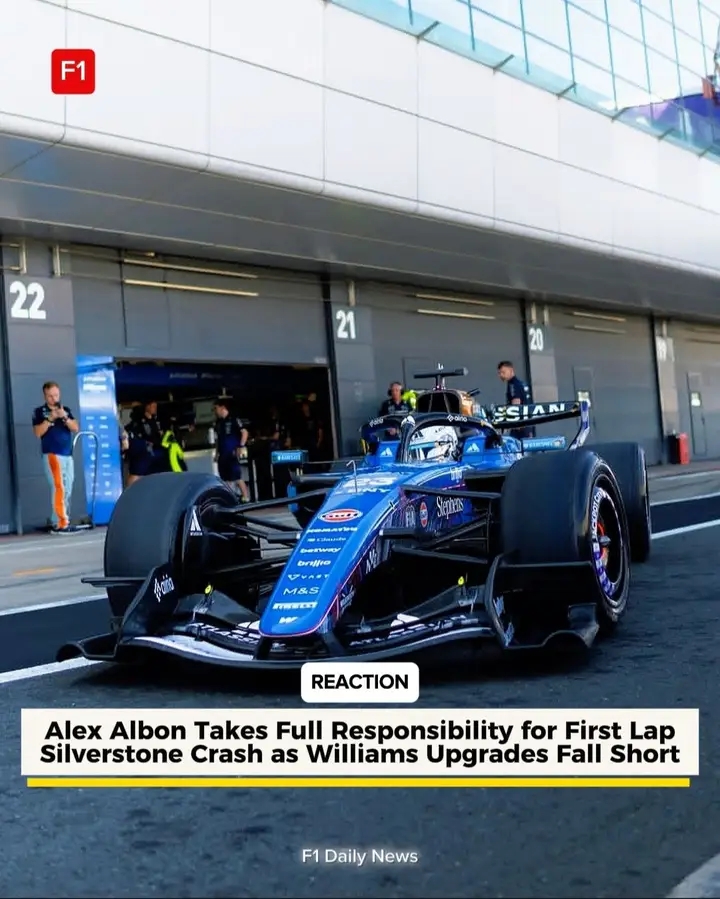
Alex Albon’s race lasted only a few corners before disaster struck. After a poor getaway off the line, the Thai driver locked his brakes and made contact with Ollie Bearman’s Haas, damaging the Williams’ front wing beyond repair.
The incident forced Albon into an immediate pit stop for a replacement nose, dropping him to the back of the field with little chance of recovering. Race stewards later handed him a time penalty for causing the collision, effectively ending any realistic hopes of challenging for points.
Rather than viewing the race as a complete loss, Williams switched its focus toward gathering technical information. With points already out of reach, engineers used the remaining laps to evaluate the team’s new front wing and collect valuable data that could help improve future performance.
Albon did not attempt to shift blame after the race, admitting the mistake was entirely his own. His honesty reflects the leadership role he has taken within Williams over recent seasons, but it also adds to a frustrating campaign that has featured multiple retirements and missed opportunities.
WILLIAMS TURNS A BAD DAY INTO A DEVELOPMENT TEST
Although the final result was disappointing, Williams tried to maximize the value of Albon’s compromised race.
The team had introduced a revised front wing at Silverstone as part of an ongoing development programme. Engineers are also preparing a much larger upgrade package expected later in the season, making every lap of data especially valuable.
Using a Grand Prix as a live testing environment is never the preferred strategy, but Formula 1 teams often seize such opportunities when competitive results are already out of reach. Every run with new aerodynamic components provides information that cannot be fully replicated in simulations or wind tunnels.
Whether those findings translate into meaningful performance gains over the coming races remains one of the biggest questions facing Williams.
CARLOS SAINZ DELIVERS A FRUSTRATING REALITY CHECK
Carlos Sainz’s afternoon offered little encouragement either.
Despite another excellent race start that briefly lifted him into the top ten, the Spaniard gradually slipped backwards as faster cars exposed Williams’ lack of race pace. A late-race penalty ultimately left him classified 17th, although points were already well beyond reach.
Sainz acknowledged that his strong starts have become a recurring theme this season. The problem, however, is that Williams simply lacks the speed to defend those positions over a full race distance.
His comments paint a clear picture of the team’s current limitations. Strong execution from the drivers can only compensate for so much when outright car performance is missing.
WHY THE NEW UPGRADE PACKAGE IS CAUSING CONCERN
Perhaps the biggest concern emerging from Silverstone is not the final result itself but the apparent lack of progress from Williams’ latest upgrades.
The team had hoped its revised aerodynamic package would help close the gap to midfield rivals. Instead, both drivers reported little evidence of improved competitiveness.
That is particularly worrying because Formula 1 development is a relentless race. Every unsuccessful upgrade costs valuable time while competitors continue improving.
If Williams cannot unlock meaningful gains soon, it risks slipping further behind teams such as Racing Bulls, Haas, Alpine and Sauber as the second half of the season approaches.
SAINZ QUESTIONS THE DEVELOPMENT DIRECTION
Sainz stopped short of openly criticizing the team but admitted there are serious questions to answer regarding the car’s development path.
The four-time Grand Prix winner believes his own performances have remained consistently strong throughout 2026. His qualifying pace, race craft and excellent starts have frequently extracted everything available from the FW48.
However, driver confidence can only offset limited machinery for so long.
His remarks suggest growing concern that Williams is failing to convert engineering effort into measurable lap-time improvements. In modern Formula 1, where tenths of a second separate multiple teams, even small development setbacks can dramatically affect championship positions.
THE MIDFIELD BATTLE IS BECOMING MORE COMPETITIVE
The fight behind the front-running teams has become one of the closest contests in Formula 1 this season.
Margins between midfield rivals are incredibly small, meaning every successful upgrade package can dramatically alter the competitive order.
While Racing Bulls have continued making steady progress, Williams appears to have stalled. Losing ground now could have long-term financial consequences because Constructors’ Championship positions determine significant prize money distributions.
Every missed opportunity therefore carries importance beyond a single race weekend.
WHAT WILLIAMS MUST DO NEXT
The upcoming races could prove decisive for Williams’ season.
The larger upgrade package currently under development now carries even greater importance after Silverstone’s disappointing outcome. Engineers will need to understand exactly why the latest parts failed to produce the expected gains and quickly identify solutions.
Equally important will be rebuilding momentum on track. Clean race weekends, stronger qualifying performances and reliable execution will be essential if the team hopes to return to regular points contention.
Both Albon and Sainz have demonstrated throughout their careers that they can maximize opportunities when given competitive machinery. The challenge now lies with the technical department to provide a car capable of matching that level of driving.
WHAT THIS MEANS FOR THE REST OF THE 2026 SEASON
Silverstone may ultimately be remembered as a turning point for Williams.
If the data collected from Albon’s extended test run helps unlock meaningful improvements, the difficult weekend could eventually produce long-term benefits.
If not, concerns surrounding the team’s development programme will only intensify as rivals continue moving forward.
For now, Williams leaves its home Grand Prix disappointed, without points and searching for answers. With the championship entering its crucial middle phase, the next upgrade package may determine whether the team can rejoin the midfield fight or endure a frustrating second half of the 2026 Formula 1 season.