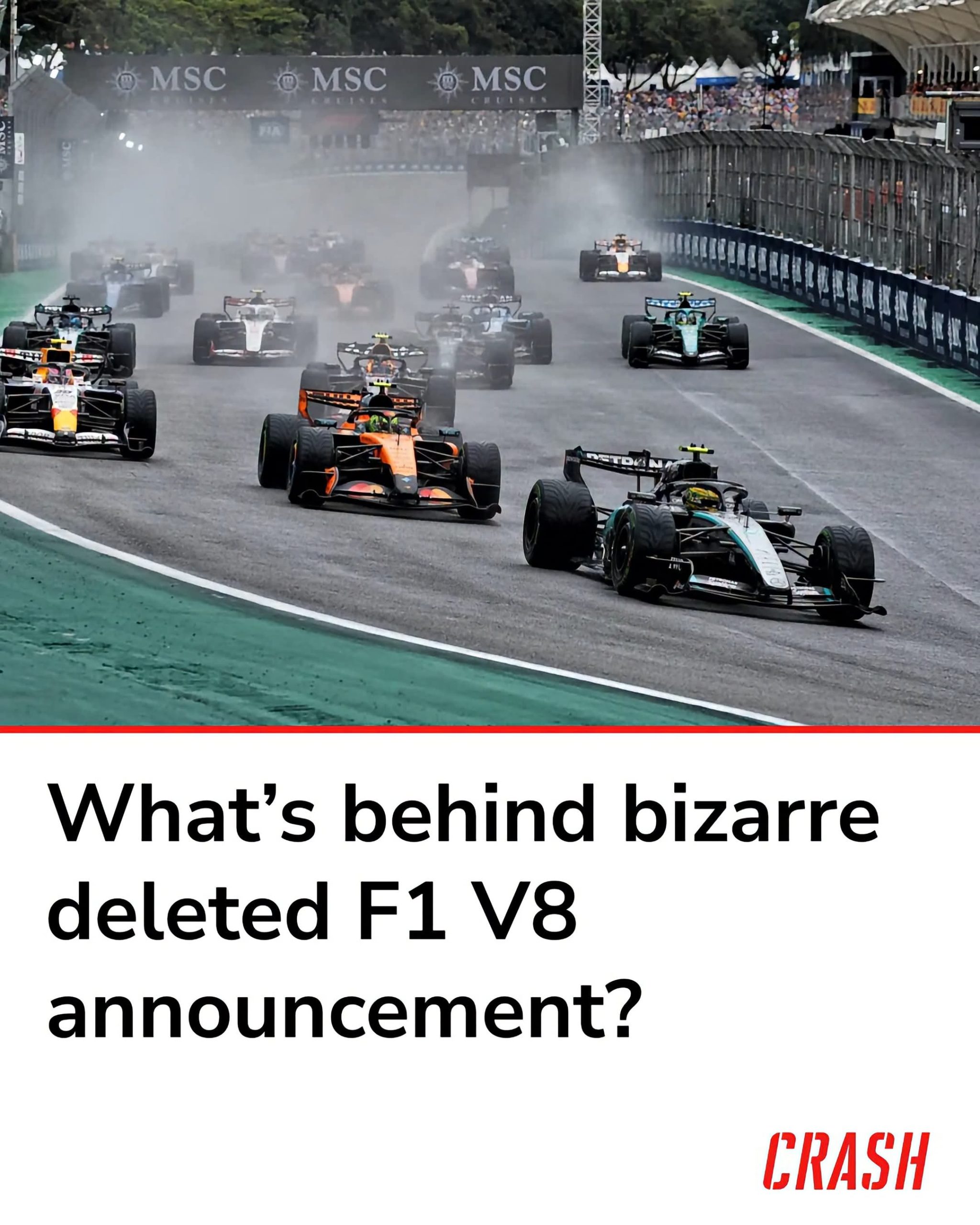
Formula 1’s long-discussed return to V8 engines has taken an unexpected turn after the FIA appeared to announce a historic agreement before deleting graphics that revealed the proposed changes.
The development has created confusion around the championship’s technical future, particularly after FIA president Mohammed Ben Sulayem publicly suggested that the next generation of Formula 1 engines could bring back V8 power by 2030.
Although the proposed direction appears to have received broad support from manufacturers, the sudden removal of the announcement graphics suggests that important details are still being negotiated.
With another major meeting scheduled for December, Formula 1 fans may have to wait longer before receiving official confirmation of exactly what the next engine era will look like.
FIA’S V8 ANNOUNCEMENT DISAPPEARS AFTER SURPRISE DEVELOPMENT
The controversy began on Tuesday when Ben Sulayem shared an audio message on Instagram accompanied by a short but significant caption: “You spoke, we listened. V8s coming soon…”
The message immediately attracted attention because it appeared to confirm that Formula 1 was moving closer to abandoning its current power unit direction in favour of a new V8-based formula.
However, the situation became confusing when graphics published across other FIA communication channels, which indicated that an agreement in principle had been reached on the new regulations framework, were subsequently deleted.
The original Instagram audio message remained available, but the removal of the other material raised questions about whether the governing body had announced the development before every manufacturer had fully agreed to the proposed regulations.
There has been no clear explanation for why the graphics were removed.
The timing is particularly interesting because a meeting involving the FIA, Formula One Management and power unit manufacturers had taken place on Tuesday to discuss the proposed engine changes.
MANUFACTURERS REPORTEDLY BACK THE V8 DIRECTION
According to reporting by The Race cited in the original coverage, there was broad agreement among power unit manufacturers over the proposed 2030 V8 framework.
However, broad agreement does not necessarily mean that every participant accepted every detail of the proposal.
That distinction could explain the confusion surrounding the FIA’s communication.
Formula 1’s engine regulations involve significant financial and technical commitments. Manufacturers must consider development costs, performance targets, sustainability requirements and the long-term competitiveness of their power units before agreeing to a new framework.
Even if the general idea of returning to V8 engines has gained support, disagreements over specific technical details could delay a final announcement.
The FIA may have expected a stronger level of agreement than was achieved during the discussions, leading to speculation that the initial announcement was premature.
Until the governing body provides further clarification, the deleted graphics should not be treated as proof that the final regulations have already been approved.
WHAT THE PROPOSED 2.1-LITRE V8 ENGINE WILL LOOK LIKE
The proposed engine concept is understood to centre on a 2.1-litre turbocharged V8 configuration, with some form of hybrid assistance expected to remain part of the package.
This would represent a major change from the 1.6-litre turbocharged V6 hybrid power units introduced in 2014 and retained under the 2026 regulations.
The proposed arrangement is intended to offer a simpler and more affordable alternative to the current generation of highly complex hybrid engines.
One important consideration is how manufacturers can adapt their existing technical knowledge and facilities without having to begin development entirely from scratch.
The 2.1-litre concept is understood to have been considered a cost-effective option because it could allow manufacturers to build on aspects of their current V6 development programmes.
Hybrid technology is also expected to remain, although its contribution would be reduced compared with the current system.
This suggests Formula 1 is not planning to abandon electrification completely. Instead, the objective appears to be finding a different balance between combustion power and electrical assistance.
WHY THE FIA WANTS TO BRING BACK V8 ENGINES
Ben Sulayem has been one of the strongest advocates of returning to V8 engines, arguing that Formula 1 needs a power unit formula that is simpler, lighter and less expensive.
The debate has become more prominent following the introduction of the 2026 regulations, which placed greater emphasis on electrical power and energy management.
While the technology represents an important step in modern motorsport, concerns have emerged about the complexity of the systems and the extent to which drivers must manage energy deployment during races.
A V8 return could help Formula 1 reconnect with some of the characteristics that made previous generations of cars popular.
The sound is an obvious attraction. V8 engines produced a distinctive high-revving soundtrack that remains popular among many long-time supporters.
However, the argument goes beyond nostalgia. A simpler engine formula could potentially reduce development costs, make the sport more attractive to manufacturers and allow greater emphasis to be placed on the driving experience.
The challenge will be delivering those benefits without compromising the sustainability commitments that have become central to Formula 1’s modern identity.
DECEMBER 10 MEETING COULD DECIDE THE NEXT STEP
The next important moment is expected to come on December 10, when further discussions are scheduled to take place at the FIA World Motor Sport Council.
The meeting will take place shortly after the conclusion of the 2026 Formula 1 season in Abu Dhabi.
It could provide greater clarity about the proposed 2030 framework, including the technical details that manufacturers have yet to agree upon.
The timing is significant because the current power unit regulations are scheduled to remain in place until the end of 2030.
A new engine formula introduced in 2030 would therefore require careful planning to ensure manufacturers, teams and suppliers have sufficient time to prepare.
Any delay in reaching a final agreement could affect development schedules and the wider preparations for the next generation of Formula 1 cars.
FORMULA 1 FACES A DELICATE ENGINE DECISION
The V8 debate has exposed an important challenge for Formula 1: finding a technical direction that satisfies manufacturers while keeping fans interested in the product.
The championship cannot make major regulatory decisions based on nostalgia alone. Manufacturers need a formula that makes commercial and engineering sense, while the FIA must protect the sport’s long-term sustainability objectives.
The deleted announcement has therefore created more questions than answers.
There appears to be significant momentum behind the proposed V8 direction, but the remaining disagreements show that reaching a final agreement is more complicated than simply announcing a return to an older engine configuration.
For fans, the possibility of hearing V8 engines again is exciting. For manufacturers, however, the next few weeks could determine the technical and financial direction of Formula 1 for years to come.
The December 10 meeting is now an important date to watch. Until then, the V8 return remains a developing proposal rather than a fully settled regulatory reality.