Formula 1 teams are heading into a particularly challenging qualifying session at the 2026 Las Vegas Grand Prix, with unexpected weather conditions leaving several teams struggling to understand their cars ahead of one of the most unpredictable weekends of the season.
The opening practice sessions in Las Vegas delivered very little useful information, creating an unusual situation in which teams could enter qualifying without having properly evaluated their dry-weather performance.
With championship ambitions, team rivalries and valuable points still at stake, the lack of preparation could have significant consequences when the lights go out on Saturday night.
For teams accustomed to spending hours analysing data and refining their setups, the situation presents an uncomfortable challenge: making crucial decisions without having the information they would normally rely upon.
RAIN DESTROYS VALUABLE PRACTICE OPPORTUNITIES
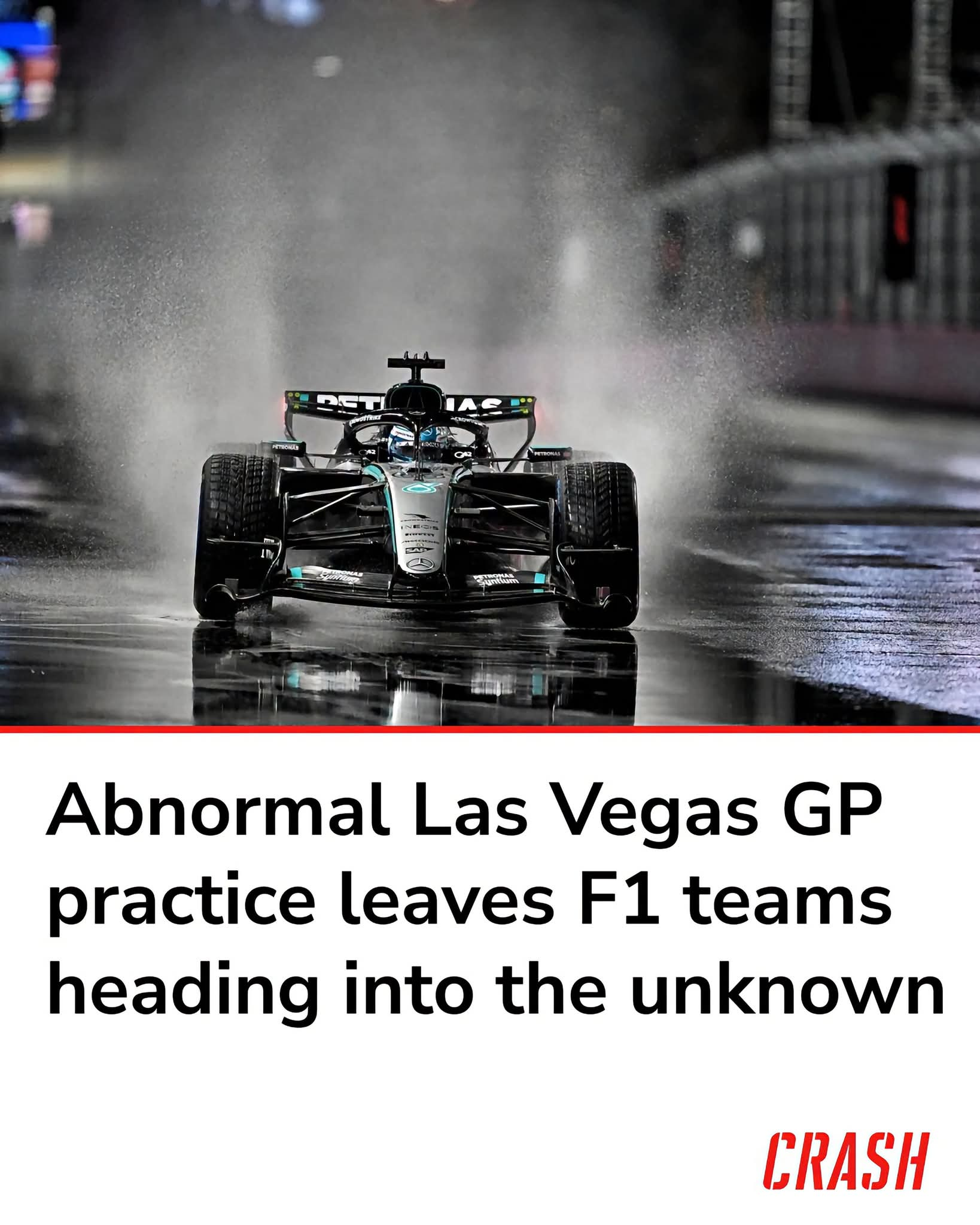
The problems began during Thursday’s opening practice session, when heavy rain left the Las Vegas Strip Circuit covered in water.
Conditions were sufficiently difficult that no driver completed a timed lap, with teams choosing to remain in their garages rather than risk unnecessary accidents or waste their limited allocation of wet-weather tyres.
Although safety is always the priority, the lack of running immediately created a preparation headache.
Formula 1 teams normally use the opening practice sessions to evaluate aerodynamic performance, tyre behaviour, braking stability and overall car balance.
However, with the circuit offering virtually no representative running, engineers were left with considerably less information than they would have wanted.
The second practice session provided slightly better conditions, as the rain stopped and the circuit gradually began drying.
Mercedes driver George Russell eventually topped the FP2 timesheets, but the results offered little indication of the competitive order expected during qualifying.
Russell himself acknowledged that Mercedes was not necessarily the fastest team, pointing towards the impressive pace demonstrated by McLaren and Charles Leclerc at different stages of the session.
His comments highlighted just how difficult it was to draw meaningful conclusions from the available data.
GEORGE RUSSELL WARNS MERCEDES ABOUT THE REAL PICTURE
Russell’s performance in FP2 might have looked encouraging for Mercedes supporters, but the British driver was careful not to place too much importance on the result.
The Mercedes driver explained that changing wet-weather conditions made it difficult to establish a reliable performance picture.
He also suggested that McLaren looked particularly competitive, while Ferrari’s Charles Leclerc demonstrated encouraging speed during certain stages of the session.
This is an important distinction because a driver topping a practice session does not necessarily mean their team has the fastest car.
Track conditions, tyre selection, fuel loads and the timing of individual laps can dramatically influence the results.
Mercedes therefore faces the same fundamental problem as its rivals: understanding how its car will behave when the circuit returns to dry conditions.
With George Russell and Kimi Antonelli both expected to play important roles in the remaining weekend, Mercedes will need to make the most of its limited preparation time.
LEWIS HAMILTON EXPECTS A COMPLETE RESET
Ferrari’s Lewis Hamilton also acknowledged the unusual circumstances surrounding the Las Vegas weekend.
The seven-time world champion suggested that the information gathered during Thursday’s sessions would have limited value because the remaining sessions were expected to take place in dry conditions.
Hamilton’s assessment reflects a wider problem affecting the entire grid.
Teams have effectively lost two important opportunities to understand their cars in the conditions that matter most for qualifying and the race.
For Hamilton, the challenge is particularly significant because qualifying performance is crucial around the Las Vegas Strip Circuit.
The circuit features long straights, heavy braking zones and relatively limited opportunities to recover from mistakes.
A driver who struggles to find the correct balance could quickly lose valuable lap time.
Ferrari will therefore need to approach final practice with an aggressive but carefully managed programme, gathering as much information as possible before qualifying begins.
MCLAREN AND RED BULL FACE IMPORTANT UPGRADE QUESTIONS
The weather disruption has also complicated the evaluation of technical developments brought to Las Vegas.
McLaren had planned to assess a new floor, but the team decided against installing it on Lando Norris’ car during the wet sessions.
According to McLaren senior director Randy Singh, the conditions made it difficult to collect the necessary information because some sensors had to be protected from the water.
Running a new aerodynamic component without being able to properly measure its performance would have offered limited benefits.
The team therefore preferred to postpone the evaluation until conditions became more suitable.
Red Bull also abandoned plans to test a new front-wing development because of the weather.
This creates an interesting technical challenge.
Modern Formula 1 upgrades are developed through extensive simulations, wind-tunnel testing and engineering analysis. However, real-world track data remains essential to understanding whether a development delivers the expected improvement.
McLaren and Red Bull now have less time to establish whether their respective upgrades can provide a competitive advantage.
With the leading teams often separated by extremely small margins, even a minor aerodynamic improvement could prove important.
TYRE MANAGEMENT COULD DECIDE THE LAS VEGAS GRAND PRIX
One of the biggest unanswered questions concerns tyre performance.
Las Vegas is already a challenging destination for Formula 1 teams because of its unusually cold nighttime conditions.
Unlike several other circuits on the calendar, the Las Vegas Strip Circuit can make it difficult for drivers to generate and maintain sufficient tyre temperature.
This becomes particularly important during qualifying, when drivers need maximum grip to attack the circuit’s high-speed sections and heavy braking zones.
If the tyres are not operating within their ideal temperature window, drivers can struggle with reduced grip, inconsistent handling and increased locking under braking.
The uncertainty also extends to Sunday’s race.
George Russell highlighted the possibility of different graining behaviour compared with previous editions of the event.
The 2023 race featured significant tyre degradation, while the 2024 edition was more manageable from a tyre-management perspective.
The difference between a successful one-stop strategy and a potentially slower two-stop approach could therefore become an important strategic consideration.
Teams will be desperate to understand how the available tyre compounds respond to the cold conditions.
Unfortunately, the disrupted practice sessions have made that task considerably more difficult.
FINAL PRACTICE BECOMES THE MOST IMPORTANT SESSION OF THE WEEKEND
With Thursday providing very little representative running, Friday’s final practice session has suddenly become extremely important.
Teams will have to compress programmes that would normally be spread across several sessions.
Engineers need to evaluate qualifying pace, conduct longer race simulations, understand tyre degradation and make final adjustments to their car setups.
All of this must be achieved within a single hour of running.
Ferrari deputy team principal Jérôme d’Ambrosio acknowledged that the teams would have to condense their programmes and make the most of the available opportunity.
This creates another potential disadvantage for teams that encounter reliability problems or suffer interruptions during final practice.
A red flag, mechanical issue or traffic-related problem could destroy an important part of a team’s preparation.
Consequently, reliability and operational efficiency could become just as important as outright performance.
The teams that organise their programmes most effectively could gain a significant advantage over rivals who struggle to complete their planned running.
WHY THE LAS VEGAS CIRCUIT MAKES THE SITUATION EVEN MORE DIFFICULT
The Las Vegas Strip Circuit is not an ordinary Formula 1 venue.
Its combination of long straights, slow corners and demanding braking zones requires a carefully balanced car setup.
Teams must find sufficient aerodynamic efficiency to remain competitive along the straights without sacrificing the stability and grip needed through the slower sections.
The circuit also presents unusual challenges when it comes to tyre preparation.
Cold asphalt can make it difficult to generate the necessary temperature, particularly during qualifying out-laps.
Drivers must therefore manage their preparation carefully to ensure their tyres are ready when they begin a flying lap.
The lack of representative dry-weather running makes these decisions considerably more complicated.
A setup that appears competitive in one set of conditions might become less effective when track temperatures and grip levels change.
This is precisely why the disrupted practice sessions could have a significant influence on the starting grid.
WHICH TEAMS COULD BENEFIT FROM THE UNEXPECTED CHAOS?
Although the weather disruption has created problems for everyone, not every team will necessarily be affected equally.
MERCEDES
Russell’s FP2 performance provides some encouragement, but Mercedes cannot assume that its wet-weather competitiveness will translate into dry-weather pace.
The team will need to establish whether its car can generate sufficient tyre temperature while maintaining a competitive balance.
MCLAREN
McLaren appears to have demonstrated encouraging speed, even though the wet conditions prevented a complete assessment of its performance.
The opportunity to evaluate its new floor during final practice could become particularly important.
If the upgrade delivers the expected improvement, McLaren could strengthen its qualifying prospects.
FERRARI
Ferrari has plenty of questions to answer following the disrupted opening sessions.
Hamilton and Leclerc will need a predictable car underneath them, particularly around a circuit where confidence under braking and traction out of slow corners is essential.
RED BULL
Red Bull faces its own uncertainties after abandoning its planned front-wing evaluation.
Max Verstappen and Isack Hadjar will need to extract maximum performance from the available package while the engineers work to improve the car’s balance.
Verstappen’s experience at the circuit could prove valuable, especially when the team has limited preparation data.
WHAT THIS MEANS FOR THE LAS VEGAS GRAND PRIX
The biggest consequence of the disrupted practice sessions is that the competitive order could be considerably different from what the early results suggest.
Mercedes, McLaren, Ferrari and Red Bull might all discover that their cars behave differently once the circuit becomes fully dry.
This increases the possibility of unexpected qualifying results.
A team that manages to understand the tyres quickly could find itself in a stronger position than a rival that appeared faster during practice.
It also increases the importance of driver confidence.
When preparation time is limited, experienced drivers who can quickly communicate changes in car behaviour to their engineers become particularly valuable.
Hamilton, Verstappen and Russell have all demonstrated their ability to adapt to difficult conditions throughout their careers.
However, younger drivers such as Antonelli and Hadjar will also have opportunities to demonstrate their technical feedback and ability to adapt under pressure.
PREDICTION: QUALIFYING COULD PRODUCE A SURPRISE STARTING GRID
The Las Vegas Grand Prix is now shaping up to be an intriguing test of preparation, adaptability and engineering execution.
Mercedes might enter qualifying with some confidence following Russell’s FP2 performance, but McLaren’s apparent speed means the team cannot take anything for granted.
Ferrari also has the potential to challenge if Hamilton and Leclerc find the right balance during final practice.
Red Bull should not be underestimated either, particularly with Verstappen’s previous success at the circuit.
Our expectation is that the gaps between the leading teams could be extremely small once everyone has access to representative dry-weather conditions.
The most important factor might not be which team looked fastest during Thursday’s practice sessions, but which one makes the best use of Friday’s remaining preparation time.
FINAL VERDICT: THE REAL LAS VEGAS GRAND PRIX BATTLE STARTS NOW
The 2026 Las Vegas Grand Prix has already delivered an unexpected challenge for Formula 1’s leading teams.
Rain prevented meaningful running in FP1, while the changing conditions during FP2 offered limited information about the dry-weather competitive order.
Mercedes, Ferrari, McLaren and Red Bull now face an important test of their engineering capabilities as they attempt to prepare their cars for qualifying and the race.
The situation also introduces an additional element of unpredictability into a championship weekend where every competitive advantage matters.
One thing is certain: the team that understands its car, tyres and setup requirements most quickly could emerge as the biggest winner.
In Las Vegas, where the smallest mistake can have major consequences, preparation could ultimately make the difference between pole position and disappointment.SEO KEYWORDS: 2026 Las Vegas Grand Prix, F1 Las Vegas GP qualifying, Formula 1 latest news, Lewis Hamilton Ferrari, George Russell Mercedes, Max Verstappen Red Bull, McLaren F1, Las Vegas GP practice results.
SEO META DESCRIPTION: F1 teams face a major challenge ahead of the 2026 Las Vegas Grand Prix as rain disrupts practice, leaving Mercedes, Ferrari, McLaren and Red Bull searching for answers before qualifying.
Suggested URL Slug: f1-teams-las-vegas-gp-qualifying-practice-weather-chaos-2026
—
Reporting context: November 20, 2026. The article reflects the situation following Thursday’s disrupted practice sessions, before qualifying.