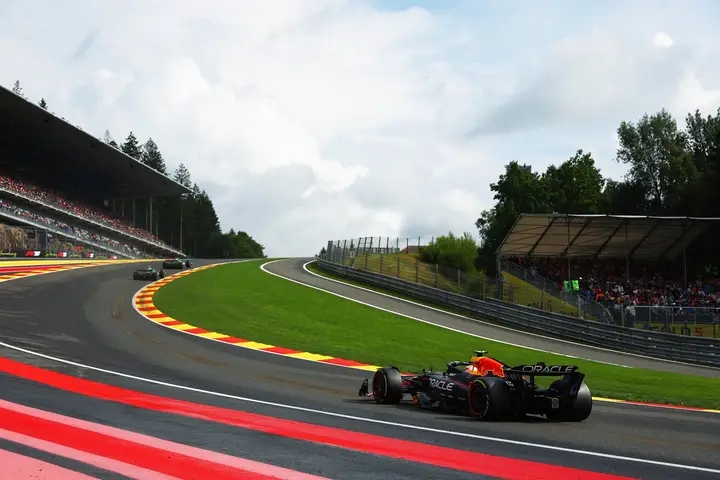
The Belgian Grand Prix is already shaping up to be one of the biggest technical challenges of the 2026 Formula 1 season, with several drivers warning that managing battery deployment around Spa-Francorchamps could have a major impact on race performance. Among those raising concerns is Fernando Alonso, who believes drivers may spend large portions of the lap with dramatically reduced electrical assistance, leaving them with power levels even lower than a Formula 2 car in certain sections.
As Formula 1 continues adapting to its current hybrid power unit regulations, Spa’s unique layout is expected to expose one of the biggest weaknesses of the existing energy deployment system.
ALONSO EXPLAINS WHY SPA PUSHES THE HYBRID SYSTEM TO ITS LIMIT
According to Alonso, both Silverstone and Spa-Francorchamps are extremely demanding circuits when it comes to energy management because of their long full-throttle sections.
He explained that drivers cannot simply use maximum battery deployment on every straight. If they exhaust their electrical energy too early—particularly from La Source through Eau Rouge, Raidillon, and up to Les Combes—they risk having almost no additional electrical power available for the remainder of the lap.
Instead, teams must carefully decide where to deploy energy for maximum lap-time benefit. Using too much at the start of the lap can leave drivers vulnerable later, while being overly conservative may sacrifice valuable speed in key overtaking zones.
This delicate balancing act could become one of the defining factors of the Belgian Grand Prix weekend.
WHY BATTERY DEPLOYMENT IS SO IMPORTANT AT SPA
Modern Formula 1 cars rely on a combination of internal combustion engine performance and electrical energy harvested by the hybrid system.
The battery stores recovered energy and releases it strategically during acceleration. However, circuits with extended periods at full throttle consume that stored energy much faster than it can be replenished.
Spa is one of the longest and fastest tracks on the calendar, making efficient deployment incredibly difficult. Once the available electrical energy has been used, drivers must rely much more heavily on the internal combustion engine alone.
Alonso pointed out that in those moments, overall power output drops significantly, creating a noticeable performance deficit compared to when full hybrid assistance is available.
SILVERSTONE OFFERED A PREVIEW OF WHAT TO EXPECT
The challenges experienced at Silverstone have already given teams valuable insight into what awaits in Belgium.
Alonso described the famous Maggotts-Becketts-Chapel sequence as almost acting like a “charging station,” allowing the hybrid system to recover some energy before another burst of acceleration.
Even with that opportunity, drivers still found themselves carefully managing battery usage throughout the lap.
Spa presents an even greater challenge because of its combination of long straights and high-speed corners, placing additional strain on the energy recovery system.
OTHER DRIVERS SHARE THE SAME CONCERNS
Alonso is far from alone in his assessment.
Oliver Bearman suggested that if drivers already found Silverstone demanding, Spa could prove even tougher from an energy management perspective. His comments underline how seriously teams are preparing for the unique demands of the Belgian circuit.
Max Verstappen also acknowledged the issue. Although the Dutch driver considers Spa one of his favorite tracks on the Formula 1 calendar, he admitted that managing energy there is likely to be another difficult experience similar to what drivers encountered at Silverstone.
When drivers from multiple teams reach the same conclusion, it often highlights a genuine technical challenge rather than a team-specific issue.
FORMULA 1 IS ALREADY LOOKING FOR LONG-TERM SOLUTIONS
The concerns expressed by drivers also reinforce why Formula 1 continues evaluating future power unit regulations.
One objective is to reduce the extent to which race performance depends on battery deployment, creating a more consistent balance between electrical power and the internal combustion engine.
Such changes could improve racing by ensuring drivers are less constrained by energy limitations and more able to push throughout an entire lap without constantly managing battery reserves.
While those developments are aimed at future seasons, the current regulations mean teams must continue finding creative solutions within the existing framework.
WHAT THIS MEANS FOR THE BELGIAN GRAND PRIX
Energy management could become just as important as outright pace during the Belgian Grand Prix weekend.
Teams that develop the most efficient deployment strategies may gain valuable tenths of a second every lap, while drivers who misuse their battery could become easy targets on Spa’s long straights.
Qualifying could also be heavily influenced by how effectively teams optimize energy deployment over a single flying lap, particularly with overtaking opportunities heavily dependent on straight-line speed.
Strategy engineers will therefore play a crucial role alongside the drivers, determining exactly where electrical assistance should be used to maximize performance.
WHY THIS STORY MATTERS
The comments from Fernando Alonso, Max Verstappen, and Oliver Bearman highlight how Formula 1 continues evolving into a sport where technical management is every bit as important as raw driving talent.
Spa-Francorchamps has always tested courage and precision, but in the hybrid era it also demands exceptional energy management. Drivers must constantly balance aggression with efficiency, knowing that one poorly timed deployment could leave them significantly slower for the remainder of the lap.
As the championship battle intensifies, mastering these technical challenges could make the difference between victory and defeat. The Belgian Grand Prix is unlikely to be decided by speed alone—it may instead be won by the team that best understands how to manage every joule of energy around one of Formula 1’s most iconic circuits.