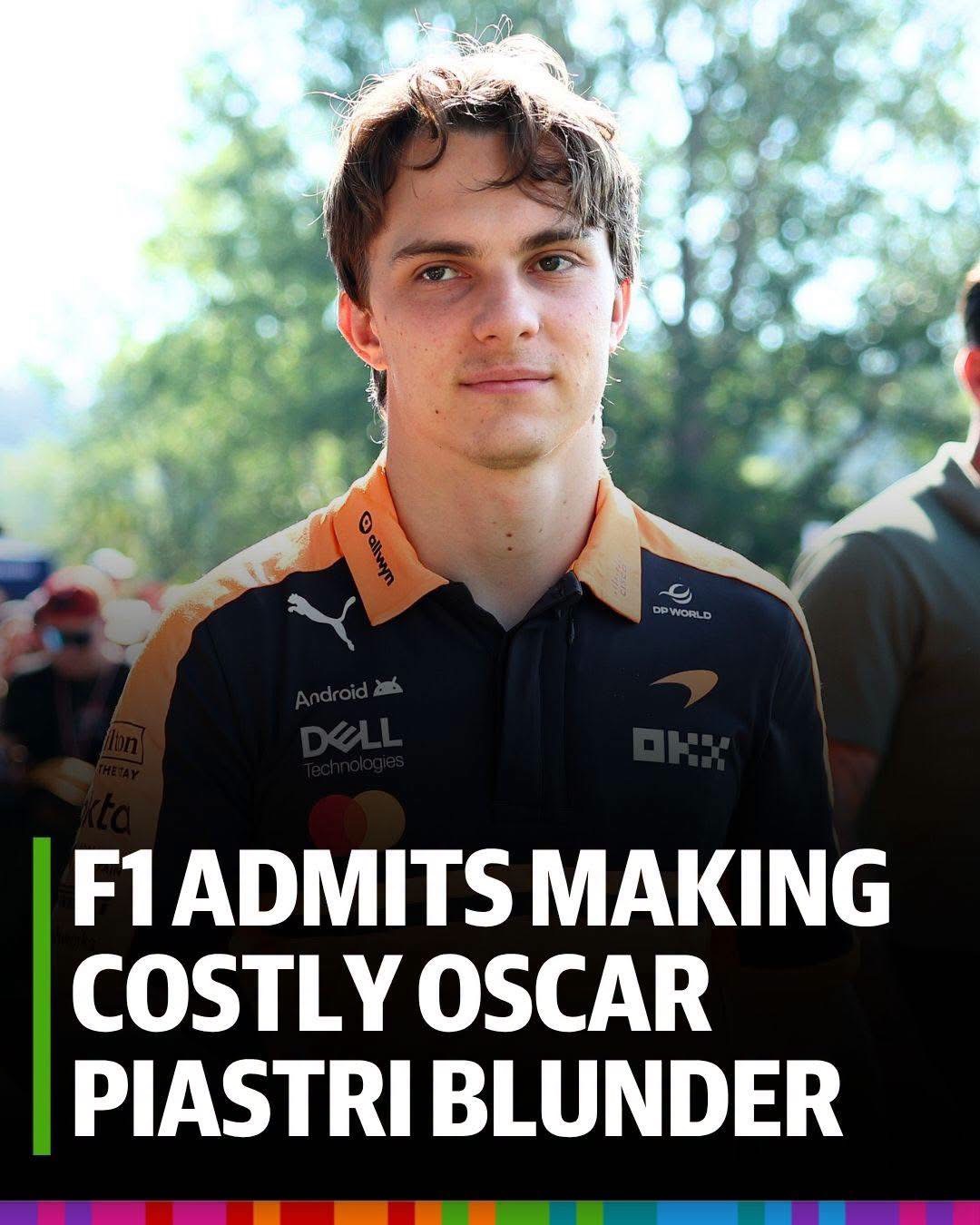
Formula 1 has acknowledged a costly officiating mistake involving Oscar Piastri at the Belgian Grand Prix, prompting the FIA to overhaul how certain race incidents will be judged going forward. The decision comes after widespread debate over a controversial incident at Spa-Francorchamps that many fans, analysts, and teams believed unfairly impacted the McLaren driver’s race.
The admission is significant because it highlights Formula 1’s willingness to review its own decisions during one of the most fiercely contested championship seasons in recent memory. With the title battle tightening and every point carrying enormous weight, the FIA’s latest move could have lasting implications for future Grands Prix and the integrity of the championship.
BELGIAN GRAND PRIX INCIDENT SPARKED WIDESPREAD DEBATE
The Belgian Grand Prix delivered plenty of drama, but one of its biggest talking points centered on Oscar Piastri and a controversial stewarding decision.
During the race, Piastri became involved in an incident that ultimately influenced his final result. While race officials applied the existing interpretation of the regulations, the aftermath generated intense criticism from across the Formula 1 community. Many observers argued that the punishment—or lack of one in related incidents—created an inconsistent standard that disadvantaged the Australian.
As discussions intensified throughout the week, pressure mounted on the FIA to explain its reasoning and evaluate whether the current penalty guidelines were achieving their intended purpose.
FIA RESPONDS WITH IMPORTANT RULE CHANGE
Rather than simply defending its original decision, Formula 1’s governing body has reportedly acknowledged shortcomings in how the Belgian Grand Prix incident was handled.
In response, the FIA has introduced changes to the way similar penalties will be assessed in future races. While the governing body has not suggested officials acted in bad faith, it has recognized that clearer and more consistent standards are necessary to avoid repeating similar controversies.
The revision is designed to provide stewards with a more structured framework when evaluating incidents involving close racing, ensuring that comparable situations receive comparable outcomes regardless of the teams or drivers involved.
For Formula 1, consistency has become just as important as speed when it comes to maintaining credibility.
WHY THE DECISION MATTERS FOR THE TITLE FIGHT
The timing of this admission could hardly be more important.
Oscar Piastri remains firmly involved in the championship battle, and every point lost through controversial officiating can dramatically influence the standings over a 24-race calendar. A single decision in July may ultimately affect who lifts the Drivers’ Championship trophy in December.
McLaren has consistently demonstrated race-winning pace throughout the 2026 campaign, but victories and podium finishes often come down to fine margins. When penalties alter race results, they also affect constructors’ points, strategic decisions, and momentum heading into future rounds.
That is why both teams and drivers have repeatedly pushed the FIA to improve transparency surrounding stewarding decisions.
CONSISTENT STEWARDING HAS BECOME A MAJOR ISSUE
The Belgian Grand Prix was not an isolated controversy.
Throughout the 2026 Formula 1 season, multiple incidents have raised questions about whether similar situations are being judged consistently. From first-lap collisions to unsafe releases and overtaking disputes, several high-profile penalties have divided opinion among teams, drivers, and fans alike.
Drivers have increasingly emphasized that they are not necessarily seeking fewer penalties—they simply want predictable standards that allow them to understand exactly where the limits are.
When competitors enter a corner, they should know how officials are likely to interpret the incident if contact occurs.
That level of consistency benefits everyone, from rookies learning racecraft to experienced champions fighting for world titles.
WHAT THIS MEANS FOR OSCAR PIASTRI AND McLAREN
Although the FIA’s acknowledgment cannot reverse what happened at Spa, it does offer some validation for McLaren and Piastri.
The Australian has earned praise throughout the season for his aggressive yet controlled driving style, and many believed the Belgian decision unfairly overshadowed another strong performance. Knowing that Formula 1 has reviewed the situation may provide confidence that future incidents will be judged under clearer guidelines.
For McLaren, the change could also influence race strategy.
Teams regularly calculate overtaking risks, defensive tactics, and pit stop decisions based partly on how likely drivers are to receive penalties. Greater clarity from race officials allows engineers to make more informed decisions during crucial moments.
HUNGARIAN GRAND PRIX COULD BE THE FIRST REAL TEST
Attention now shifts to the Hungarian Grand Prix, where the FIA’s updated approach is expected to receive immediate scrutiny.
The Hungaroring’s narrow layout often produces close wheel-to-wheel battles, particularly during the opening laps when overtaking opportunities are limited. If another controversial incident occurs, observers will closely examine whether officials apply the revised standards consistently.
That makes Hungary more than just another championship round—it becomes an opportunity for Formula 1 to demonstrate that it has genuinely learned from the criticism generated by the Belgian Grand Prix.
FORMULA 1’S CREDIBILITY DEPENDS ON DECISIONS LIKE THIS
Mistakes are inevitable in any fast-moving sport, but how governing bodies respond often defines public confidence.
By acknowledging that Oscar Piastri was negatively affected by the Belgian Grand Prix decision and implementing changes instead of ignoring criticism, the FIA has taken an important step toward improving consistency across Formula 1.
Whether the revised approach succeeds will only become clear over the remainder of the season. However, with championship battles becoming increasingly intense, drivers, teams, and fans will expect the same standards to apply every weekend.
If the FIA delivers on that promise, the controversy surrounding Spa may ultimately strengthen Formula 1’s officiating rather than undermine it.