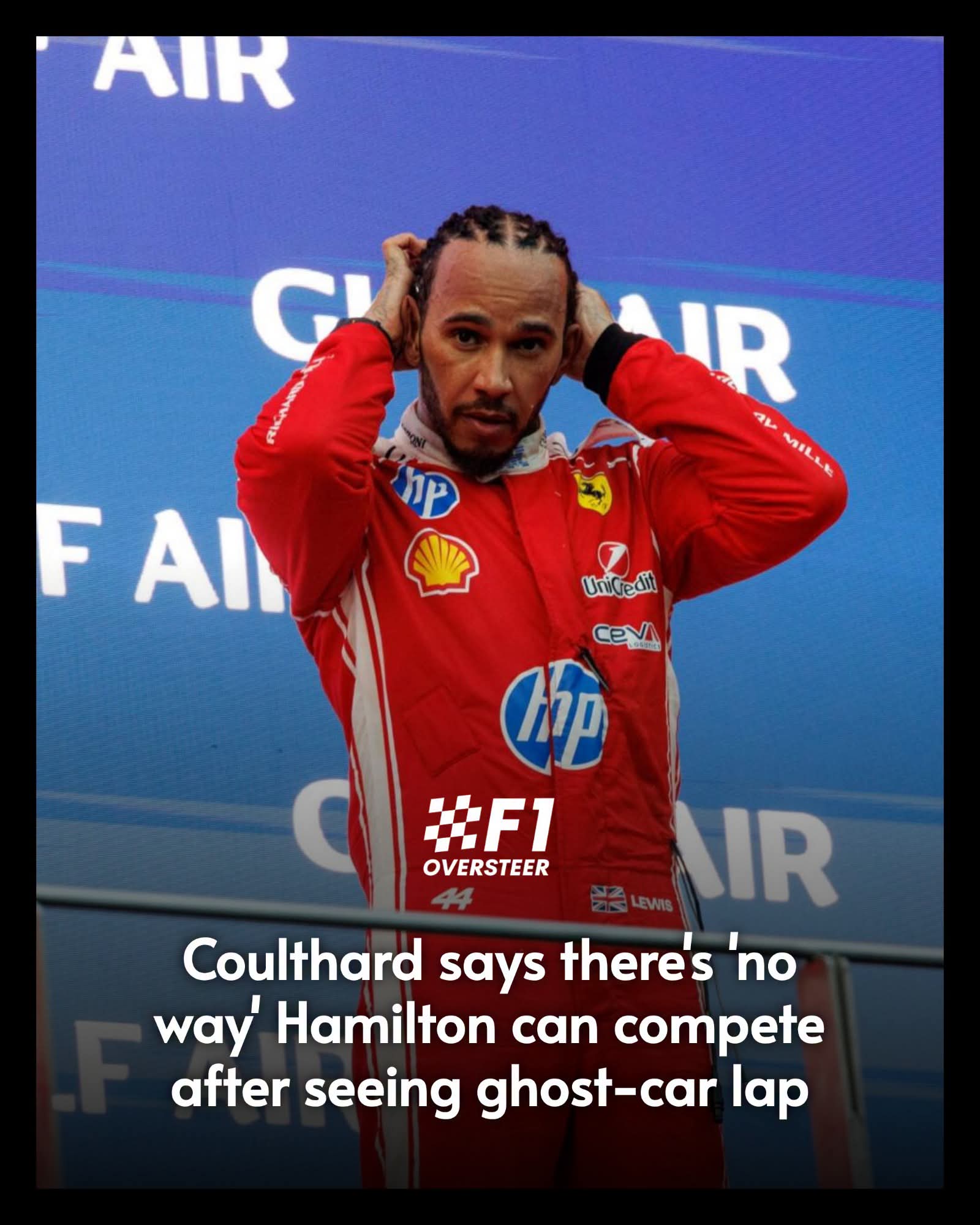
DAVID COULTHARD REVEALS THE FERRARI WEAKNESS THAT LEFT LEWIS HAMILTON “NO WAY” TO MATCH MAX VERSTAPPEN
HAMILTON’S PODIUM HID A SERIOUS FERRARI PROBLEM
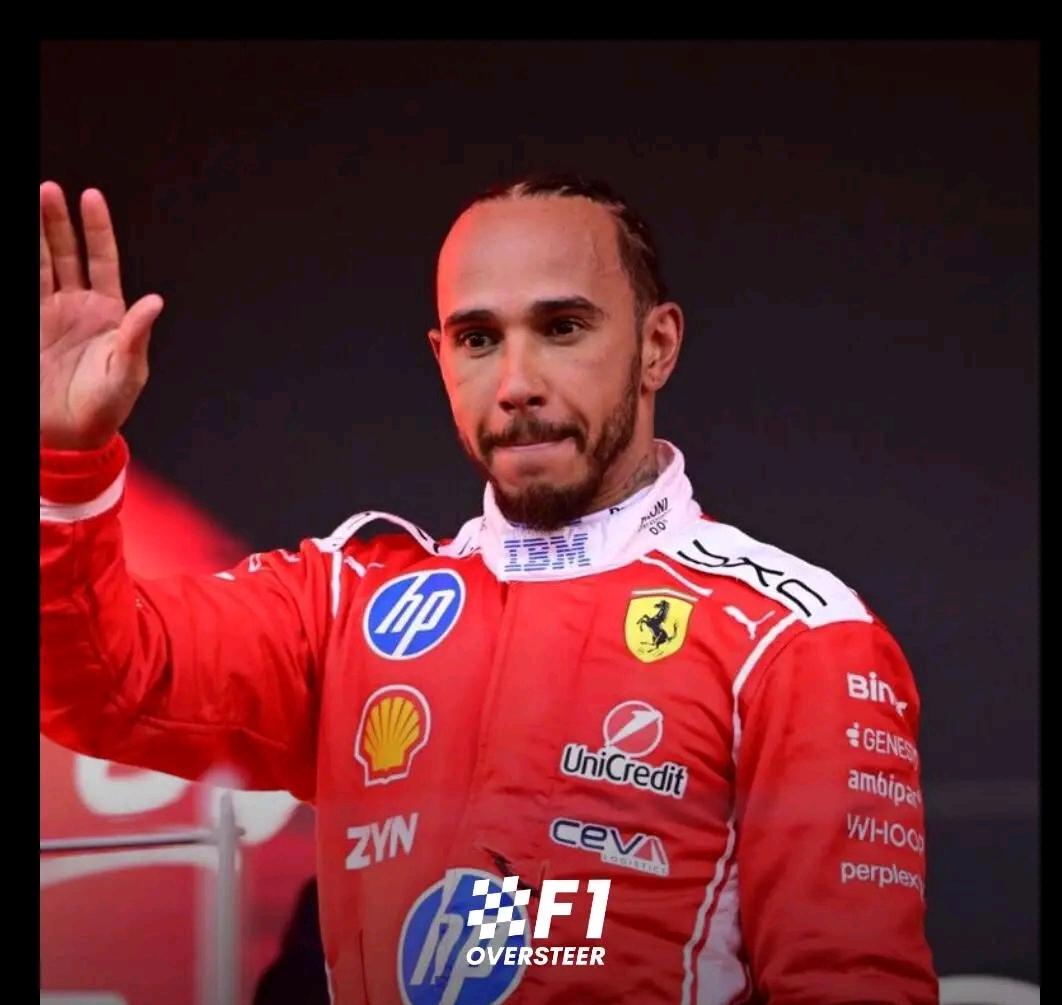
Lewis Hamilton produced one of the most impressive recovery drives of his Ferrari career at the 2026 Bahrain Grand Prix in Malaysia.
Starting from the front row, Hamilton’s race initially appeared to collapse after Ferrari’s early slick-tyre gamble left him struggling on a damp track. He dropped as low as 18th before fighting his way back through the field and eventually finishing third.
Max Verstappen won from pole, with Kimi Antonelli taking second and Hamilton completing the podium.
But beneath Hamilton’s remarkable comeback was a problem that Ferrari still appears unable to solve.
The Ferrari looked competitive through many corners.
On the straights, however, the picture was very different.
And according to former F1 driver David Coulthard, a ghost-car comparison between Hamilton and Verstappen made the weakness impossible to ignore.
COULTHARD SAW THE DIFFERENCE ON THE STRAIGHTS
Hamilton had already warned before the race that Ferrari was losing significant time to Red Bull when both cars were at full throttle.
He estimated the deficit at roughly three or four tenths on the straights.
Coulthard’s analysis backed up that observation.
The former McLaren and Red Bull driver pointed out that Ferrari’s chassis appeared to be working extremely well, particularly in lower-speed sections, but Red Bull was able to claw back substantial time through its power unit and aerodynamic efficiency.
His most damaging conclusion concerned the run toward the final corner.
According to Coulthard, there was effectively no way for Hamilton to match Verstappen in that particular section.
That is a huge concern for Ferrari because a deficit on a straight cannot easily be recovered simply by driving harder.
THE GHOST CAR TELLS A DIFFERENT STORY
Ghost-car footage is particularly useful in F1 because it allows analysts to compare two laps almost corner by corner.
Instead of simply looking at the final lap time, viewers can see exactly where one car gains or loses time.
In Hamilton’s case, the comparison with Verstappen revealed the Ferrari losing ground during high-speed acceleration and full-throttle sections.
That supports Hamilton’s own explanation.
Ferrari was not necessarily suffering from a universally slow car.
It was suffering from an imbalance.
The SF26 could perform strongly in certain corners, but once the cars were pointed straight and energy deployment became critical, Verstappen’s Red Bull could create a gap.
FERRARI MAY HAVE ONE OF THE BEST CHASSIS PACKAGES
This is what makes the situation particularly frustrating for Hamilton and Ferrari.
Coulthard’s assessment was not simply that Ferrari had built a bad car.
Quite the opposite.
He suggested Ferrari was doing an excellent job mechanically, particularly through slower corners.
That means Maranello may already have a strong foundation.
The problem is that Formula 1 rewards the entire lap—not individual sectors.
A car can be brilliant in the corners and still lose a qualifying battle if its rival gains several tenths on the straights.
That is exactly the type of performance deficit Ferrari needs to address.
THE POWER UNIT IS PART OF THE EQUATION
The straight-line problem is particularly significant under the 2026 regulations.
The new generation of Formula 1 power units places much greater emphasis on electrical deployment and energy management.
That means straight-line performance is not simply about the combustion engine.
Battery deployment, energy harvesting, electrical power delivery and aerodynamic drag all interact.
If a car cannot deploy energy as efficiently as its rival, the loss can become extremely visible on a long straight.
That appears to be what Hamilton experienced against Verstappen.
ANTHONY DAVIDSON SAW THE SAME THING
Coulthard was not alone in reaching that conclusion.
Sky Sports F1 analyst Anthony Davidson also examined the ghost-car footage and highlighted Hamilton’s losses associated with energy deployment.
The analysis effectively matched what Hamilton had already told the media.
That makes the problem more difficult for Ferrari to dismiss.
When the driver’s own comments, the telemetry-style visual comparison and independent analysis all point toward the same weakness, the team has a much clearer development target.
HAMILTON’S PODIUM SHOULD NOT BE UNDERESTIMATED
Despite all of this, Hamilton’s third-place finish deserves enormous credit.
His race nearly fell apart at the beginning.
The early switch to slick tyres proved badly timed because the circuit was not ready for them. Hamilton subsequently dropped deep into the field.
But rather than allowing the strategy error to end his afternoon, he began recovering.
He overtook multiple rivals, managed his tyres and took advantage of changing conditions and Safety Car interventions.
Eventually, he passed Isack Hadjar late in the race to secure third place. Reuters reported that Hamilton’s recovery took him from 18th to the podium after the early tyre gamble.
That makes the podium arguably more impressive than a normal third-place finish.
HAMILTON COULD NOT BEAT VERSTAPPEN ON PURE PACE
The more worrying conclusion for Ferrari is what might have happened without the chaos.
Verstappen started from pole and ultimately won by 2.307 seconds.
Hamilton finished 4.919 seconds behind the Red Bull.
But the final gap does not tell the whole story.
The race contained rain, tyre mistakes, Safety Cars and several strategic complications.
Under more conventional conditions, Ferrari may still have struggled to match Verstappen’s Red Bull over a full stint.
That is the question Ferrari needs to answer.
Can the team actually fight Red Bull on pure performance, or does it currently need unpredictable races to create opportunities?
THE FRONT ROW PROVED FERRARI HAS SPEED
There is also reason for optimism.
Hamilton qualified second at Sepang with a 1:35.428, just 0.298 seconds behind Verstappen’s pole time.
That is hardly the profile of a fundamentally slow car.
Ferrari clearly has enough performance to challenge for the front row.
The problem appears to emerge when the car is compared directly with Red Bull across different sections of the lap.
That distinction is crucial.
Ferrari does not necessarily need to redesign everything.
It needs to understand exactly where its current package is surrendering performance.
HAMILTON’S COMMENTS NOW LOOK EVEN MORE IMPORTANT
Hamilton’s pre-race assessment initially sounded like the usual driver complaint about straight-line speed.
After seeing the ghost-car comparison, however, his comments appear much more significant.
He had already identified the weakness.
Coulthard then saw the same deficit through the data-style comparison.
Davidson reached a similar conclusion.
That suggests Hamilton understands his car reasonably well.
The challenge is not necessarily identifying the problem.
The challenge is fixing it.
FERRARI HAS A DIFFICULT DEVELOPMENT TRADE-OFF
Solving the problem may not be straightforward.
Reducing aerodynamic drag could improve Ferrari’s straight-line performance.
But removing too much downforce could damage the car’s cornering ability.
Ferrari’s current strength appears to be its performance in certain corners.
Therefore, simply reducing drag could create a new weakness.
Engineers have to find additional efficiency without sacrificing the mechanical and aerodynamic strengths already present.
That is one of the hardest jobs in modern F1 development.
THE REAL QUESTION IS WHETHER FERRARI CAN CLOSE THE GAP
Hamilton’s podium has created an interesting contradiction.
Ferrari has shown that it can produce a car capable of qualifying on the front row.
Hamilton has shown that he can recover from a disastrous start and still finish on the podium.
But Verstappen has shown that Red Bull remains capable of winning when the conditions allow the car’s strengths to come through.
The gap is therefore not necessarily as large as the championship standings might suggest—but Ferrari still has a performance problem that cannot be ignored.
HAMILTON’S EXPERIENCE IS BUYING FERRARI TIME
One positive for Ferrari is Hamilton himself.
At 41, he is no longer simply relying on raw qualifying speed.
His experience becomes increasingly valuable during races where conditions change rapidly.
The Sepang race demonstrated that.
Hamilton survived a disastrous strategic call, managed the recovery and found opportunities throughout the field.
That kind of experience can turn a poor weekend into a podium.
But it cannot completely compensate for a car that is consistently slower in critical sections.
Eventually, Ferrari needs the machinery to meet the driver’s ability.
VERSTAPPEN HAS GIVEN RED BULL A WARNING SHOT
Verstappen’s victory was particularly significant because it was his first win of the 2026 season.
He converted pole into victory despite the chaotic conditions and took maximum points from a race where Ferrari had looked dangerous in qualifying.
That is exactly the kind of result Red Bull will want to build on.
Ferrari, meanwhile, has to make sure Hamilton’s podium is not simply viewed as a successful recovery from a strategic mistake.
The bigger objective is to make the Ferrari fast enough that Hamilton does not need a chaotic race to fight for victory.
THE BOTTOM LINE FOR HAMILTON AND FERRARI
David Coulthard’s “no way” assessment is intentionally blunt, but the underlying technical point is serious.
Hamilton cannot realistically out-drive a significant straight-line deficit forever.
He can recover from mistakes.
He can outperform expectations.
He can maximize Ferrari’s strengths.
But if Verstappen continues gaining several tenths on the straights, Ferrari will eventually need a technical solution rather than another heroic Hamilton recovery.
The encouraging part is that the Ferrari clearly has genuine pace.
Hamilton qualified on the front row.
He recovered from 18th to third.
And the car appears strong through several types of corners.
The next step is turning that promising package into a complete one.
Because if Ferrari can retain its cornering advantage while eliminating the straight-line weakness, Hamilton may finally have the weapon he needs to challenge Verstappen on equal terms.
Until then, the ghost car has exposed an uncomfortable truth for Maranello:
Ferrari may be close—but in the places where Verstappen is fastest, Hamilton still has no answer.