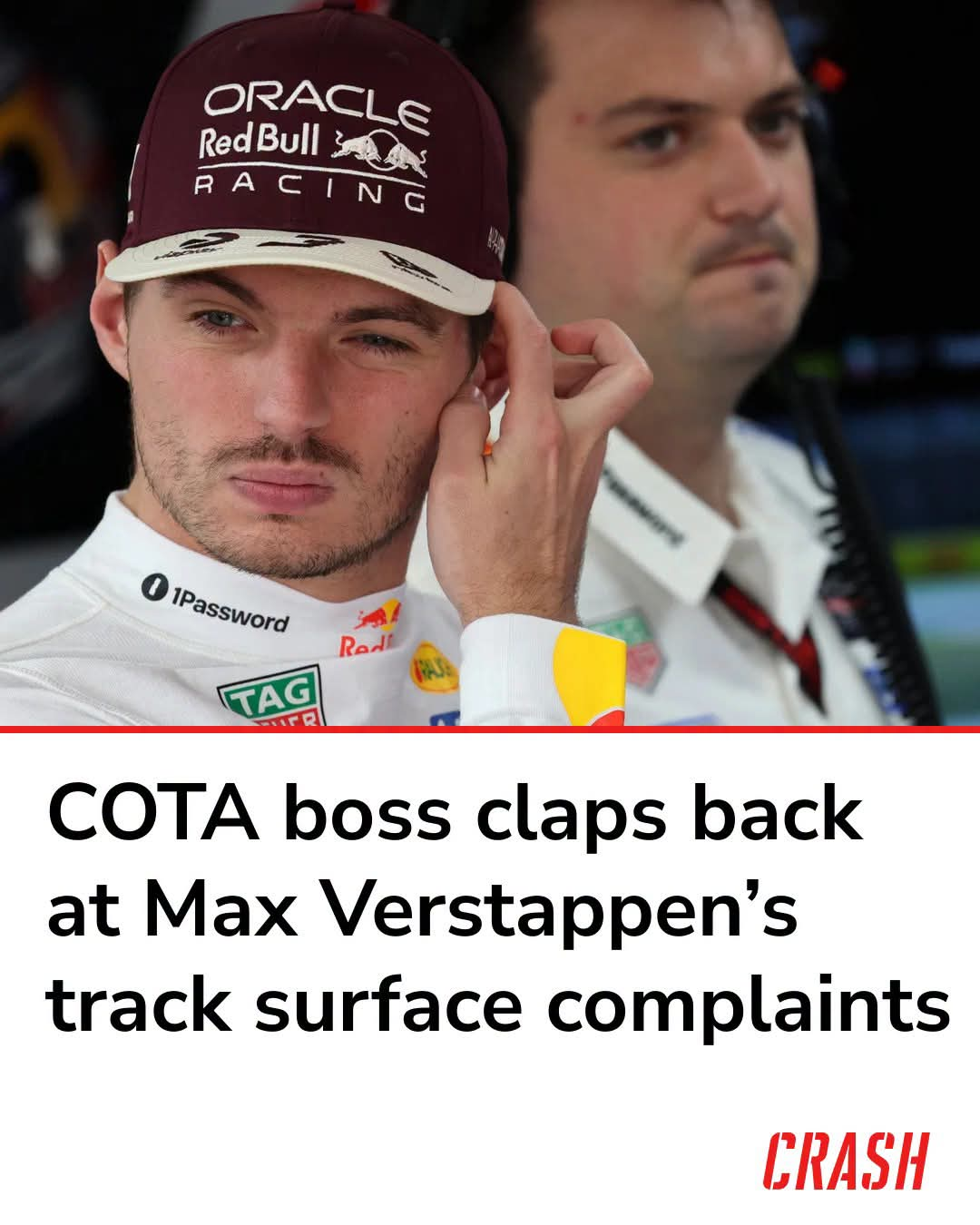
COTA’s boss has hit back at Verstappen’s claims over the US GP track surface…🚨 BREAKING: COTA BOSS HITS BACK AT MAX VERSTAPPEN OVER US GP TRACK SURFACE CLAIMS
The Circuit of The Americas (COTA) boss has hit back at Max Verstappen following the Red Bull driver’s comments about the track surface ahead of the United States Grand Prix, reigniting the debate over circuit conditions, driver safety and the challenges facing Formula 1 at one of its most demanding venues.
Verstappen, a four-time world champion, has never been afraid to speak openly about circuit conditions, and concerns surrounding the Austin track surface have once again drawn attention to the difficulties drivers face when pushing their cars to the limit. The response from COTA’s leadership has added another talking point to an already intense United States Grand Prix weekend.
The Circuit of The Americas, located in Austin, Texas, is one of the most recognisable venues on the Formula 1 calendar. Its combination of fast corners, heavy braking zones, dramatic elevation changes and technical sections makes it a favourite among many racing fans. However, the condition of the asphalt can significantly influence how drivers approach the circuit.
VERSTAPPEN’S CONCERNS PUT COTA UNDER THE SPOTLIGHT
Verstappen’s comments have placed renewed attention on the quality and consistency of the track surface at COTA.
For Formula 1 drivers, the condition of the asphalt is about far more than comfort. Surface irregularities can affect a car’s balance, compromise tyre contact and make it more difficult to maintain consistent performance throughout a lap.
Modern Formula 1 cars are particularly sensitive to ride height and aerodynamic performance. When a car encounters bumps or uneven sections, the driver may need to adjust braking points, steering inputs and throttle application to maintain control.
At a circuit like Austin, where several corners demand rapid changes of direction, an inconsistent surface can make the challenge even greater.
Verstappen’s observations have therefore contributed to a wider discussion about whether circuit conditions are allowing drivers to extract the maximum performance from their cars without unnecessary compromises.
However, the precise wording of Verstappen’s original remarks and the details of the COTA boss’s response have not been provided in the initial report. The disagreement should not be interpreted as a confirmed safety dispute without the original statements.
COTA BOSS DEFENDS THE CIRCUIT
The response from COTA’s leadership has brought the circuit’s perspective into the debate.
Organising a Formula 1 race involves maintaining a venue that must accommodate some of the fastest racing machinery in the world while meeting the sport’s technical and safety requirements.
Track surfaces also face considerable challenges from weather conditions, temperature changes, repeated vehicle loads and the natural ageing of asphalt. These factors can influence grip levels and surface characteristics over time.
For circuit officials, maintaining a racing surface is an ongoing responsibility rather than a one-time exercise. Resurfacing work, inspections and maintenance decisions must be carefully coordinated around the demands of hosting major international events.
A response from COTA’s boss highlights the importance of considering the circuit’s position alongside the drivers’ experiences. Drivers judge a venue from behind the wheel, while organisers must consider engineering requirements, maintenance schedules and the overall condition of the facility.
Nevertheless, the exact argument made by COTA’s boss must be verified before specific quotations or claims about the circuit’s maintenance are attributed to the official.
WHY THE TRACK SURFACE MATTERS TO FORMULA 1 TEAMS
Track conditions can have a significant influence on the competitive order during a Grand Prix weekend.
A bumpy surface may force teams to reconsider suspension settings, ride height and aerodynamic compromises. Engineers must find a setup that provides enough stability over uneven sections without sacrificing performance through faster corners.
Tyre management is another important consideration.
The level of grip available affects how much energy is transferred through the tyres during braking, acceleration and cornering. If the surface behaves differently from what teams expect, tyre degradation and performance can become harder to predict.
That uncertainty is especially important during qualifying, when drivers attempt to extract the maximum possible performance over a single lap.
Even a small loss of confidence through a high-speed corner can cost valuable time. At the highest level of Formula 1, where margins between competitors are often extremely small, those differences can determine starting positions and ultimately influence race results.
A CHALLENGE FOR VERSTAPPEN AND RED BULL
For Verstappen and Red Bull, understanding the track surface will be essential to preparing a competitive car for the United States Grand Prix.
The Dutchman is renowned for his ability to extract performance from difficult situations, but even the most accomplished drivers must adapt when circuit conditions create additional challenges.
Red Bull’s engineers will need to evaluate the available data, study tyre behaviour and determine how the car responds across the circuit’s different sectors.
The team’s ability to find the right balance could prove decisive, particularly if its rivals arrive with competitive setups and strong pace.
Verstappen’s feedback will form an important part of that process. Driver comments help engineers understand characteristics that may not be immediately obvious from telemetry alone.
At the same time, the team’s ultimate objective remains straightforward: maximise performance and secure the strongest possible result.
THE DEBATE IS FAR FROM OVER
The exchange between Verstappen and COTA’s leadership has created another storyline for the United States Grand Prix.
The discussion highlights the sometimes difficult relationship between drivers and circuit organisers, particularly when opinions differ over the condition of a venue.
Drivers want surfaces that allow them to race confidently and consistently, while organisers must balance maintenance demands with the practical realities of operating a major sporting facility.
Whether the disagreement leads to further changes or remains a talking point throughout the weekend will depend on the details of the comments and any subsequent action by circuit officials.
For now, attention will return to the track, where Verstappen and his rivals must turn their preparations into results.
The central question is whether the surface will become a decisive factor in the battle for victory at Austin—or whether the drivers and teams can adapt well enough to keep the focus firmly on racing.
As the United States Grand Prix unfolds, the debate surrounding COTA’s track surface is likely to remain an important talking point among drivers, teams and fans.
#F1 #USGP #MaxVerstappen #RedBullRacing #COTA #Formula1
Editorial note: The original comments and the COTA boss’s exact response were not supplied. Verify both statements against the original interview before publishing this as a factual report.