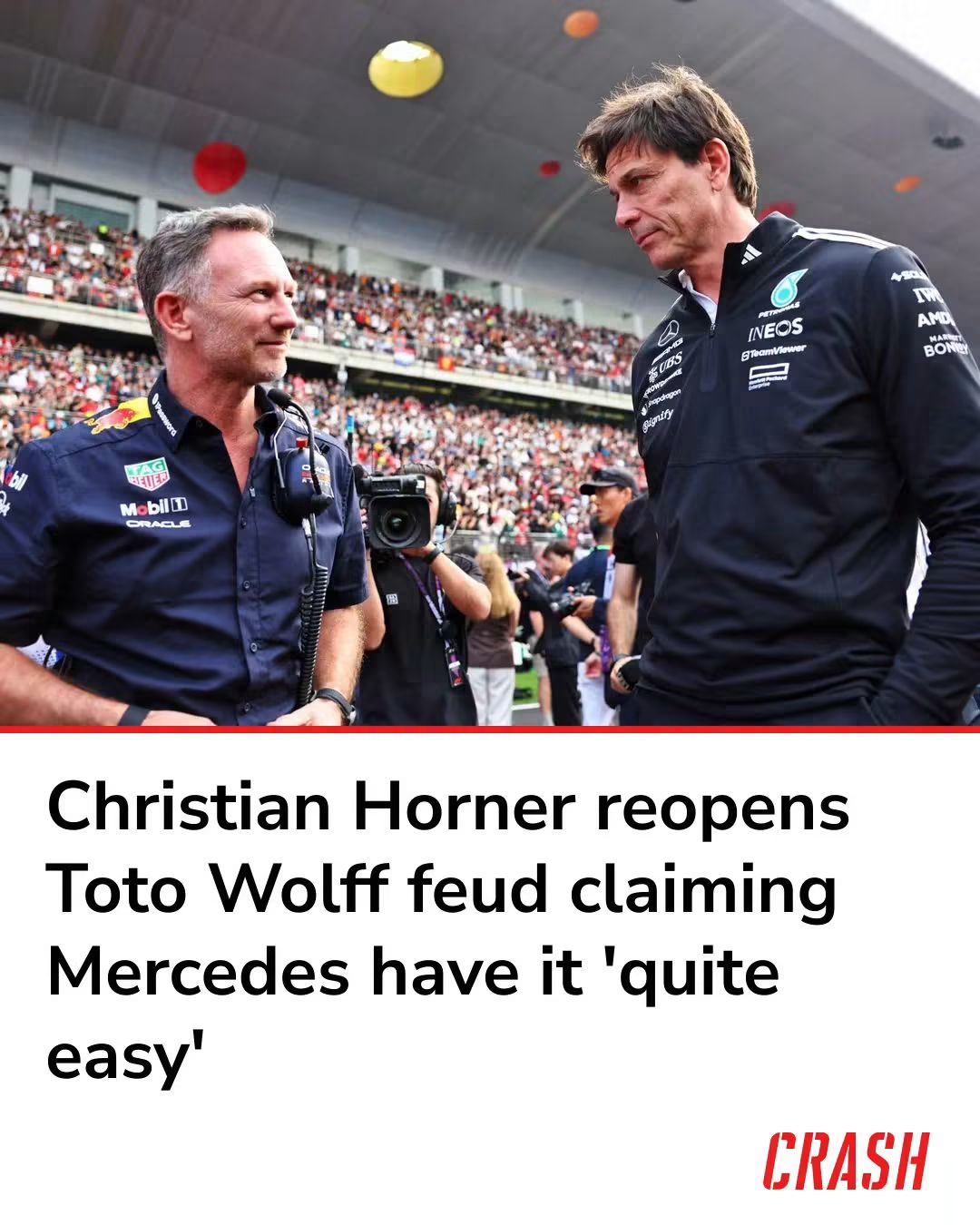
Christian Horner has never been one to stay quiet when the subject turns to Toto Wolff. Even after leaving Red Bull Racing, the former team principal has reopened one of Formula 1’s most colourful feuds by arguing that the Mercedes boss currently enjoys an unusually smooth ride at the head of the sport.
In a recent interview, Horner stated that Wolff has it “quite easy at the moment.” His reasoning is straightforward: without a true antagonist in the paddock willing and able to challenge him publicly, the Austrian faces far less pressure than during the height of the Red Bull-Mercedes battles. Horner specifically pointed to McLaren CEO Zak Brown, noting that Brown’s team relies on Mercedes power units and is therefore “compromised” and unable to “ruffle feathers” the way Horner once did.
WHY HORNER BELIEVES FORMULA 1 NEEDS PROPER RIVALRIES
Horner framed the issue in broader sporting terms. “All sport needs rivalry, whether it’s Ferguson and Wenger, Mourinho and Guardiola,” he said. “It percolates and polarises. I used that to galvanise good people to take on Mercedes.”
The comparison lands because those football rivalries were never purely about results. They created narrative, sharpened focus inside the organisations, and gave fans a reason to care beyond the scoreline. In Formula 1, the Horner-Wolff dynamic performed a similar function for years. Press conferences became theatre. Team principals’ meetings occasionally turned combustible. Netflix’s *Drive to Survive* turned the personal edge into appointment viewing. That friction, Horner argues, helped motivate people inside Red Bull to close the gap on a dominant Mercedes.
Now that dynamic has largely disappeared. Red Bull sits outside the title fight, and no other team principal currently matches the willingness—or the platform—to go toe-to-toe with Wolff in public the way Horner once did.
THE HISTORICAL CONTEXT OF THE HORNER-WOLFF FEUD
The rivalry did not begin in 2021, but that season defined it. Max Verstappen’s first title, sealed in controversial circumstances in Abu Dhabi, came against Lewis Hamilton and a Mercedes team that had owned the hybrid era. The on-track intensity spilled into the garage next door. Accusations flew. Radio messages grew heated. Personal jibes became common currency.
Later clashes—over porpoising safety, driver comments, engine performance—kept the needle sharp even when Red Bull pulled clear on track. Wolff has since described periods of the relationship in blunt terms, while also acknowledging that Horner’s presence as a protagonist made the sport more interesting. The two men exchanged messages after Horner’s departure that mixed respect with residual edge, confirming that the rivalry had been both professional and deeply personal.
Horner’s exit from Red Bull in July 2025 after two decades ended that chapter. The team has since restructured. Mercedes, meanwhile, has returned to the front of the grid. Early indications in the current season show the Silver Arrows leading the constructors’ standings, with a young driver at the top of the drivers’ championship after a string of victories. For the first time since 2020 and 2021 respectively, a Drivers’ and Constructors’ title for Mercedes looks highly probable.
WHAT THIS MEANS FOR MERCEDES, MCLAREN AND THE REST OF THE GRID
If Horner is correct, the absence of a genuine political and personal rival changes the environment inside Mercedes. Teams that enjoy relative peace can focus more purely on performance. Yet the same comfort can reduce the external pressure that sometimes sharpens decision-making and internal accountability.
For McLaren the observation is particularly pointed. Running Mercedes engines creates a commercial and technical relationship that limits how freely Zak Brown can criticise the power-unit supplier. Other customer teams face similar constraints. That leaves the paddock without a natural sparring partner for Wolff at a moment when Mercedes sits at the top of the pile.
Red Bull’s current position further softens the landscape. With the Milton Keynes squad no longer the primary threat, the old bipolar tension has dissolved. Newer team principals and different power structures have not yet produced an equivalent public antagonist.
THE WIDER IMPACT ON FORMULA 1’S ENTERTAINMENT VALUE
Formula 1 has always thrived on personalities as much as pure speed. The sport’s commercial growth in recent years owed a great deal to the characters who filled the screen and the quote sheets. When two team principals with strong track records and contrasting styles spent years locking horns, the product gained an extra layer that pure on-track competition sometimes lacked.
Horner’s comments arrive at a moment when the grid looks more competitive in some respects and more settled in others. A dominant Mercedes without a vocal rival risks a quieter paddock narrative. Whether that helps or hinders the show remains open to debate. Some will argue that on-track racing is what ultimately matters. Others will note that the stories surrounding the racing—feuds, mind games, public pressure—have historically amplified interest.
LOOKING AHEAD: WILL A NEW RIVALRY EMERGE?
Horner himself remains linked to possible returns to the sport. Any future role he takes would immediately recalibrate the political temperature. Even without him, the combination of rising young talents, shifting manufacturer alliances, and the natural ambition of other team principals could eventually produce a fresh antagonist for Wolff.
For now, however, Horner’s assessment stands as a pointed observation from someone who once thrived on exactly the kind of friction he now says is missing. Mercedes sits in a strong position. Wolff faces fewer public challenges from across the garage. And one of Formula 1’s most enduring rivalries has, for the time being, gone quiet.
Whether that silence represents progress or a loss of edge is a question the sport will answer on the track—and in the press conferences—over the months ahead.