Formula 1 has always been a sport defined by a unique combination of driver talent and engineering excellence. While fans often debate whether championships are won by exceptional drivers or dominant cars, one current F1 star has suggested a revolutionary idea that could settle the argument once and for all.
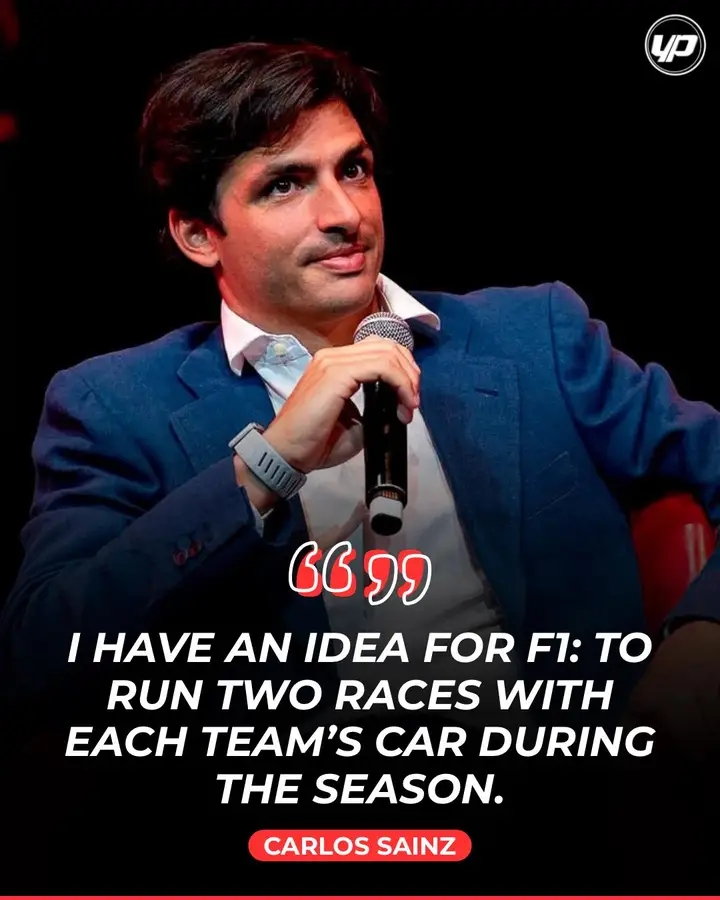
Carlos Sainz has put forward a bold concept that would fundamentally transform the way Formula 1 operates. Rather than drivers remaining tied to a single team throughout the season, the Spaniard believes competitors should race for multiple teams across the championship, creating what he considers a genuine test of driving ability.
The proposal is unlikely to become reality anytime soon, but it has reignited one of Formula 1’s oldest debates: how much of success is determined by the driver, and how much is determined by the machinery beneath them?
SAINZ’S VISION FOR A TRUE DRIVERS’ CHAMPIONSHIP
Sainz suggested a system in which Formula 1 drivers would effectively be contracted by the sport itself rather than individual teams.
Under this model, every driver would compete in different cars throughout the season. A competitor might race two events for Williams, two for Ferrari, two for Mercedes, two for McLaren, and so on.
The objective would be simple: eliminate the performance advantage that comes from being in the fastest car.
For decades, Formula 1 has seen dominant teams create periods of sustained success. Whether it was Ferrari in the early 2000s, Red Bull during Sebastian Vettel’s championship era, Mercedes throughout the turbo-hybrid era, or Red Bull again with Max Verstappen, superior machinery has often played a decisive role in title battles.
Sainz’s proposal seeks to level that playing field entirely.
If every driver had equal access to every car on the grid, the championship standings would theoretically reflect pure driving performance rather than engineering superiority.
It’s a fascinating concept that challenges the very foundation of Formula 1.
WHY THE CAR HAS ALWAYS MATTERED IN FORMULA 1
One of the biggest criticisms of Formula 1 from casual fans is that the fastest car often determines the champion before the season even begins.
History provides plenty of examples.
Even legendary champions such as Michael Schumacher, Lewis Hamilton, Ayrton Senna, Alain Prost, and Max Verstappen benefited from driving cars capable of consistently winning races.
That does not diminish their achievements. In fact, extracting maximum performance from a championship-winning machine requires extraordinary skill.
However, Formula 1 has never been a spec series. The sport was built around innovation, engineering creativity, and technological development.
Unlike categories such as IndyCar or Formula 2, where equipment is far more standardized, Formula 1 celebrates the competition between manufacturers and designers just as much as the battle between drivers.
This is precisely why discussions like Sainz’s proposal generate such passionate reactions.
WHAT WOULD HAPPEN IF EVERY DRIVER RACED EVERY CAR?
The idea creates endless fascinating scenarios.
Imagine Verstappen stepping into a Haas for a weekend.
Picture Charles Leclerc driving a McLaren while Lando Norris races a Ferrari.
Consider George Russell taking over a Red Bull while Oscar Piastri spends a race weekend in a Mercedes.
Fans would finally get direct comparisons between drivers that have remained impossible for generations.
Questions that dominate Formula 1 discussions could potentially be answered:
- Is Verstappen truly the fastest driver on the grid regardless of machinery?
- Could Hamilton still challenge the younger generation in equal equipment?
- Would Norris outperform Leclerc in the same car?
- How would rookies compare against world champions when given identical opportunities?
The concept would create one of the most intriguing sporting experiments in motorsport history.
THE MAJOR PROBLEMS WITH SAINZ’S IDEA
While the proposal sounds exciting in theory, implementing it would be extraordinarily difficult.
Modern Formula 1 cars are developed around specific driver preferences. Seating positions, steering wheel layouts, brake feel, suspension settings, and aerodynamic characteristics are all tailored to maximize performance for particular drivers.
Constantly rotating drivers between teams would create logistical nightmares.
Teams invest hundreds of millions of dollars developing cars designed to suit their own objectives and driver lineups. Convincing them to hand over their machinery to rivals would be almost impossible.
There is also the issue of intellectual property.
Formula 1 teams guard technical secrets with extreme care. Allowing competitors to regularly drive rival cars could expose valuable information and reduce the incentive for innovation.
Most importantly, it would fundamentally alter the DNA of Formula 1.
The sport has always been about the combination of driver excellence and engineering brilliance. Removing one side of that equation risks turning Formula 1 into an entirely different category.
WHY SAINZ’S COMMENTS REFLECT A GROWING F1 DEBATE
Although his proposal is unlikely to be adopted, Sainz’s comments highlight an increasingly common discussion among fans and experts.
As Formula 1 becomes more data-driven and technologically advanced, many supporters want better ways to evaluate individual driver performance.
The current generation features exceptional talents throughout the grid. Yet some drivers spend years in midfield machinery, never receiving an opportunity to prove what they could achieve in a championship-contending car.
Meanwhile, others benefit from joining top teams at precisely the right moment.
This reality often leaves fans wondering how different the standings would look if everyone had equal equipment.
Sainz’s suggestion may be extreme, but it shines a spotlight on a legitimate question that Formula 1 continues to wrestle with.
THE IMPACT ON THE WORLD CHAMPIONSHIP
If Formula 1 somehow adopted a rotating-car system, the championship landscape would change dramatically.
Consistency would become even more important than outright speed.
Drivers would need to adapt instantly to different handling characteristics, power delivery systems, braking behavior, and aerodynamic philosophies.
The most versatile competitors would likely thrive.
Historically, drivers known for their adaptability—such as Fernando Alonso, Lewis Hamilton, and Max Verstappen—might enjoy a significant advantage in such a format.
At the same time, specialists who excel in cars built around their preferences could struggle when forced to adjust every few races.
The championship would become less about maximizing a single package and more about demonstrating all-around driving mastery.
COULD FORMULA 1 EVER CONSIDER SOMETHING SIMILAR?
A complete implementation of Sainz’s idea remains virtually impossible.
Teams, manufacturers, sponsors, and stakeholders have too much invested in the current structure.
However, Formula 1 could potentially explore smaller experiments in the future.
All-star events, exhibition races, simulator competitions, or special testing sessions featuring drivers from different teams could offer fascinating insights without disrupting the championship itself.
Such initiatives would give fans a glimpse into how the sport’s biggest stars compare in identical machinery while preserving the competitive integrity of Formula 1.
FINAL THOUGHTS
Carlos Sainz’s proposal may sound radical, but it touches on one of the most enduring questions in motorsport.
What truly makes a champion—the driver or the car?
The reality is that Formula 1’s greatness comes from the combination of both. The sport’s appeal lies in watching world-class drivers push cutting-edge machines to their limits while teams battle to create the fastest package possible.
Even if Sainz’s vision never becomes reality, it has succeeded in sparking a fascinating conversation. And for fans who have spent years arguing about who would win in equal machinery, the idea offers a tantalizing glimpse into a Formula 1 world where every driver finally gets the same opportunity to prove their worth.
Whether that would improve the sport or undermine its identity remains open to debate—but it is a discussion that is unlikely to disappear anytime soon.