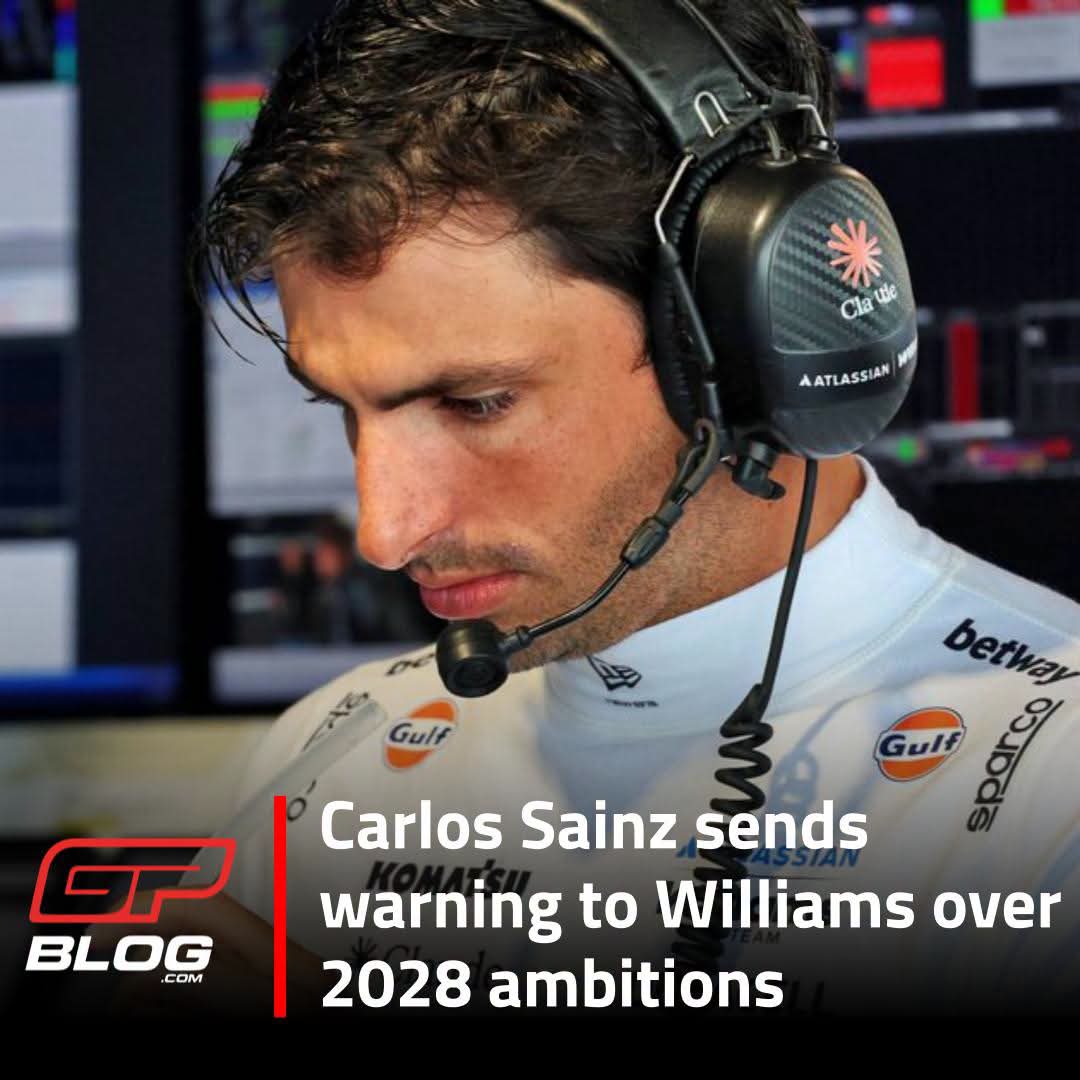
Carlos Sainz has delivered one of his clearest messages yet about his future ambitions in Formula 1, admitting that while he believes in Williams’ long-term project, he is already evaluating how long he is prepared to wait before the team becomes a genuine race-winning contender.
The Spaniard joined Williams with the vision of helping revive one of Formula 1’s most iconic teams. However, after a difficult start to the 2026 season, Sainz has openly acknowledged that the road back to the front may be taking longer than expected.
While Williams team principal James Vowles has repeatedly pointed toward 2028 as a realistic target for challenging the sport’s elite, Sainz appears determined to accelerate that timeline.
WILLIAMS’ REBUILD HAS HIT AN EARLY OBSTACLE
Williams entered Formula 1’s new era hoping to build on the momentum generated during previous seasons. Instead, the opening phase of 2026 has highlighted just how difficult the journey back to competitiveness remains.
After seven rounds, Williams has struggled to consistently score points, leaving both Sainz and teammate Alex Albon fighting in the midfield rather than challenging the leading teams.
For Sainz, the situation presents a complicated dilemma. On one hand, he joined the Grove-based outfit believing in its long-term vision. On the other, Formula 1 careers are limited, and drivers at the highest level rarely want to spend years waiting for potential success.
The four-time Grand Prix winner understands that patience is necessary during a rebuild, but patience in Formula 1 has limits.
WHY SAINZ’S COMMENTS MATTER
Sainz’s remarks are significant because they reveal the mindset of a driver still hungry for victories and championships.
Unlike younger drivers who can afford several rebuilding seasons, Sainz is entering a crucial stage of his career. Every year spent outside the fight for podiums is a year lost in the pursuit of major achievements.
His comments should not necessarily be interpreted as dissatisfaction with Williams. Instead, they reflect the reality of modern Formula 1, where drivers constantly balance loyalty to a project against their desire to compete at the highest level.
The Spaniard’s statement essentially serves as a challenge to Williams management: prove that the project is moving in the right direction and do it faster than expected.
JAMES VOWLES FACES A CRITICAL TEST
Few team principals have received as much praise for a rebuilding strategy as James Vowles.
Since arriving from Mercedes, Vowles has focused on restructuring Williams from the ground up, investing heavily in infrastructure, personnel, and long-term development.
The problem is that Formula 1 rarely rewards long-term plans unless short-term progress is visible.
Sainz’s arrival was viewed as a major statement of intent. Signing a proven race winner demonstrated that Williams was serious about returning to competitiveness.
However, if the team’s performance stagnates for multiple seasons, keeping a driver of Sainz’s caliber could become increasingly difficult.
THE 2028 TARGET MAY BE TOO FAR AWAY
The biggest concern for Williams is that Formula 1 evolves incredibly quickly.
A target that seems realistic today can become outdated within months if rival teams make faster progress.
Sainz himself hinted at this possibility by suggesting that Williams may already be further behind than anticipated.
The concern is not simply about points or race results. It is about whether the team is developing at a pace capable of catching Mercedes, Ferrari, McLaren, Red Bull, Audi, and Aston Martin in the coming years.
If those rivals continue improving while Williams progresses more slowly, the 2028 objective could become increasingly ambitious.
SAINZ’S RADICAL VISION FOR FORMULA 1
Adding another fascinating dimension to the discussion, Sainz recently proposed one of the most unconventional ideas Formula 1 has ever heard.
The Spaniard suggested a championship format where drivers would compete in every car on the grid throughout the season. Under the concept, drivers would no longer belong to individual teams but would instead rotate between machines, ensuring everyone has the same equipment over the course of a campaign.
While Sainz admitted such an idea is highly unlikely due to sponsorship, commercial, and contractual complications, it highlights a question that has existed in Formula 1 for decades.
How much success comes from the driver, and how much comes from the car?
The proposal may never happen, but it reflects Sainz’s belief that driver talent can sometimes be overshadowed by machinery.
WHAT THIS MEANS FOR THE DRIVER MARKET
Although there is no immediate indication that Sainz wants to leave Williams, his comments inevitably fuel speculation about future opportunities.
Formula 1’s driver market can change rapidly. Contracts, performance fluctuations, and new regulations often create unexpected openings.
If Williams fails to demonstrate meaningful progress over the next 12 to 18 months, rival teams could begin viewing Sainz as one of the most attractive experienced drivers available.
His combination of technical feedback, race-winning experience, and leadership qualities makes him a valuable asset for any ambitious project.
PREDICTION: WILLIAMS MUST SHOW PROGRESS BY 2027
The next season could become the most important period of Williams’ modern rebuilding effort.
Sainz remains committed to the project, but commitment alone cannot sustain a partnership indefinitely. Results, progress, and clear evidence of improvement will ultimately determine whether he remains patient.
If Williams takes a noticeable step forward in 2027, the Spaniard is likely to stay and continue building toward the team’s long-term vision.
However, if the team remains trapped in the midfield, difficult conversations could emerge much sooner than anyone at Grove would like.
For now, Sainz’s message is clear: he believes in Williams, but he wants success to arrive sooner rather than later. And in Formula 1, that kind of pressure can either accelerate a team’s rise—or expose just how far it still has to go.