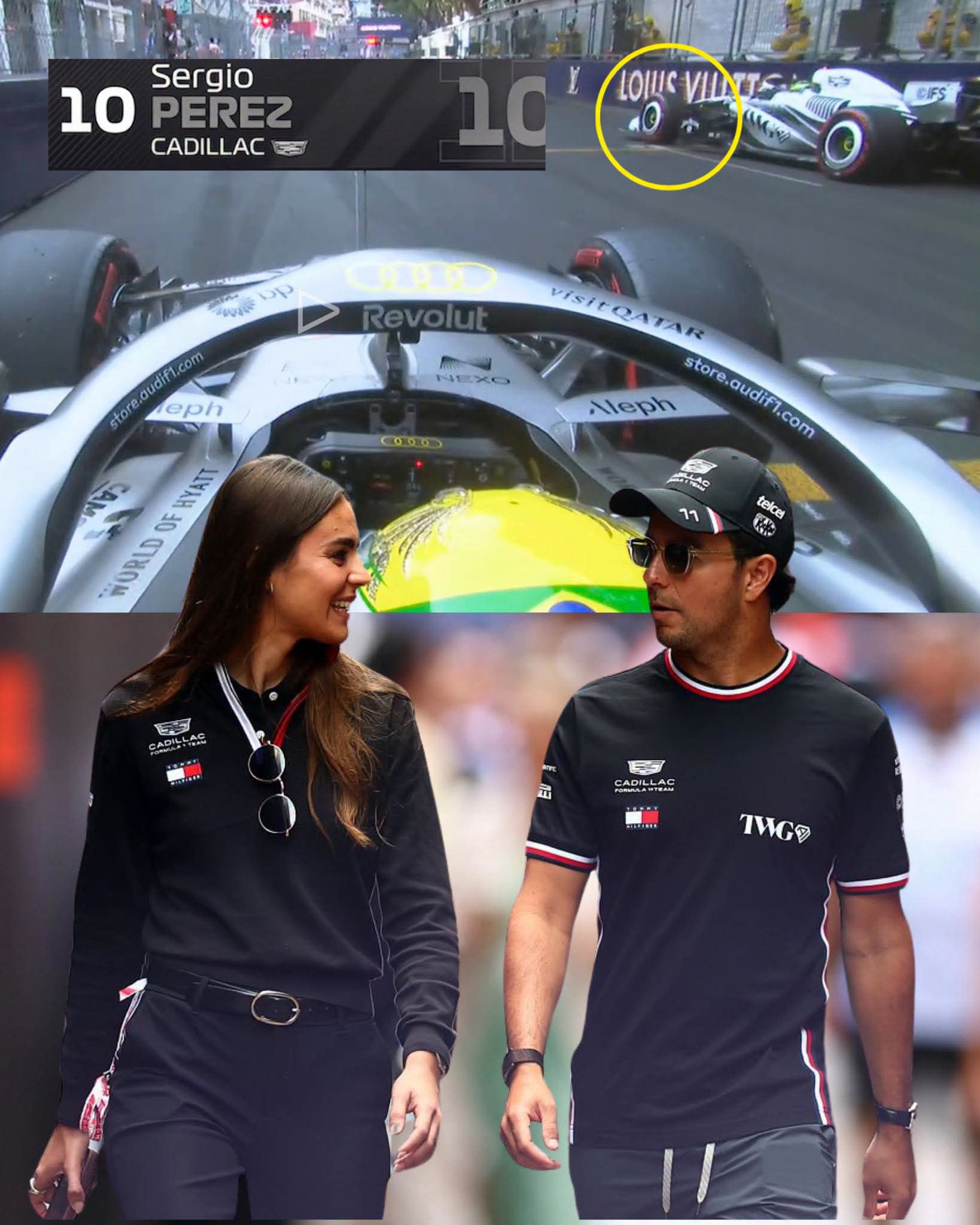
Cadillac and Sergio Perez have reportedly presented their initial defense to FIA stewards following the controversial incident that has sparked debate throughout the Formula 1 paddock. According to emerging details, the team argues that the movement of Perez’s car was not the result of driver error, but rather a mechanical issue involving a soft brake pedal that caused the car to roll unintentionally.
The situation has quickly become one of the most discussed topics ahead of the Spanish Grand Prix, with the final decision potentially carrying significant consequences for both Perez and Cadillac’s championship campaign.
CADILLAC’S MAIN ARGUMENT CENTERS ON A MECHANICAL FAILURE
At the heart of Cadillac’s defense is the claim that Perez experienced an abnormal brake pedal response at a critical moment. The team reportedly believes the issue caused an involuntary movement of the car, meaning the Mexican driver did not intentionally place the vehicle in an incorrect position or violate procedures.
Mechanical failures have always occupied a complicated space in Formula 1 regulations. While drivers are ultimately responsible for their cars on track, stewards have historically considered whether an incident was caused by factors beyond a driver’s control when determining penalties.
Cadillac’s strategy appears focused on proving that Perez could not reasonably have prevented the movement and that the circumstances warrant a different interpretation of the regulations.
PREVIOUS FIA CASES COULD PLAY A CRUCIAL ROLE
Perhaps the most important element of Cadillac’s defense is its reliance on precedent.
Formula 1 teams frequently reference previous stewarding decisions when challenging penalties or presenting appeals. Consistency remains one of the FIA’s most important objectives, and teams often argue that similar incidents should produce similar outcomes.
Cadillac reportedly believes there are historical examples where mechanical problems were treated differently from driver-caused infractions. By pointing to those cases, the team hopes to convince the stewards that Perez’s situation deserves the same consideration.
Whether the FIA agrees that the circumstances are comparable remains to be seen, but precedent can often become a powerful factor in controversial rulings.
WHY THIS CASE MATTERS BEYOND ONE DRIVER
Although the immediate focus is on Perez, the outcome could have wider implications across Formula 1.
Teams closely monitor every stewarding decision because each ruling helps shape future interpretations of the regulations. If Cadillac successfully argues that mechanical issues should reduce or eliminate responsibility in situations like this, other teams could use similar arguments in future investigations.
That is why incidents that may initially appear minor often attract enormous attention inside the paddock. Today’s ruling can become tomorrow’s precedent.
For Cadillac, the stakes are especially high as the team continues building its presence in Formula 1. Every point matters in a tightly contested midfield battle, and avoiding a costly penalty could provide a significant boost to its campaign.
CHECO PEREZ’S REPUTATION IS ALSO ON THE LINE
For Perez personally, the case is about more than championship points.
The Mexican driver arrived at Cadillac carrying enormous expectations. As one of the most experienced drivers on the grid, he was expected to provide leadership, consistency, and valuable technical feedback as the team establishes itself.
Any penalty resulting from procedural mistakes could attract criticism, particularly given the intense scrutiny that follows a driver of Perez’s profile. A successful defense, however, would reinforce the argument that the incident was beyond his control and preserve confidence in his performances.
With several strong drives already this season, Perez will be eager to ensure the story remains focused on his racing rather than off-track controversies.
WHAT THE FIA WILL HAVE TO DECIDE
The central question facing the stewards is straightforward: Was the movement of the car caused primarily by driver action or by a genuine mechanical issue?
If evidence supports Cadillac’s explanation, the team may have a strong case for leniency. Modern Formula 1 cars generate enormous braking forces, and even minor abnormalities can have significant consequences.
However, the FIA will also need to consider the broader implications of its decision. Any ruling must balance fairness to the team with the need to maintain clear and enforceable standards across the grid.
A DECISION THAT COULD SET THE TONE FOR FUTURE CASES
As Formula 1 heads into another crucial race weekend, the Perez investigation has become about far more than a single incident.
Cadillac’s defense highlights the increasingly technical nature of modern stewarding decisions, where data, telemetry, and mechanical analysis often prove just as important as what spectators see on television.
The final verdict could influence championship points, shape future FIA interpretations, and provide a clearer understanding of how Formula 1 intends to handle similar situations moving forward.
For now, all eyes remain on the stewards as Cadillac and Sergio Perez wait to learn whether their mechanical-failure argument will be enough to avoid further consequences.