CHINESE AUTOMOTIVE GIANT TAKES ANOTHER STEP TOWARD FORMULA 1
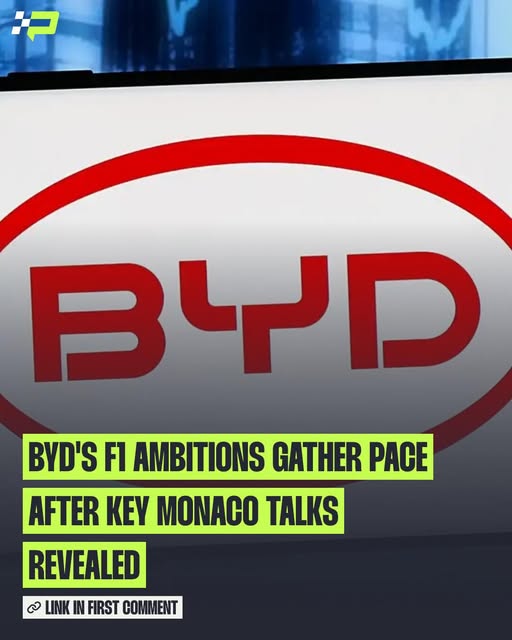
Formula 1’s growing global appeal may soon attract another major automotive powerhouse. BYD, one of the world’s largest vehicle manufacturers and a dominant force in the electric vehicle sector, has intensified its exploration of Formula 1 following a series of high-level meetings during the Monaco Grand Prix weekend.
The discussions involved BYD executive vice-president Stella Li, Formula 1 CEO Stefano Domenicali, and FIA President Mohammed Ben Sulayem. While no official commitment has been announced, the significance of these meetings cannot be ignored. They represent one of the clearest indications yet that BYD is seriously evaluating a future role within the sport.
At a time when Formula 1 is expanding into new markets and attracting unprecedented manufacturer interest, the prospect of BYD entering the championship could have major implications for the sport’s future landscape.
WHY FORMULA 1 IS ATTRACTING BYD
BYD’s rise over the past decade has been extraordinary. The company has transformed itself into one of the global automotive industry’s most influential players, competing directly with established giants across the electric and hybrid vehicle markets.
For a company with global ambitions, Formula 1 offers something few marketing platforms can match: worldwide visibility, cutting-edge technological development, and access to millions of passionate fans.
Stella Li emphasized that Formula 1’s combination of innovation, energy, and emotional connection is particularly appealing. From a business perspective, the championship provides a powerful stage for demonstrating engineering excellence while simultaneously strengthening brand recognition in key international markets.
As Formula 1 continues to expand its footprint across North America, Asia, and the Middle East, the commercial opportunities for manufacturers like BYD are becoming increasingly attractive.
MULTIPLE PATHWAYS INTO FORMULA 1 REMAIN OPEN
One of the most intriguing aspects of BYD’s exploration is that the company appears to be considering several different routes into the championship.
Launching a completely new Formula 1 team remains one possibility, although doing so would require enormous investment in infrastructure, personnel, and technical expertise. While BYD possesses substantial financial resources, building a competitive Formula 1 operation from scratch remains one of the most difficult challenges in motorsport.
Another option could involve purchasing a significant stake in an existing team. This approach would provide immediate access to experienced personnel, established facilities, and existing competitive structures. Industry observers have already speculated about potential partnerships involving teams seeking additional investment or long-term strategic backing.
BYD’s leadership has made it clear that no single path has been chosen, suggesting the company is still gathering information before making any major decisions.
THE ENGINE REGULATION QUESTION COULD SHAPE EVERYTHING
Perhaps the biggest obstacle facing any potential BYD Formula 1 project is the uncertainty surrounding future power unit regulations.
The FIA has openly discussed the possibility of introducing naturally aspirated V8 engines with reduced hybrid components later in the decade. Such a move would significantly alter Formula 1’s technological direction and create new challenges for manufacturers planning long-term investments.
This issue is particularly important for BYD because the company’s modern identity is built around electric and hybrid technology. On paper, Formula 1’s current hybrid power units appear more aligned with BYD’s expertise than a future V8-focused formula.
However, Stella Li’s comments suggest the company is keeping an open mind. She highlighted BYD’s strengths in material science and engineering, indicating that even traditional combustion engine development may not be completely outside the company’s capabilities.
That flexibility could prove crucial as Formula 1 continues debating its technological future.
CHRISTIAN HORNER LINKS ADD ANOTHER INTRIGUING DIMENSION
Adding further intrigue to the story are reports linking former Red Bull team boss Christian Horner to discussions involving BYD.
Horner remains one of the most successful and influential figures in modern Formula 1 history. His experience building Red Bull into a championship-winning powerhouse makes him an attractive figure for any manufacturer considering a long-term entry into the sport.
While no formal arrangement exists, the possibility of Horner playing a role in a future BYD-backed project has generated significant speculation throughout the paddock.
For BYD, acquiring leadership with proven Formula 1 expertise would immediately strengthen any future bid. For Horner, a partnership with one of the world’s fastest-growing automotive companies could provide a compelling route back into Formula 1 ownership and management.
At this stage, however, the situation remains firmly in the exploratory phase.
WHAT A BYD ENTRY WOULD MEAN FOR FORMULA 1
Formula 1 has experienced a remarkable surge in manufacturer interest in recent years. Audi has joined the grid, Cadillac is preparing for its arrival, and several major automotive groups continue monitoring the sport’s direction.
The addition of BYD would represent another major victory for Formula 1’s commercial and technological appeal.
It would also strengthen Formula 1’s position in China, one of the most important automotive markets in the world. Having a Chinese automotive giant actively involved in the championship could unlock new sponsorship opportunities, attract additional fans, and deepen the sport’s influence across Asia.
From a competitive standpoint, another manufacturer entering Formula 1 would increase investment, accelerate innovation, and potentially create new rivalries that could shape future championship battles.
CHALLENGES STILL STAND IN THE WAY
Despite the excitement surrounding the possibility, significant hurdles remain.
Formula 1 is one of the most technically demanding sports on the planet. Success requires not only financial resources but also decades of engineering expertise, operational excellence, and strategic planning.
Several paddock insiders remain skeptical about how quickly BYD could establish a competitive presence, particularly given its limited motorsport experience. Building facilities, recruiting personnel, and developing power unit technology would require years of preparation.
Additionally, any future entry would need approval through Formula 1’s formal governance processes, which have become increasingly rigorous following recent expansion discussions.
PREDICTION: BYD’S FORMULA 1 JOURNEY IS ONLY BEGINNING
While an official Formula 1 entry may still be several years away, the momentum behind BYD’s exploration appears genuine.
The company is clearly conducting extensive research, engaging directly with Formula 1’s most powerful decision-makers, and evaluating multiple strategic opportunities. Those are not the actions of an organization seeking short-term publicity.
Whether BYD ultimately enters as a team owner, investor, technology partner, or future power unit manufacturer remains uncertain. What seems increasingly clear is that the company views Formula 1 as a valuable platform for achieving its global ambitions.
As Formula 1 continues evolving into a truly worldwide championship, BYD could become one of the next major names shaping the sport’s future. The conversations held in Monaco may ultimately be remembered as the first significant step toward a partnership that changes Formula 1’s competitive landscape for years to come.