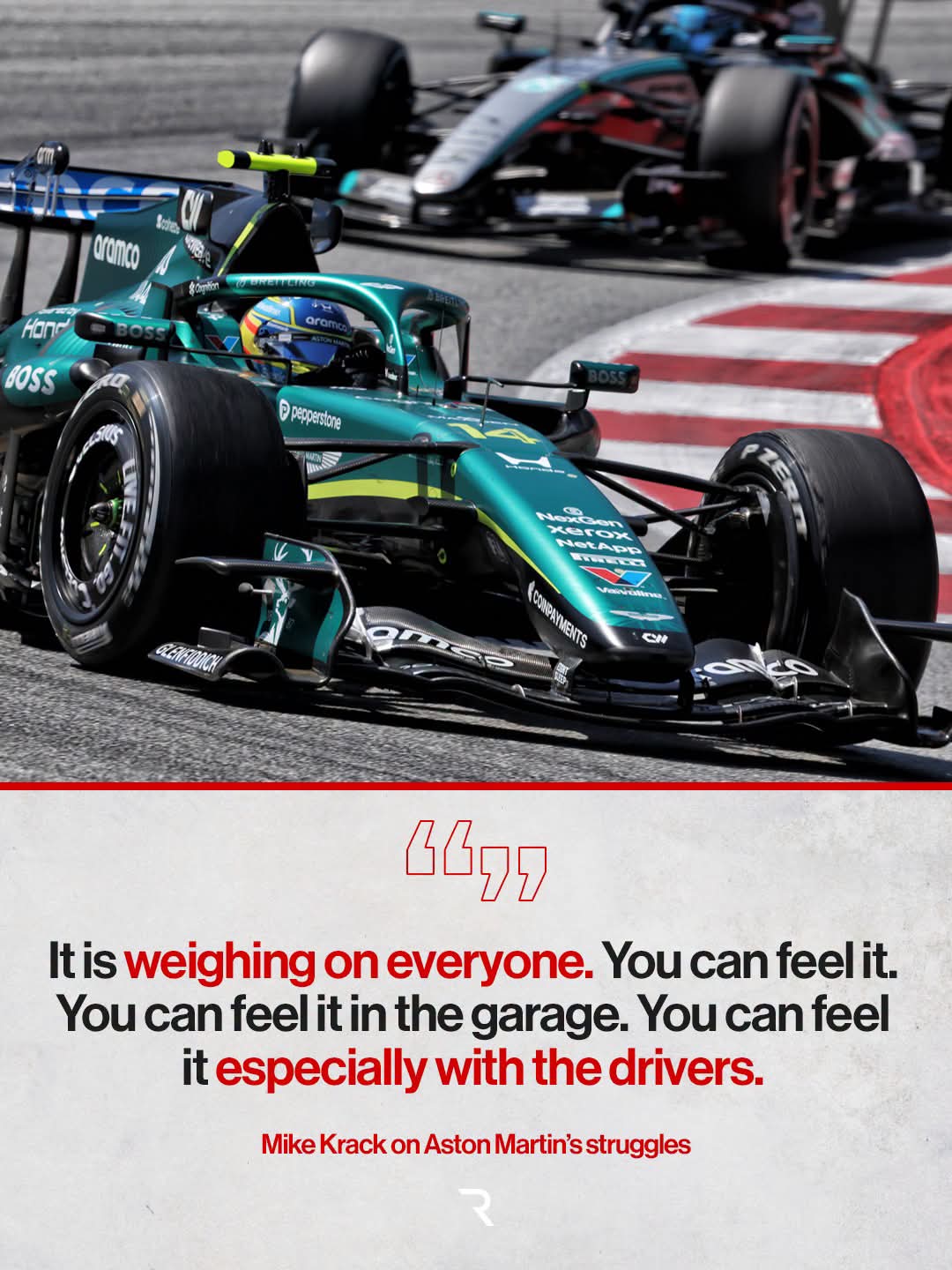
Aston Martin entered Formula 1’s new era with ambitions of becoming a championship-winning force. Massive investments, state-of-the-art facilities, world-class engineering talent, and the signing of elite drivers created expectations that the Silverstone-based outfit would soon challenge the sport’s traditional powerhouses.
Instead, the team finds itself facing a growing performance crisis.
As disappointing results continue to pile up, Aston Martin executive has openly acknowledged that the team’s lack of development progress is affecting every department within the organization. From engineers and mechanics in the garage to the drivers behind the wheel, frustration is beginning to spread throughout the entire operation.
His comments offer a rare glimpse into the reality of a Formula 1 team struggling to meet its own expectations.
ASTON MARTIN’S PROMISING PROJECT HAS STALLED
Not long ago, Aston Martin appeared to be one of Formula 1’s most exciting success stories.
The team emerged as a surprise contender after the introduction of the current regulations, regularly challenging for podiums and establishing itself as a genuine threat to the front-running teams. Many believed it was only a matter of time before Aston Martin joined the championship fight.
However, Formula 1 moves quickly.
While rivals such as Mercedes, Ferrari, McLaren, and Red Bull continued to unlock performance through aggressive development programs, Aston Martin gradually lost momentum. Upgrades that were expected to move the team forward often delivered limited gains, and in some cases appeared to expose new weaknesses.
The result has been a worrying trend where competitors continue to improve while Aston Martin struggles to keep pace.
WHY DEVELOPMENT IS THE TRUE BATTLE IN MODERN FORMULA 1
Formula 1 success is rarely determined by a car’s performance at the start of a season.
The teams that win championships are usually the teams that develop the fastest.
Every race weekend generates enormous amounts of data. Engineers analyze tire behavior, aerodynamic performance, suspension characteristics, and countless other variables in an attempt to find extra lap time. Even gains measured in hundredths of a second can transform a team’s fortunes over the course of a season.
When development stalls, however, the consequences become severe.
Drivers begin pushing beyond the car’s limits. Engineers become increasingly frustrated when upgrades fail to produce expected results. Mechanics work harder while receiving fewer rewards in terms of race performance.
Krack’s admission highlights exactly how damaging that situation can become.
THE PRESSURE IS GROWING ON FERNANDO ALONSO AND THE DRIVERS
One of the biggest victims of Aston Martin’s decline has been veteran driver .
Widely regarded as one of the most talented and complete drivers in Formula 1 history, Alonso remains capable of extracting remarkable performances from difficult machinery. However, even a driver of his caliber can only compensate for so many technical shortcomings.
When a team lacks development momentum, drivers often find themselves trapped in a frustrating cycle. They push harder to compensate for performance deficits, increasing the risk of mistakes while simultaneously exposing the car’s limitations.
That pressure can eventually affect confidence, race strategy, and long-term morale.
For Aston Martin, maintaining driver belief in the project may become just as important as finding additional speed.
ADRIAN NEWEY’S ARRIVAL ADDS A NEW DIMENSION
One reason Aston Martin remains optimistic is the arrival of legendary designer .
Newey’s reputation as one of the greatest technical minds in Formula 1 history has generated enormous excitement throughout the paddock. His involvement represents a major statement of intent from team owner .
However, Newey alone cannot instantly solve every problem.
Formula 1 projects require time, coordination, and a clear technical direction. Even the most brilliant engineers need strong supporting structures and the ability to implement ideas effectively.
The challenge for Aston Martin is ensuring that Newey’s expertise translates into measurable on-track improvements rather than becoming another promise for the future.
WHY 2026 MAY ALREADY BE THE PRIORITY
A growing number of observers believe Aston Martin’s current struggles may partially reflect a strategic shift toward the future.
With major regulation changes reshaping Formula 1, many teams have begun allocating resources toward next-generation car development rather than maximizing current performance.
If Aston Martin has quietly redirected significant attention toward future projects, it could explain the slower pace of development seen this season.
While that approach carries short-term risks, it may offer long-term rewards if the team emerges with a competitive package under the next regulatory cycle.
The problem is that Formula 1 is an unforgiving environment. Fans, sponsors, and drivers expect progress now, not years down the road.
THE BIGGEST TEST OF ASTON MARTIN’S AMBITIONS
Krack’s comments reveal more than just disappointment over results.
They expose the psychological challenge facing a team that expected to be fighting much closer to the front.
Championship-winning organizations are built on confidence, momentum, and belief. When development stagnates, those qualities are tested. Every missed opportunity increases pressure, and every underwhelming result invites more scrutiny.
The coming months could prove decisive for Aston Martin’s future direction.
If upgrades begin delivering meaningful gains, the narrative could quickly shift toward optimism and recovery. But if rivals continue pulling away, questions surrounding the team’s technical structure and long-term strategy will only intensify.
WHAT HAPPENS NEXT COULD DEFINE ASTON MARTIN’S FUTURE
Aston Martin still possesses many of the ingredients required for success. The team has world-class facilities, substantial financial backing, experienced leadership, and one of the strongest technical groups in Formula 1.
Yet none of those advantages guarantee results.
Krack’s candid admission serves as a reminder that Formula 1 remains the most competitive engineering challenge in motorsport. Ambition alone is not enough. Progress must be visible on the stopwatch.
For now, Aston Martin faces a critical period. The team’s ability to restart its development momentum may determine whether it becomes a genuine championship contender in the years ahead or remains another ambitious project struggling to fulfill its enormous potential.