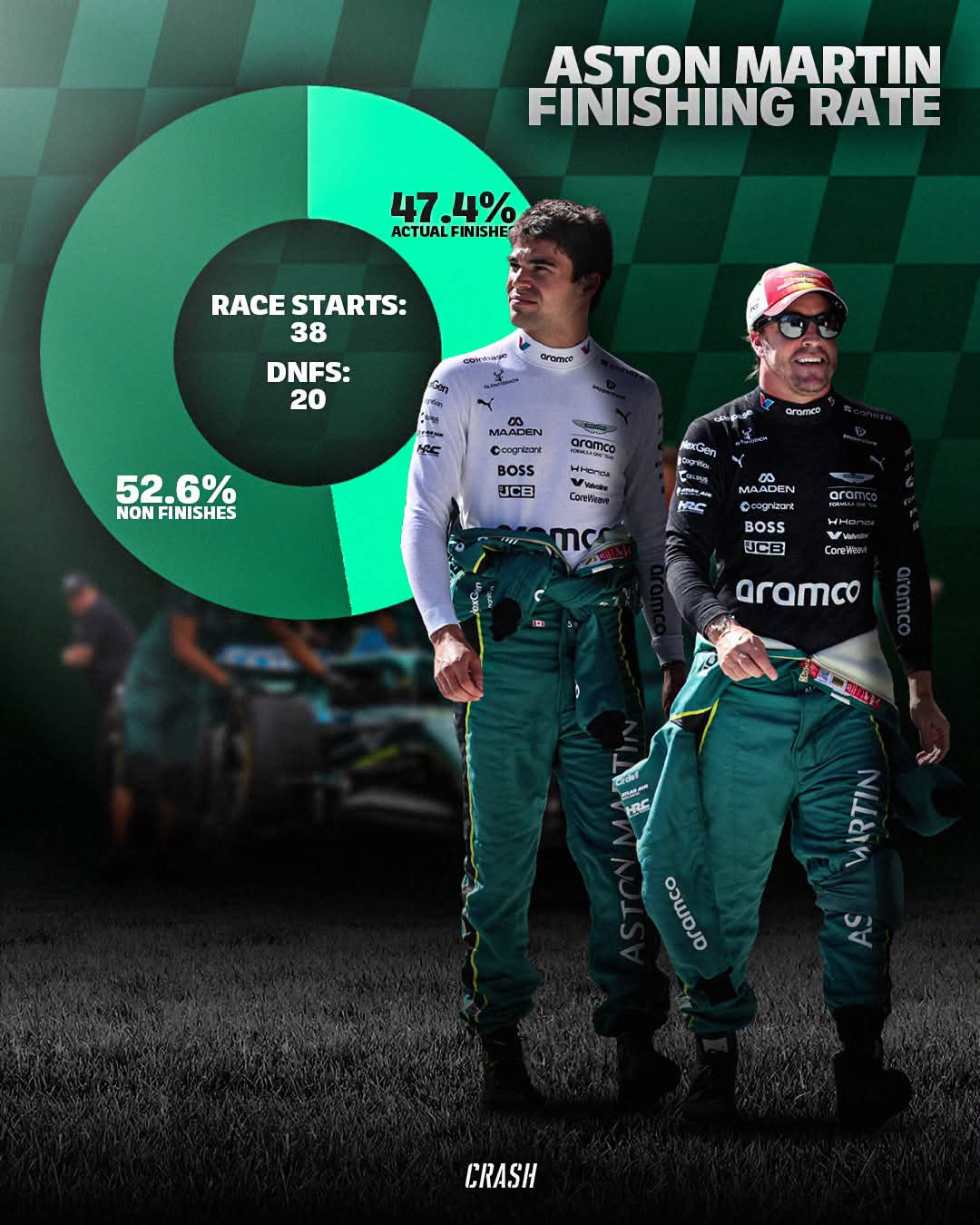
Formula 1’s 2026 season was supposed to mark a fresh start under radical new technical regulations. For Aston Martin, it has instead become a season-long exercise in damage limitation. Twenty retirements across the two cars have left the team with a finishing rate of just 47.4 percent after 19 races. That is not a midfield blip. It is one of the worst reliability records of the hybrid era and the single biggest factor holding the Silverstone squad at the wrong end of the constructors’ table.
As the paddock arrives at Interlagos for the São Paulo Grand Prix, the question is no longer whether Aston Martin can score points. The more fundamental issue is whether both cars can simply reach the chequered flag.
THE NUMBERS THAT TELL A STORY OF ATTRITION
After 38 starts, Aston Martin has classified only 18 finishes. Twenty DNFs. The rate sits at 47.4 percent. By comparison, the rest of the field has largely adapted to the new power-unit and chassis rules. Teams such as Mercedes and Ferrari are finishing more than 90 percent of their starts. Even the new Cadillac operation, for all its growing pains, is significantly more reliable.
Lance Stroll has borne the heaviest load. The Canadian has failed to finish more races than he has completed. Fernando Alonso has fared better on paper yet still sits on a career-low finishing percentage for a full season. The double retirement in Mexico City, where both cars lasted just five laps with ERS cooling failures, was only the latest chapter in a campaign defined by power-unit and related systems problems.
WHY THE 2026 REGULATIONS HAVE EXPOSED ASTON MARTIN
The new rules package was always going to stress power units more than the previous generation. Higher electrical deployment, tighter packaging, and revised cooling requirements created a steeper learning curve. Honda’s first full season as Aston Martin’s exclusive partner has been plagued by MGU-K, battery, and cooling-circuit issues that appear under race loads far more than in free practice.
Mexico’s high altitude simply magnified a vulnerability that already existed. The thinner air reduced cooling efficiency and the team knew before the race that a double DNF was probable. Interlagos sits much lower. Early indications from Friday practice in São Paulo suggest the latest countermeasures are working: both cars completed healthy mileage without the previous thermal warnings. That is progress, but progress measured in laps completed rather than points scored.
THE HUMAN AND STRATEGIC COST
Reliability failures do more than erase points. They destroy data collection, force engineers into constant firefighting, and erode morale. Team principal Mike Krack has openly admitted that maintaining motivation is difficult when the cars keep stopping. For a two-time world champion like Alonso, the frustration is obvious. He has shown competitive pace on several weekends only to see it wasted. Stroll’s confidence cannot be helped by a season in which mechanical misfortune has become the default outcome.
The constructors’ championship implications are clear. Aston Martin sits tenth with seven points, five behind Williams. With only four races remaining, every classified finish matters for both the final ranking and the financial and technical resources that flow from it. More importantly, the team is trying to build a foundation for 2027 while still learning the current car. Continuous early retirements make that learning almost impossible.
WHAT BRAZIL COULD SIGNAL
Interlagos has historically been kind to cars that can manage tyres and survive the mixed conditions that often arrive on race day. If the cooling fixes hold and the Honda unit can run a full race distance without intervention, Aston Martin has a realistic chance of converting practice mileage into two classified results. That alone would represent a significant step.
A points finish remains a stretch given the current performance level of the AMR26, but simply finishing both cars would change the internal conversation. It would give the engineers clean data, give the drivers confidence that the package can last, and give the wider organisation proof that the reliability programme is finally moving in the right direction.
THE BIGGER PICTURE FOR ASTON MARTIN AND HONDA
This season has been a brutal reminder that pairing a prestigious chassis brand with a new power-unit supplier does not guarantee success, especially under regulation change. Honda has history of recovering from difficult first seasons. Aston Martin has invested heavily in facilities and personnel, including the arrival of Adrian Newey in a senior role. Neither party can afford another year of similar attrition.
For the drivers, the stakes are personal. Alonso’s contract situation and legacy remain under quiet discussion. Stroll’s future is tied to both performance and the team’s ability to give him a car that reaches the end. For the organisation as a whole, finishing races is the absolute minimum requirement before any talk of midfield progress or championship contention can resume.
Sunday’s race at Interlagos will not rewrite the 2026 season. But if both green cars are still circulating when the chequered flag falls, it will be the first genuine sign that Aston Martin’s reliability crisis may finally be under control. After twenty DNFs and a finishing rate below 50 percent, that modest achievement would feel like a victory in itself.