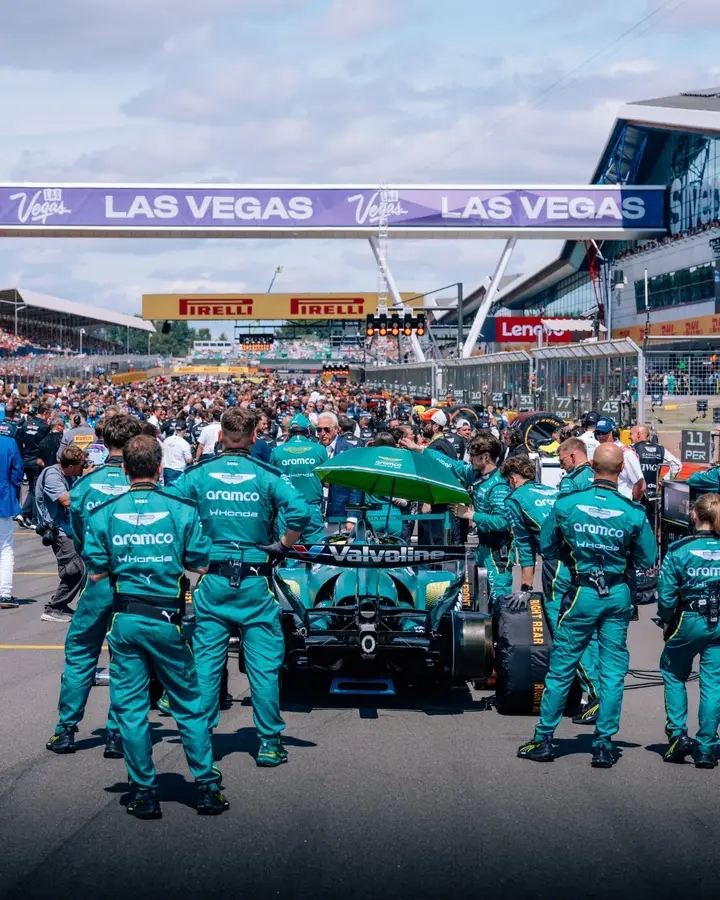
Aston Martin is preparing to introduce a significant package of upgrades at the Hungarian Grand Prix, but the team’s approach goes far beyond simply adding new performance parts. In modern Formula 1, every aerodynamic update must fit within the strict financial regulations that govern the sport, forcing teams to make difficult choices about where and when to spend their limited resources.
Team principal Mike Krack recently offered a fascinating look into Aston Martin’s thinking, comparing Formula 1’s cost cap to shopping with a fixed budget at a supermarket. His explanation highlights one of the biggest realities of today’s championship: success is no longer determined solely by engineering brilliance but also by financial efficiency.
THE SUPERMARKET COMPARISON EXPLAINS F1’S COST CAP PERFECTLY
Krack’s supermarket analogy makes the complexities of Formula 1’s budget cap surprisingly easy to understand.
He explained that if someone enters a supermarket with €100, they cannot spend more than that amount. Every purchase must be carefully considered, and once the money is gone, there is no opportunity to buy more. Formula 1 teams face the same challenge throughout the season.
Every new front wing, floor, suspension component, or aerodynamic package consumes part of the team’s financial allocation. The objective is to extract the maximum amount of performance while staying within the FIA’s spending limits.
Unlike previous eras, where wealthier teams could simply outspend their rivals, today’s Formula 1 rewards organizations that can combine innovation with disciplined financial management.
WHY CRASHES CAN CHANGE AN ENTIRE DEVELOPMENT PLAN
One of Krack’s most interesting observations involved the hidden cost of accidents.
Every major crash requires replacement parts, and those components also count against the team’s financial budget. That means an unexpected collision can force a team to rethink its entire development strategy.
If too much money is spent repairing damaged cars, fewer resources remain for performance upgrades later in the season. This creates a delicate balancing act between pushing for maximum performance and protecting valuable financial flexibility.
For Aston Martin, avoiding unnecessary damage could prove just as important as finding extra lap time through new aerodynamic developments.
ASTON MARTIN IS ALSO INVESTING IN SMARTER PRODUCTION
Krack revealed that Aston Martin is not only designing faster parts but also finding ways to manufacture them more efficiently.
With new personnel joining the organization, the team has focused on improving production processes that reduce manufacturing costs without sacrificing quality or performance.
This strategy allows Aston Martin to stretch every dollar further under the cost cap. If a component can be produced more cheaply while delivering the same performance, the savings can be redirected toward additional upgrades elsewhere on the car.
In Formula 1’s financial era, engineering efficiency inside the factory can be just as valuable as innovation on the racetrack.
WHY THE COST CAP HAS CHANGED FORMULA 1
Since the introduction of the FIA’s financial regulations, Formula 1 has evolved into a sport where technical excellence and financial discipline go hand in hand.
Krack acknowledged that debates will continue over whether the cost cap is beneficial, but he emphasized that the regulations are simply part of the sport. Like technical rules governing car weight or engine specifications, every team accepts the framework and must find the best way to compete within it.
This philosophy reflects how Formula 1 has shifted over recent seasons. Winning now requires mastering engineering, operations, race strategy, manufacturing, and financial planning simultaneously.
Teams that excel in all of these areas are increasingly the ones challenging for championships.
WHAT THE HUNGARIAN GP UPGRADE COULD MEAN
The timing of Aston Martin’s latest upgrade package could be significant.
The Hungarian Grand Prix is traditionally held at a circuit where aerodynamic efficiency, mechanical grip, and car balance play a crucial role. If the new components perform as expected, Aston Martin could strengthen its position in the fiercely competitive midfield and potentially challenge the leading teams more consistently.
With the field closer than ever under Formula 1’s current regulations, even small gains of a few tenths of a second can dramatically alter qualifying positions and race outcomes.
A successful upgrade would also provide valuable momentum heading into the second half of the season.
WHY THIS STORY MATTERS
Mike Krack’s comments offer an important reminder that Formula 1 has become as much a contest of resource management as pure engineering.
The teams that spend their budgets most effectively—not necessarily the ones that spend the most—are increasingly finding themselves in contention. Every development package, manufacturing decision, and race weekend now carries financial consequences that can shape the remainder of the season.
For Aston Martin, the upcoming Hungarian Grand Prix represents more than just another opportunity to score points. It is a test of whether months of careful planning, smarter production methods, and disciplined spending can translate into meaningful performance gains on the circuit.
As the championship enters a crucial phase, Aston Martin’s calculated approach may prove that in modern Formula 1, the smartest teams are not simply the fastest—they are the ones that know how to make every euro count.