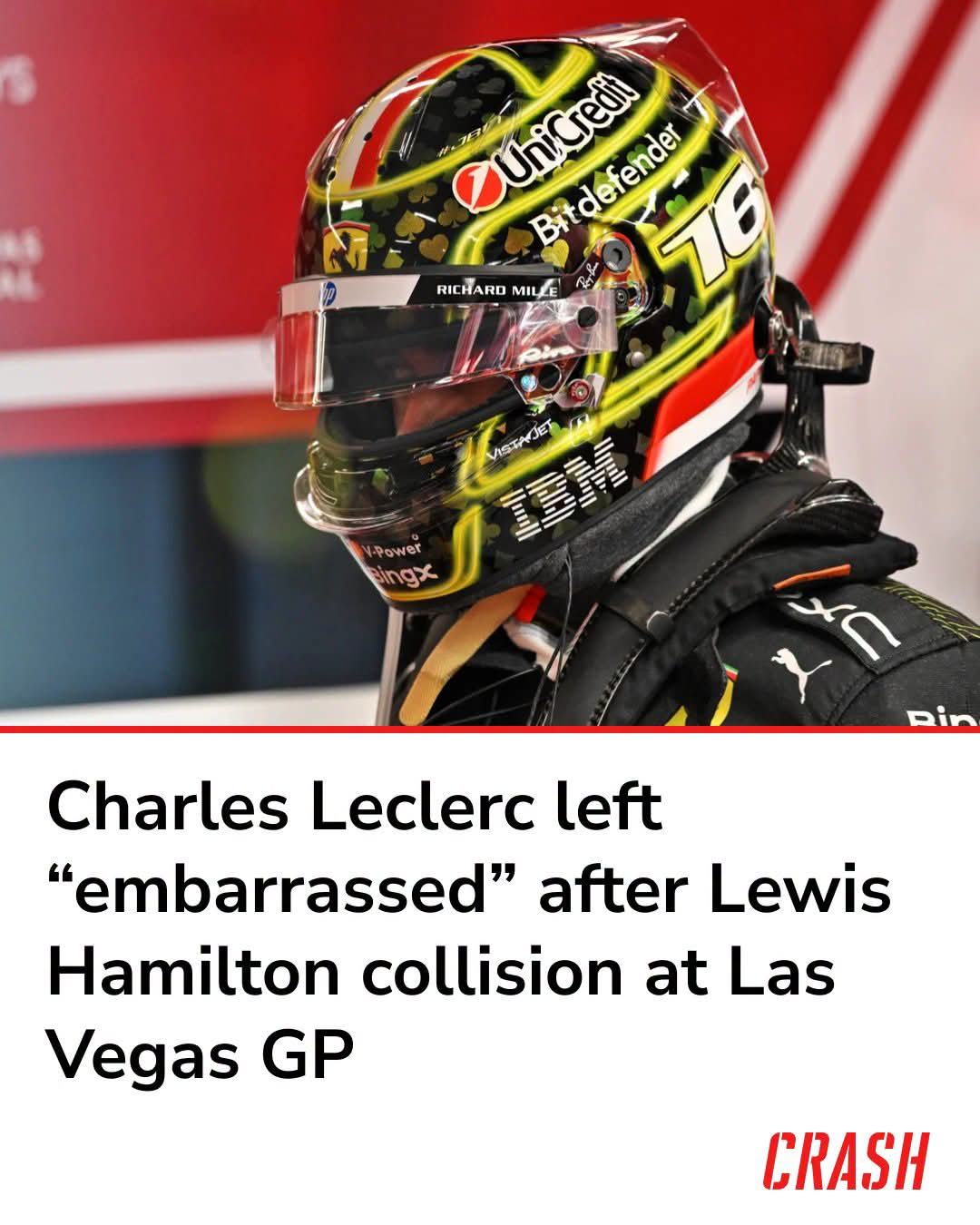
Ferrari’s 2026 season continues to deliver drama for all the wrong reasons. At the Las Vegas Grand Prix, Charles Leclerc and Lewis Hamilton produced yet another on-track collision that left the team scrambling for scraps and the Monegasque driver openly admitting he felt embarrassed for the Scuderia.
What should have been a recovery drive from a disappointing qualifying turned into another public airing of internal tensions. The latest incident has raised fresh questions about how Ferrari manages two ultra-competitive drivers and whether the partnership can deliver results before the year ends.
WHAT HAPPENED ON THE STREETS OF LAS VEGAS
Both Ferraris started outside the top ten after being eliminated in Q2. In a chaotic race full of overtakes and strategy swings, the pair found themselves racing each other as much as the cars ahead. On lap 38 at Turn 7, Leclerc launched an aggressive move up the inside of Hamilton, who was already engaged with a McLaren.
Contact followed. Hamilton spun and dropped down the order. Stewards quickly investigated and ruled Leclerc wholly to blame, citing that he approached from a considerable distance and had not earned the right to the corner. A 10-second time penalty was applied. Leclerc crossed the line sixth on the road but was classified tenth. Hamilton recovered to seventh after serving his own earlier 10-second penalty for leaving the track and gaining an advantage while battling Lando Norris.
Ferrari left the Strip with just a handful of points and another intra-team mess to clean up.
LECLERC ACCEPTS RESPONSIBILITY AND ADMITS EMBARRASSMENT
In the aftermath, Leclerc did not hide from the decision. He accepted the stewards’ verdict without argument and described his own feelings in blunt terms.
He explained that the move looked feasible because of the fight ahead involving Hamilton and the McLaren, and that he believed there was space on the inside. He also noted that Hamilton, given the angle of his car, may not have seen him. Crucially, Leclerc refused to shift blame onto his teammate. Instead he focused on the damage done to the team.
“I just feel very bad for the team again,” he said, later adding that he felt “quite embarrassed for the team in general.” The comments carried weight because this was not an isolated moment. It was the third significant on-track clash between the two Ferrari drivers in 2026, following incidents at Monza and Mexico City.
TEAM PRINCIPAL VASSEUR DELIVERS A CLEAR MESSAGE
Frederic Vasseur left little room for interpretation. He described the collision as “completely unacceptable” and spoke of a “lack of respect” — not only toward the team and sponsors, but especially toward the people working at the factory. On the cool-down lap he ordered Leclerc to report to him immediately after the race, before any media duties.
The Frenchman’s frustration is understandable. Only weeks earlier, after the Mexico City episode that helped hand victory to Max Verstappen, Vasseur had already reminded both drivers that the team’s interests must come first. The Las Vegas incident suggested those talks had limited lasting effect.
WHY THIS STORY MATTERS BEYOND ONE RACE
Intra-team collisions are not new in Formula 1. What makes the Ferrari situation notable is the combination of star power, high expectations, and repeated flashpoints in a single season. Hamilton arrived at Maranello as a seven-time champion seeking a fresh challenge. Leclerc remains the long-term face of the team and a driver still chasing his first title. When two drivers of that calibre race each other hard, the margin for error shrinks dramatically.
The points lost in Las Vegas are relatively small in isolation. The cumulative cost is larger. Every time the Ferraris take points off each other or force the team into damage limitation, rivals gain ground. In a tightly contested constructors’ battle, those moments matter. They also create narrative noise that distracts from car development and strategy execution.
For the drivers, the psychological impact is real. Public embarrassment, radio complaints, and post-race lectures from the team principal erode trust. Once drivers start racing each other as primary rivals rather than teammates, the risk of further incidents rises. History shows that some pairings survive these periods and emerge stronger; others never fully recover the necessary level of cooperation.
BROADER IMPACT ON FERRARI AND THE CHAMPIONSHIP PICTURE
Ferrari’s 2026 campaign has been defined by flashes of genuine pace mixed with operational and interpersonal setbacks. The Las Vegas result will not decide the championship, but it reinforces a pattern of self-inflicted wounds. Sponsors and the factory workforce notice when hard work is undone by avoidable contact. Media coverage focuses on the drama rather than any underlying progress in the car.
Looking ahead, the calendar offers little breathing room. The remaining races will test whether Vasseur can impose clearer rules of engagement or whether the drivers will continue to interpret racing room in ways that prioritise personal positions. Stricter team orders are one possible path, though they often breed resentment. Clearer pre-race agreements on when to race and when to hold position are another.
PREDICTIONS AND UNIQUE INSIGHTS
Expect Ferrari to hold further internal discussions before the next event. Vasseur has shown he will not stay silent when he believes the team has been disrespected. Whether those talks produce lasting change depends on both drivers accepting that their individual ambitions cannot come at the consistent expense of collective results.
Leclerc’s willingness to accept blame publicly is a positive sign of accountability. The real test will be whether that accountability translates into different decision-making the next time a similar opportunity appears. Hamilton, for his part, has made clear through radio messages and post-race comments that he wants clearer direction from the team.
For the wider sport, these episodes remain compelling viewing. Fans are drawn to the human drama of elite competitors colliding under pressure. Yet for a manufacturer with Ferrari’s history and resources, sustained internal friction is a luxury it can ill afford if it wants to convert potential into trophies.
The Las Vegas collision was not the first chapter in the Leclerc-Hamilton story, and it is unlikely to be the last. How the team and the two drivers respond in the coming weeks will determine whether the partnership becomes a strength or continues to function as a recurring liability.