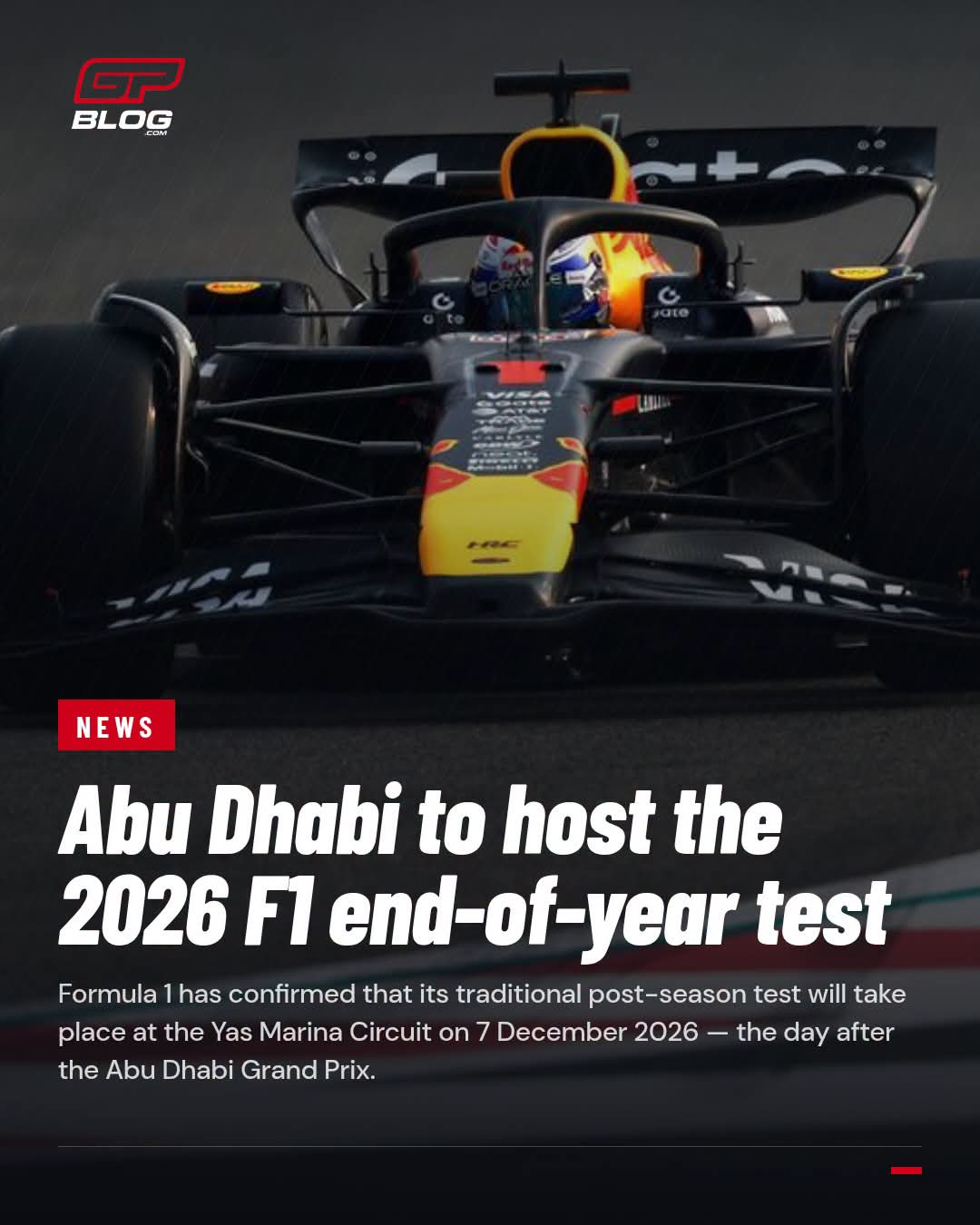
Formula 1 has confirmed that the traditional post-season test will return to Yas Marina Circuit in Abu Dhabi after the 2026 Abu Dhabi Grand Prix. On paper, that closes the loop on the calendar. In practice, it arrives with a clear asterisk: nothing is fully guaranteed until the cars are on track.
The confirmation comes days after F1 and the FIA stood down contingency plans for Imola and locked in the final two races of the season in Qatar and Abu Dhabi. The test follows the same logic. Keep the race, keep the test. But the same security considerations that forced earlier calendar changes still hang over the entire Middle East swing.
WHY THE END-OF-YEAR TEST STILL MATTERS IN A STABILIZED CHAMPIONSHIP
By the time the field reaches Yas Marina in early December, both titles will already be decided. Kimi Antonelli has secured the drivers’ championship as the youngest champion in F1 history, and Mercedes has wrapped up the constructors’ crown. That removes the usual drama of a title fight, yet the test retains real value.
Pirelli still needs meaningful running for tyre development under the next generation of regulations. Teams use the session for young driver evaluation, systems checks, and gathering data that feeds into the following season’s car programs. Rookies limited to two or fewer Grand Prix starts get dedicated track time. Even established drivers often take part, although high-profile absences — Max Verstappen has skipped several recent editions — have become more common as the calendar has grown denser.
Losing the test would not rewrite the 2026 season. It would, however, remove a useful development window at a moment when the sport is transitioning into new technical rules. For smaller teams and driver academies, those miles are harder to replace.
THE SECURITY CONTEXT THAT STILL SHAPES EVERY DECISION
The decision to keep Abu Dhabi is not made in isolation. Earlier in 2026, the Bahrain and Saudi Arabian Grands Prix were disrupted by regional conflict. Bahrain’s event was relocated to Malaysia; Saudi Arabia’s race was cancelled. Those disruptions forced F1 into contingency planning that included standing Imola up as a possible season finale.
By mid-November the assessment had shifted. Travel advice still permitted movement into Qatar and the UAE. Insurance remained valid. Other major events, including MotoGP in Qatar, had gone ahead. F1 informed Imola it was no longer required and confirmed the original calendar order: Las Vegas, Qatar, then Abu Dhabi on 4-6 December.
FIA president Mohammed Ben Sulayem publicly stated the governing body was ready for both Gulf races and committed to delivering the events. F1 leadership has maintained the same position while repeatedly stressing that safety remains the non-negotiable priority. If conditions deteriorate in the coming weeks, both the races and the subsequent test can still be pulled.
That dual message — confirmation today, flexibility tomorrow — is the only realistic way to operate in the current environment.
IMPACT ON TEAMS, DRIVERS, AND THE BROADER SPORT
For the 11 teams, the practical effect is continuity. Freight plans, personnel travel, and hotel bookings can proceed on the original schedule rather than a late pivot to Italy. That reduces last-minute cost and complexity after a long season.
For young drivers and academy prospects, the test represents one of the few remaining high-level opportunities before the winter break. Missing it would push more of that evaluation into private testing or simulator work, neither of which fully replicates the demands of a full F1 car on a Grand Prix circuit.
For Abu Dhabi and the wider Gulf region, retaining both the race and the test reinforces their status as reliable hosts even after a turbulent year. Ticket demand for the Grand Prix itself has remained strong, underlining the commercial resilience of the event. At the same time, the episode highlights how dependent modern F1 has become on a relatively small number of high-revenue venues in politically sensitive areas.
The sport’s growing Middle East footprint delivers significant commercial returns and calendar stability in normal years. In abnormal years, it creates exactly the kind of contingency planning F1 has just navigated.
WHAT HAPPENS NEXT — AND WHAT COULD STILL CHANGE
The current trajectory points to a conventional end to the 2026 season: a triple-header finishing under the lights at Yas Marina, followed by the usual mix of race drivers and rookies running for Pirelli and team development programs.
Yet the language from both F1 and the FIA remains carefully conditional. Confirmation is not the same as a guarantee. Any significant escalation that affects travel, insurance, or the safety assessment of personnel would force a rapid re-evaluation. At that point the test would almost certainly fall with the race.
For now, the paddock can plan on Abu Dhabi. Teams will arrive with development agendas, young drivers will get their chance, and Pirelli will collect the data it needs. The sport has chosen continuity over relocation. Whether that choice survives the final weeks of the season will depend on factors far outside the control of the race director or the team principals.
In Formula 1, the calendar is rarely just a list of dates. In 2026, it has also become a running assessment of risk. Abu Dhabi has kept its test. The harder part will be making sure it actually happens.