Ferrari’s endless search for answers has taken another twist. After Christian Horner publicly described the Italian team as Formula 1’s “dream” job and its “sleeping giant,” a voice from inside Maranello’s recent past has poured cold water on the idea that one high-profile appointment could transform the Scuderia.
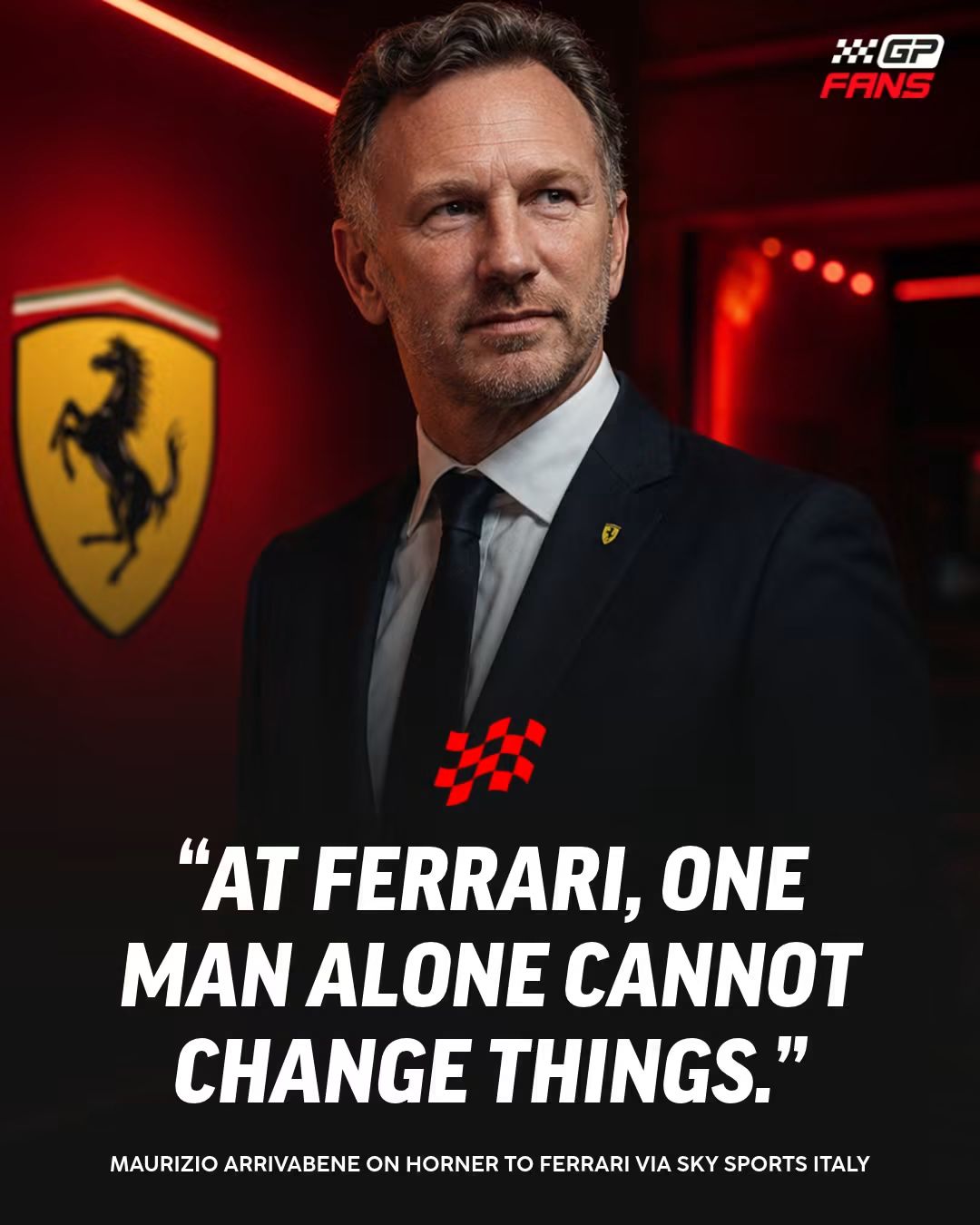
Maurizio Arrivabene, who led Ferrari as team principal from 2014 to 2019, has made it clear he does not believe even the highly decorated former Red Bull boss could single-handedly solve the team’s deep-rooted problems. “At Ferrari, one man alone cannot change things,” Arrivabene told Sky Sport Italia. He went further, suggesting that bringing in someone with Horner’s trophy cabinet might actually raise expectations to unrealistic levels and create more pressure than progress.
The comments land at a sensitive moment. Ferrari continues to underperform relative to its resources and history. Another difficult weekend in Azerbaijan only intensified the scrutiny on current team principal Fred Vasseur. Meanwhile, Horner, ousted from Red Bull in 2025, has left the door open to a move that would see him return to the pit wall without the ownership stake he has previously insisted upon—for Ferrari alone.
WHY ARRIVABENE’S WARNING CARRIES WEIGHT
Arrivabene knows the unique pressures of the role better than most. He operated inside the Ferrari machine during a period of fluctuating competitiveness and intense internal politics. His central argument is structural rather than personal. Ferrari, he notes, has lost key engineering talent over the years—figures of the calibre of Simone Resta, Enrico Sassi, Enrico Cardile and Andrea Stella, many of whom now contribute at rival teams. Rebuilding that technical depth cannot happen overnight or through one charismatic leader.
He also stresses the need for two rare commodities at Maranello: calm and genuine autonomy. “Ferrari needs calm and carte blanche. These two things can solve many problems,” Arrivabene said. “It’s not just one man, however decorated he may be, who can solve the problems.”
This is a pointed observation. Horner’s success at Red Bull was built on a specific environment—strong technical leadership around Adrian Newey for many years, a clear hierarchy, and the ability to make decisive calls with relative freedom. Ferrari’s corporate structure, with oversight from chairman John Elkann and CEO Benedetto Vigna, has rarely granted team principals that level of unchallenged authority in the modern era. History shows that even strong figures can become entangled in the politics and expectations that come with the red cars.
THE HORNER FACTOR AND RISING EXPECTATIONS
Horner’s recent comments have fuelled speculation precisely because they were so direct. After years of saying any return to Formula 1 would require equity, he carved out a clear exception for Ferrari, calling it the biggest brand in the sport and a project with untapped potential. The remarks were widely interpreted as an open invitation, or at least a signal that he remains available and interested.
Arrivabene’s counterpoint is pragmatic. A high-profile arrival with multiple championships on his résumé would immediately amplify the already enormous pressure on Ferrari to deliver instant results. In a team where patience has often been in short supply and where media scrutiny is relentless, that extra weight of expectation could prove counterproductive. Success at Ferrari has historically required more than star power at the top; it has demanded aligned technical direction, cultural stability, and the freedom to execute a long-term plan without constant second-guessing.
The current situation under Vasseur illustrates the challenge. The Frenchman has worked to stabilise the organisation and attract talent, yet results have not matched the ambition, particularly as the team looks ahead to major regulation changes. Speculation about leadership changes itself becomes a distraction, as Vasseur has openly acknowledged, noting that the team is not operating in perfect serenity when questions about Horner dominate conversations.
WHAT THIS MEANS FOR FERRARI, THE DRIVERS AND THE WIDER GRID
For Charles Leclerc and Lewis Hamilton, the ongoing uncertainty is far from ideal. Both drivers joined or stayed with Ferrari in the belief that the team could return to winning ways. Persistent leadership speculation and structural questions undermine the focus required to extract maximum performance from the car and prepare properly for future regulations. A distracted garage is rarely a high-performing one.
For the organisation itself, Arrivabene’s analysis highlights a recurring Ferrari theme: the belief that a single “saviour” figure can reverse years of relative underachievement. Past cycles of hiring and internal upheaval have shown the limitations of that approach. Sustainable competitiveness usually comes from consistent technical investment, clear decision-making processes, and protecting key people from the political noise that often surrounds the team.
The broader Formula 1 landscape also feels the ripple effects. A genuinely competitive Ferrari raises the quality of the championship and intensifies the fight at the front. Prolonged inconsistency from one of the sport’s most popular and commercially powerful teams leaves a gap that rivals are happy to fill. McLaren, Mercedes and the current Red Bull operation all benefit when Ferrari is not fully firing.
LOOKING AHEAD: STABILITY VERSUS SPECTACLE
Predictions in Formula 1 are always hazardous, but Arrivabene’s comments point toward a more measured path. Rather than chasing a big-name fix, Ferrari may be better served by doubling down on technical rebuilding, giving the current leadership clearer runway where possible, and protecting the organisation from the constant swirl of external noise. That is easier said than done in a high-stakes environment where results dictate narratives almost weekly.
Horner remains a free agent of considerable standing and proven ability. Whether Ferrari ever seriously explores a move will depend on results, internal politics, and whether the team is prepared to reshape how authority works at Maranello. Even if such a conversation were to happen, Arrivabene’s core message would still apply: one man, no matter how successful elsewhere, cannot single-handedly redesign culture, restore lost technical depth, and deliver championships in an organisation as complex as Ferrari.
The Scuderia’s problems run deeper than any single appointment. Solving them will require patience, structural clarity, and a willingness to prioritise long-term foundations over short-term headlines. Until those elements are in place, even the most decorated outsider is unlikely to wave a magic wand. For a team that has waited more than a decade and a half for a constructors’ title, that may be the most important—and most difficult—lesson of all.