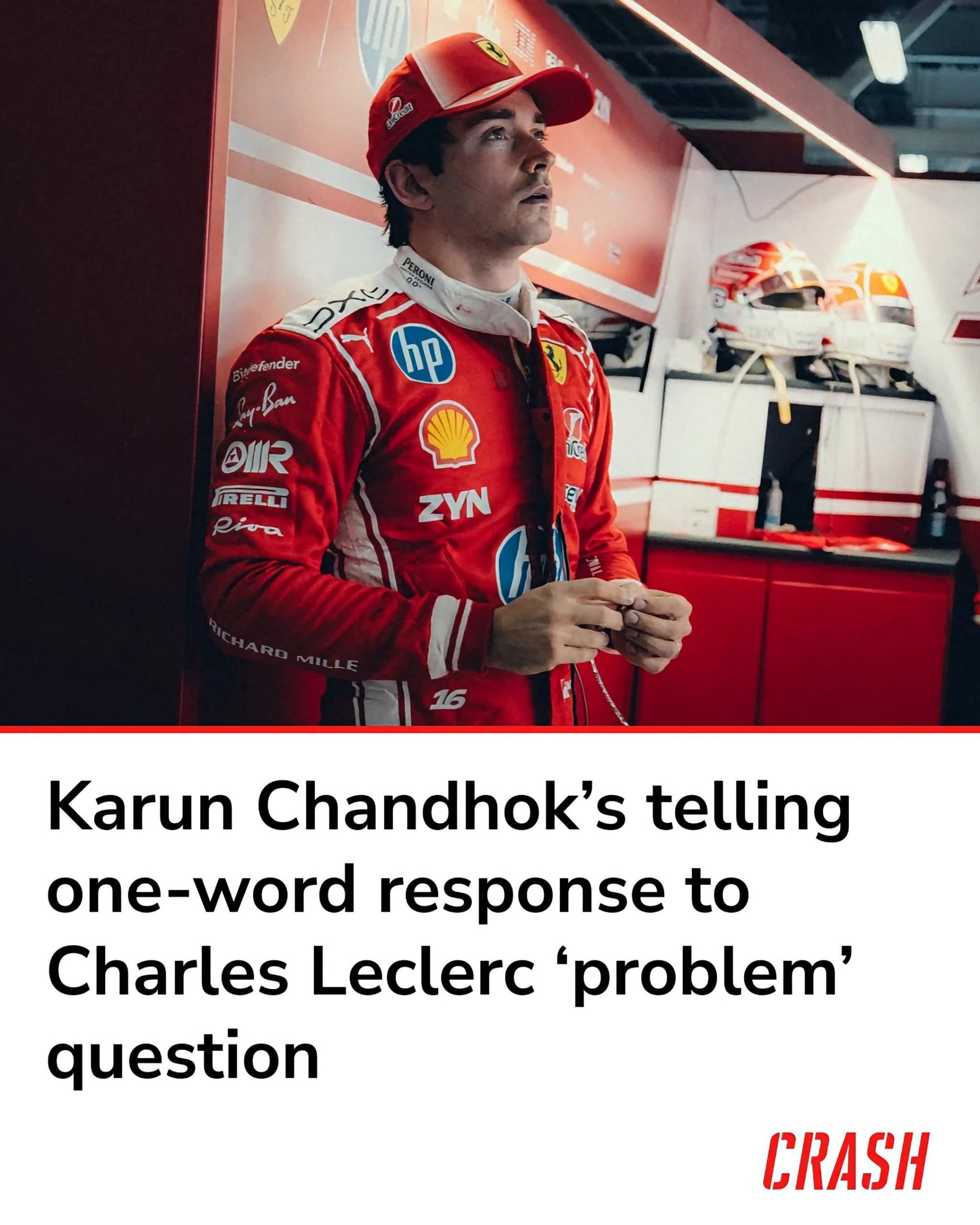
Charles Leclerc is facing growing criticism following his controversial battle with Lewis Hamilton at the Mexican Grand Prix, with former Formula 1 driver and Sky Sports pundit Karun Chandhok delivering a blunt assessment that could intensify the pressure surrounding Ferrari. Asked whether Leclerc was the problem in the latest disagreement between the Ferrari teammates, Chandhok needed just one word to make his position clear: “Yes.”
The response was followed by a detailed explanation of why he believes the Monegasque driver needs to change his approach when competing against Hamilton. More importantly, Chandhok argued that Ferrari cannot simply expect the situation to resolve itself because Leclerc may not naturally approach his teammate differently from other competitors.
His comments have added another influential voice to a controversy that is rapidly becoming one of Ferrari’s biggest talking points ahead of the Brazilian Grand Prix.
KARUN CHANDHOK DELIVERS A BLUNT VERDICT ON LECLERC
During an appearance on the F1 Show podcast, Sky Sports F1 commentator David Croft asked Chandhok whether Leclerc was the problem following the latest incident involving Hamilton.
Chandhok’s response was immediate.
“Yes.”
He then explained that Hamilton had a legitimate point, particularly because the consequences of the incidents have affected Ferrari as much as the drivers involved.
“Certainly Lewis Hamilton alluded to that, didn’t he. I think he makes a point. We’ve now had two examples of where Charles was too aggressive and Lewis has come off badly, but more importantly Ferrari has come off badly,” Chandhok said.
That final observation is particularly important.
Formula 1 teammates are expected to compete against each other, and neither Hamilton nor Leclerc should be expected to surrender every opportunity simply because they share a garage. However, there is a difference between aggressive racing and allowing an internal battle to damage the team’s overall result.
Chandhok believes Leclerc must recognise that distinction.
His assessment also suggests that Ferrari’s problems cannot be solved simply by asking Hamilton to become more patient. If the team wants both drivers to operate successfully together, it must establish expectations that apply equally to everyone.
WHY THE MEXICAN GRAND PRIX CLASH HAS BECOME SUCH A BIG ISSUE
The controversy began on the opening lap of the Mexican Grand Prix at the Autódromo Hermanos Rodríguez.
Hamilton and Leclerc were fighting for position when the Monegasque driver attacked around the outside of Turn 4. Leclerc carried too much speed, went beyond the track limits and emerged ahead of his teammate.
Hamilton was left frustrated as he lost ground to Max Verstappen during the incident.
Leclerc later received a five-second penalty for leaving the track and gaining an advantage, but the damage to Ferrari’s race had already been done. Verstappen went on to win, Hamilton finished second and Leclerc dropped to fourth.
Hamilton subsequently argued that Ferrari had lost an opportunity to secure a victory and potentially a one-two finish.
The seven-time world champion also criticised what he described as Leclerc’s “do or die” mentality, suggesting that his teammate’s determination to win the individual battle had come at the expense of the team’s interests.
That accusation has since become central to the disagreement.
For Hamilton, the issue is not simply that Leclerc overtook him. It is that the circumstances surrounding the move created an outcome that potentially cost Ferrari valuable points.
CHANDHOK EXPLAINS WHY LECLERC MAY BE MAKING THE SAME MISTAKE
Although Chandhok was critical of Leclerc, he also offered an explanation for why drivers can make questionable decisions during intense racing situations.
He pointed to the enormous adrenaline levels experienced during a Grand Prix, particularly on the opening lap when several cars are fighting for position.
“When the adrenaline is pumping, when you’re in a grand prix car, when you’re in a race, the adrenaline is pumping so hard, especially on the opening lap,” he explained.
He added that a driver’s heart rate can reach the 170s, meaning decisions are sometimes made through instinct rather than extended calculation.
This is an important consideration when analysing the Mexico incident.
Drivers have only fractions of a second to decide whether to attack, defend, brake or abandon an overtaking attempt. The pressure is enormous, and aggressive instincts are part of what makes elite racing so competitive.
However, Chandhok believes that explanation does not completely excuse Leclerc’s actions.
His argument is that experienced drivers must learn to recognise when a battle requires a different approach, particularly when the car alongside them belongs to their own team.
That distinction can be difficult to maintain when both drivers are naturally competitive, but it is essential for organisations trying to fight for championships.
FERRARI MUST INTERVENE IF LECLERC CANNOT CHANGE HIS APPROACH
Perhaps the most significant part of Chandhok’s analysis was his suggestion that Ferrari may have to become more involved in managing the relationship.
He believes Leclerc does not naturally approach Hamilton with the level of restraint that might be necessary between teammates.
“I also think it’s not coming natural to him to back off a bit and treat his team-mate a bit differently to other cars,” Chandhok explained.
He then delivered a warning about the responsibility facing Ferrari’s management.
“That’s where I think the team have to get involved. Because it’s not coming naturally, they are going to have to force him into thinking that way a bit more.”
This places considerable responsibility on team principal Fred Vasseur.
Ferrari cannot simply rely on two highly competitive drivers to work everything out independently. It needs clear racing guidelines covering situations where both cars are fighting for the same position.
Those guidelines should not necessarily prevent Hamilton and Leclerc from racing each other. Instead, they should ensure that neither driver takes unnecessary risks that could compromise the team’s overall result.
The challenge is implementing those rules without making either driver feel that they are being treated unfairly.
Hamilton has already made it clear that he expects serious discussions following the Mexico incident. Leclerc will also want assurances that he can continue competing aggressively without being unfairly restricted.
Vasseur must find a solution that satisfies both sides.
NICO ROSBERG ALSO QUESTIONS LECLERC AFTER THE FERRARI CLASH
Chandhok is not the only former driver to raise concerns about Leclerc’s involvement in the controversy.
2016 world champion Nico Rosberg also criticised the Monegasque driver following the incident in Mexico.
Speaking to Sky Sports F1, Rosberg questioned why Leclerc had repeatedly found himself at the centre of controversial battles involving Hamilton.
“Interestingly, it’s always Charles’ fault, isn’t it? It’s never Lewis’s fault. In the last couple of times, in Monza it was Charles, here it was Charles,” Rosberg said.
His comments add another layer to the discussion because Rosberg understands the complicated relationship between teammates competing for major honours.
During his Mercedes career, he experienced firsthand how quickly an internal rivalry can become uncomfortable when both drivers believe they deserve priority.
The Hamilton-Rosberg rivalry eventually became one of the defining stories of that era, with the two drivers repeatedly fighting for victories and championships.
Rosberg’s experience makes his perspective particularly interesting, although Ferrari’s current situation is not necessarily identical.
Hamilton and Leclerc have different backgrounds, competitive histories and relationships with the organisation. Nevertheless, the underlying challenge remains familiar: how can a team allow two elite drivers to compete without allowing their rivalry to become destructive?
LECLERC AND HAMILTON ARE BOTH UNDER PRESSURE AHEAD OF BRAZIL
The Brazilian Grand Prix arrives at an important moment for Ferrari.
Hamilton has publicly defended his comments and insisted that he will not apologise for expressing his feelings. He has also suggested that Leclerc races him more aggressively than other drivers.
Leclerc, meanwhile, must deal with criticism from pundits while maintaining his focus on the next race.
Neither driver can afford to allow the controversy to become a distraction from their responsibilities.
Interlagos is a circuit where close racing and unpredictable conditions can create difficult situations, meaning another battle between the Ferrari teammates could attract enormous attention.
If they encounter each other on track again, their decisions will be examined much more closely than usual.
A clean weekend could help Ferrari move beyond the Mexico controversy. Another disagreement, however, would strengthen the argument that the team needs a more clearly defined approach to managing its drivers.
VASSEUR FACES A DECISION THAT COULD SHAPE FERRARI’S FUTURE
The bigger issue for Ferrari is not whether Hamilton or Leclerc wins the next argument. It is whether the team can establish an environment where both drivers understand that individual success must support the organisation’s wider ambitions.
Vasseur has invested considerable effort in building a competitive Ferrari operation, and he cannot allow internal disagreements to repeatedly undermine that progress.
Chandhok’s comments suggest that simply asking Leclerc to be careful may not be enough. The team may need to introduce clearer instructions and expectations during races.
However, those instructions must be applied fairly.
If Hamilton receives preferential treatment, Leclerc could become frustrated. If Leclerc is allowed to race without restrictions, Hamilton may feel that his concerns are being ignored.
The ideal solution is a consistent policy that protects both drivers and prevents avoidable incidents.
Ferrari also needs to remember that its competitors will benefit whenever the Scuderia loses points through internal conflict.
THE BIG QUESTION: WILL LECLERC CHANGE HIS APPROACH?
Chandhok’s one-word response has made his position clear, but the real test will be whether Ferrari can turn the criticism into meaningful action.
Leclerc remains one of the most talented drivers on the grid, and his aggressive racing instincts have contributed to his success. The objective should not be to remove that competitiveness but to ensure that it is used intelligently when his teammate is involved.
Hamilton, meanwhile, wants to feel that he is competing on equal terms and that Ferrari will protect its collective interests.
The two drivers still have the opportunity to move beyond the Mexican Grand Prix controversy, but that will require communication, discipline and a willingness to understand each other’s perspective.
For Vasseur, the priority is preventing another costly confrontation.
Chandhok has delivered his verdict. Rosberg has added his criticism. Hamilton has refused to back down.
Now the spotlight shifts to Leclerc and Ferrari, with the Brazilian Grand Prix offering the next opportunity to prove whether the team has learned anything from Mexico.