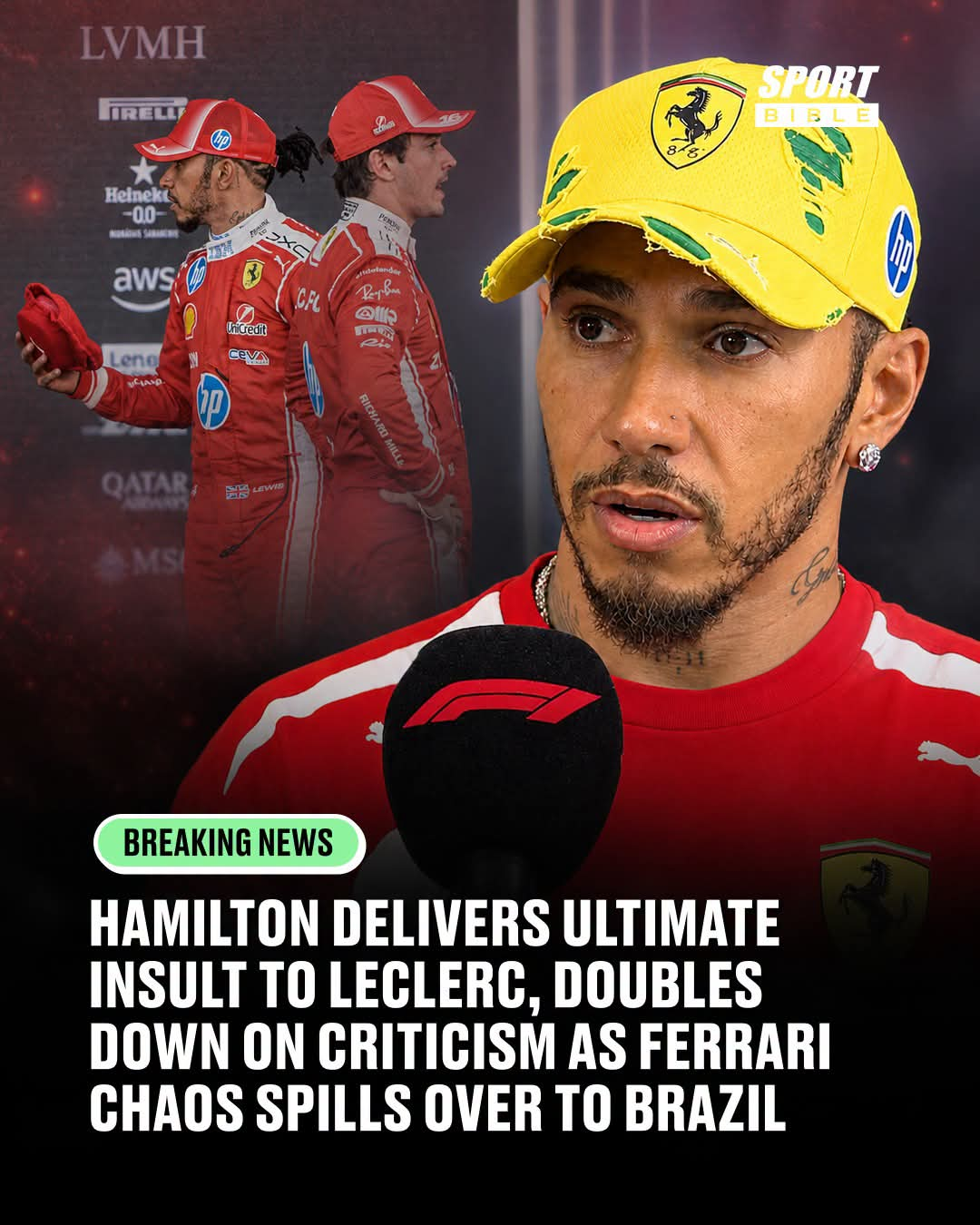
The tension between Lewis Hamilton and Charles Leclerc is showing no signs of disappearing, with the seven-time Formula 1 world champion making it clear that he has no intention of withdrawing his criticism of his Ferrari teammate. Just days after their controversial clash at the Mexican Grand Prix, Hamilton has doubled down on his comments and delivered another uncomfortable message during Thursday’s press conference ahead of the São Paulo Grand Prix.
What initially appeared to be an opening-lap disagreement has developed into a much bigger problem for Ferrari. The two drivers are now facing questions about their relationship, their approach to racing each other and whether the team’s internal harmony is beginning to suffer at a critical stage of the season.
Hamilton’s latest comments suggest that the disagreement is far from settled.
HAMILTON REFUSES TO BACK DOWN AFTER MEXICO CONTROVERSY
The controversy began at the Mexican Grand Prix when Hamilton and Leclerc found themselves fighting for position during the opening lap.
Hamilton was ahead heading into Turn 4, but Leclerc carried significant speed into the corner, ran beyond the track limits and emerged with an advantage. The Monegasque driver did not immediately surrender the position, leaving Hamilton furious over the team radio.
The British driver complained that he had effectively been pushed out by his own teammate, a particularly frustrating situation given that both drivers were competing for Ferrari.
Hamilton’s frustration did not disappear after the chequered flag. He subsequently suggested that Leclerc’s approach had damaged Ferrari’s chances of securing a stronger result, accusing his teammate of behaving as though winning individually mattered more than achieving the best possible outcome for the team.
His criticism was especially pointed when he questioned Leclerc’s mentality, suggesting that the attitude of winning at all costs could prevent Ferrari from achieving a one-two finish.
Those remarks immediately attracted attention because disagreements between teammates are never simply personal matters in Formula 1. Every battle between two drivers carrying the same team’s colours can influence race strategy, championship points and the atmosphere inside the garage.
CHARLES LECLERC GETS A ONE-WORD ANSWER FROM HAMILTON
The most revealing moment from Hamilton’s São Paulo press conference came when he was asked whether he believed Leclerc raced him more aggressively than he raced other competitors.
Hamilton’s response was brief but significant.
“Yes.”
When journalists attempted to get him to explain further, the Ferrari driver declined to expand on the answer, saying: “I can’t say more.”
Although Hamilton did not provide a detailed explanation, his response made it clear that he believes there is a difference in how Leclerc approaches wheel-to-wheel battles against him.
That perception could become an important issue for Ferrari. Teammates are expected to compete hard, but they must also trust that their rival inside the garage will respect the same racing principles applied against other drivers.
Hamilton’s comments indicate that he believes this balance has not always been present.
He also referenced Leclerc’s battle with Max Verstappen in Singapore, pointing to an occasion when the Monegasque driver was alongside the Red Bull competitor but ultimately backed out of the fight.
Hamilton appeared to suggest that Leclerc’s willingness to defend or attack changes depending on who is alongside him.
Whether Leclerc agrees with that assessment is another matter entirely. The Ferrari driver has his own racing instincts, and aggressive competition is hardly unusual among drivers fighting for position at the highest level.
However, when a seven-time world champion publicly questions the consistency of his teammate’s approach, the comments are unlikely to disappear quietly.
HAMILTON DELIVERS A DEFIANT MESSAGE AND REFUSES TO APOLOGISE
Perhaps the strongest part of Hamilton’s press conference was his refusal to apologise for expressing his frustration.
There had been expectations that the British driver might soften his position after the immediate emotions surrounding the Mexican Grand Prix had settled. Instead, he made it clear that he stood by what he said.
“I don’t really care what everyone thinks about what I said, I wear my heart on my sleeve and I say how I feel in the moment,” Hamilton explained.
He acknowledged that drivers can sometimes make comments they later regret, but insisted that this was not one of those occasions.
“I’m never going to apologise for being authentic and real and I’m not going to be silenced,” he added.
Hamilton also stated that nobody within Ferrari had instructed him to stop speaking about the disagreement.
That is an important detail because public criticism between teammates can create difficulties for a team principal trying to maintain discipline and unity. Ferrari must manage the situation carefully without making either driver feel that their concerns are being ignored.
Hamilton’s position is understandable from the perspective of a driver who believes he has been treated unfairly. However, there is also a potential cost to continuing the disagreement publicly.
Every additional comment creates another headline, another round of questions and another opportunity for the dispute to overshadow Ferrari’s actual performance on the track.
FERRARI’S TEAMMATE RELATIONSHIP FACES ITS BIGGEST TEST
Hamilton’s comments also provide an insight into the complicated relationship he has been trying to establish with Leclerc since joining Ferrari.
The seven-time champion recognised that Leclerc has spent several years at the team and has become deeply connected to its operations, personnel and culture.
Leclerc has been part of Ferrari since 2019, making him one of the most established figures within the current organisation.
Hamilton, meanwhile, arrived with a different background, experience and approach to working with a Formula 1 team.
“He has been here a long time,” Hamilton said, referring to Leclerc’s eight years with the team. He also acknowledged the Monegasque driver’s nine victories for Ferrari and his established position within the organisation.
Hamilton explained that he understood the challenge of entering a team where his teammate already had such a strong connection with the people around him.
He insisted that he had worked hard to develop a positive relationship with Leclerc, build trust and create an environment where both drivers could work together respectfully.
However, he also admitted that his personality and demands for change could make the adjustment difficult.
“Naturally, it’s not so easy having someone like me come into a team because I’m very outspoken, and I push and push and push and push for so many changes,” he explained.
This is an important part of the situation. Hamilton is not simply another driver arriving at Ferrari. He is a seven-time world champion with enormous experience and expectations, and he is accustomed to having a significant voice in the development of the team.
Leclerc, on the other hand, has spent years building his position at Ferrari and has his own ambitions of becoming the team’s leading championship contender.
Both drivers want success, but their different histories and approaches could make cooperation more complicated than Ferrari initially anticipated.
THE PRESSURE IS NOW ON FERRARI TEAM PRINCIPAL FRED VASSEUR
While the disagreement has largely centred on Hamilton and Leclerc, Ferrari team principal Fred Vasseur faces an equally important challenge.
The Frenchman must ensure that both drivers understand the team’s expectations when they are fighting each other on the circuit.
Ferrari cannot afford to allow every wheel-to-wheel incident to develop into a public disagreement. The team needs clear racing guidelines, particularly when both drivers have a realistic opportunity to fight for podiums and victories.
The Mexican Grand Prix controversy also raised questions about whether Ferrari should have intervened during the race.
If one driver believes a teammate has gained an advantage by going beyond track limits, the team must decide whether to issue instructions or allow the stewards to handle the matter.
Such decisions are never straightforward. Intervening too aggressively can create resentment, while remaining silent can leave one driver feeling unsupported.
Vasseur has already faced criticism over the team’s handling of the situation, and Hamilton’s latest comments will increase the pressure on him to establish a clear position.
Ferrari must also consider the wider consequences. Sponsors, engineers and other members of the organisation want a team capable of fighting consistently at the front, not one dominated by disagreements between its leading drivers.
BRAZILIAN GRAND PRIX COULD REVEAL WHETHER THE DISPUTE IS GETTING WORSE
The São Paulo Grand Prix now provides the next opportunity to see how Hamilton and Leclerc behave when they return to competitive action.
Interlagos is a circuit where overtaking opportunities, changing weather conditions and strategic decisions can create unpredictable races. The short lap and challenging corners can also bring teammates into close contact, particularly during the opening stages.
Ferrari will be hoping that the Mexico incident does not influence the way its drivers approach each other this weekend.
However, Hamilton’s comments have added another layer of tension. If the two drivers find themselves fighting for position again, every defensive move and overtaking attempt will attract greater scrutiny.
A clean race could help calm the situation, but another disagreement would make it increasingly difficult for Ferrari to convince observers that everything is under control.
The team also needs to avoid allowing the controversy to distract from its wider competitive objectives. With the season entering another important phase, every available championship point matters.
LECLERC NOW HAS A CHANCE TO RESPOND ON THE TRACK
Hamilton has made his position clear, but the next significant response could come from Leclerc.
The Monegasque driver has not been portrayed in this latest report as having issued a direct response to Hamilton’s comments from São Paulo. That leaves plenty of room for speculation about how he will handle the situation.
Leclerc has established himself as a highly competitive driver at Ferrari, and he will not want the impression to develop that he is unwilling to fight Hamilton fairly.
At the same time, he will be aware that responding emotionally could make an already uncomfortable situation even worse.
His strongest answer may be to focus on his performance, demonstrate his racing ability and allow his actions to speak for themselves.
But Ferrari cannot rely entirely on the drivers resolving the matter privately. The team must ensure that both men understand where the boundaries lie.
FERRARI CANNOT AFFORD A PROLONGED HAMILTON-LECLERC WAR
Hamilton’s refusal to apologise has turned the Mexican Grand Prix disagreement into one of the most closely watched stories heading into the Brazilian weekend.
His comments suggest that he believes the issue goes beyond one incident and reflects a wider difference in how Leclerc approaches battles against him compared with other competitors.
That is a serious perception for any teammate relationship, particularly inside a team with Ferrari’s history and expectations.
There is no confirmation that the disagreement has permanently damaged their relationship, nor does Hamilton’s latest statement prove that the two drivers cannot work together. However, the public nature of the criticism makes it harder for Ferrari to treat the matter as an ordinary racing misunderstanding.
The bigger question is whether Vasseur can turn this confrontation into an opportunity to establish clearer rules before another incident occurs.
Hamilton wants to feel that he can compete fairly with his teammate. Leclerc wants to protect his position and continue fighting at the front. Ferrari needs both drivers performing at their best.
If the team manages the situation properly, the controversy could eventually become a minor chapter in their partnership. But if another flashpoint emerges in Brazil, the pressure on Ferrari could become considerably greater.
For now, Hamilton has delivered his message: he stands by his words, he will not apologise, and he has no intention of remaining silent.