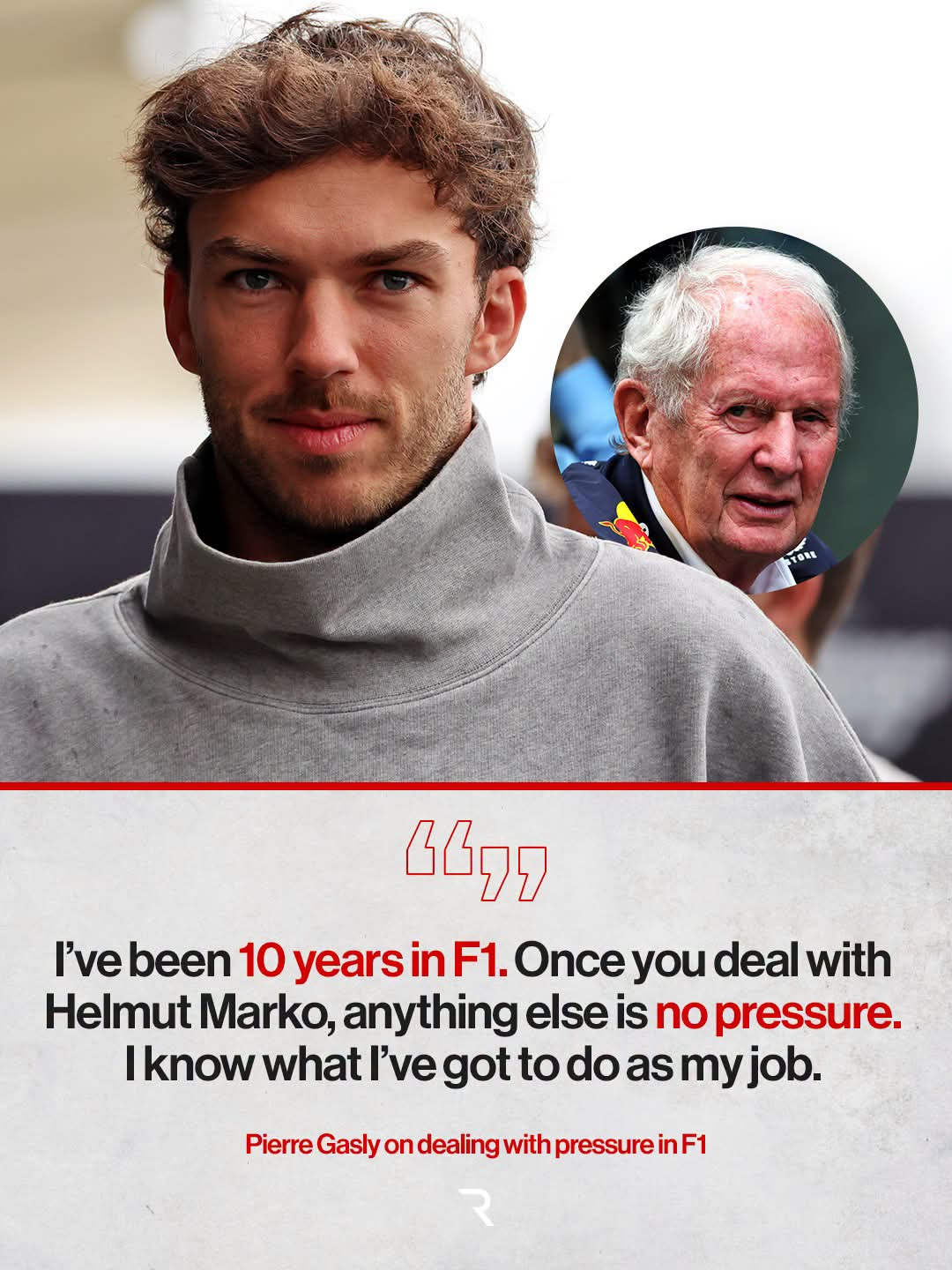
Pierre Gasly has never been one to hide behind polished media lines. Ahead of the Brazilian Grand Prix, with the Interlagos crowd set to roar for his Alpine teammate Franco Colapinto and the usual intensity of a late-season race weekend building, the Frenchman delivered a classic Gasly one-liner. Asked about the passionate support and potential extra pressure, he simply said that once you have dealt with Helmut Marko, everything else feels manageable.
That throwaway remark captures something deeper about Gasly’s career. He did not arrive in Formula 1 as a finished product who somehow discovered mental toughness later. He built it the hard way, year after year, under conditions that would have broken many drivers long before they reached the grid.
THE RED BULL PRESSURE COOKER THAT FORGED A DIFFERENT KIND OF DRIVER
Helmut Marko’s reputation inside the Red Bull junior programme needs little introduction. Exact standards, constant evaluation, and little patience for anything less than maximum results defined the system Gasly entered as a teenager. Drivers who thrived under that regime often talk about it with a mix of respect and residual tension. Gasly has done both.
The 2013 Formula Renault 2.0 season stands out as the clearest early example. It was a genuine make-or-break campaign. The championship winner walked away with a substantial financial prize; second place received nothing. Gasly went into the final race leading Oliver Rowland. Contact on the opening lap spun him around. He recovered to sixth while Rowland salvaged enough points to take the title. A month later, Marko still told Gasly he had not won enough races, taken enough poles, or set enough fastest laps. The conversation left Gasly questioning his place. Yet it ended with a Red Bull Junior Team contract.
That sequence reveals the environment. Performance was never enough on its own. The scrutiny was constant. Gasly has repeatedly said that the pressure he felt climbing the junior ranks — not knowing whether the next season of funding would materialise if results dipped — was more intense than anything he has faced in Formula 1. The F1 paddock, for all its intensity, operates with more structure and longer-term security once a driver has established himself.
FROM DEMOTION TO MONZA: THE HARDENING PROCESS CONTINUES
The real public test arrived in 2019. Promoted to Red Bull alongside Max Verstappen, Gasly struggled to adapt quickly enough to the car and the team dynamics. After 12 races he was demoted back to Toro Rosso (now Racing Bulls). For a young driver, that kind of public step down can be career-ending. Confidence collapses. Opportunities dry up.
Gasly refused to let it define him. He returned stronger, scored his first podium in Brazil later that year, and then delivered the emotional breakthrough win at Monza in 2020 for AlphaTauri. That victory was more than a race result. It was proof that the early lessons in resilience had stuck. The same driver who once faced Marko’s blunt assessments and the existential uncertainty of junior funding had learned how to process setbacks without losing the hunger that got him there.
Those experiences matter beyond the individual. Formula 1 is full of high-potential drivers who fade when the pressure spikes — whether from a teammate’s pace, a mid-season demotion, or the constant media and fan scrutiny that comes with a seat at a midfield or better team. Gasly’s path shows that early, repeated exposure to high-stakes environments can create a different baseline. What feels overwhelming to someone who has always progressed smoothly can feel familiar, almost routine, to a driver who has already survived worse.
WHY THE COMMENT STILL MATTERS IN 2026
Fast-forward to the present. Gasly is the experienced leader at Alpine, sharing the garage with the younger Colapinto. The Brazilian Grand Prix brings a passionate South American crowd that will largely favour the Argentine. Recent on-track incidents between the two teammates have already generated noise, including reports of significant online hostility directed at Gasly. In that context, his Marko quip is both humorous and revealing.
He is not dismissing the atmosphere. He is reframing it. The energy of a passionate crowd becomes something he can feed off rather than something that distracts him. That mindset is useful for Alpine as the team continues its longer-term project under new regulations and evolving internal leadership. A driver who treats external noise as secondary to his own process is exactly the kind of stabilising presence a developing team needs.
It also speaks to a broader truth about modern Formula 1. The mental side of the sport receives more attention than ever, yet the pathways that develop genuine toughness remain uneven. Drivers who come through demanding junior programmes with strong internal cultures often arrive better prepared than those whose progression was smoother or more heavily managed. Gasly’s story is a case study in that difference.
THE LONGER-TERM VALUE OF EARLY HARDSHIP
Looking ahead, Gasly’s approach positions him well for whatever the next phase of Alpine’s recovery looks like. New regulations create opportunity. Leadership roles bring extra responsibility. Teammate dynamics shift. External expectations rise and fall. The driver who learned early that external validation is unreliable and that results under pressure define progress holds an advantage.
His career is not a straight-line success story. It includes a high-profile demotion, seasons of midfield grinding, and the constant need to prove value in a sport that moves on quickly. Yet the through-line is consistent: pressure was never abstract for him. It was concrete, early, and repeated. That is why a throwaway line about Helmut Marko lands with weight. It is not bravado. It is the product of a career built on exactly that foundation.
In an era when mental performance is discussed as openly as aerodynamics, Gasly offers a reminder that some of the most useful training still happens long before a driver ever sits in an F1 car. The lessons stick. The standards remain. And when the crowd gets loud or the weekend turns chaotic, the response is already rehearsed.