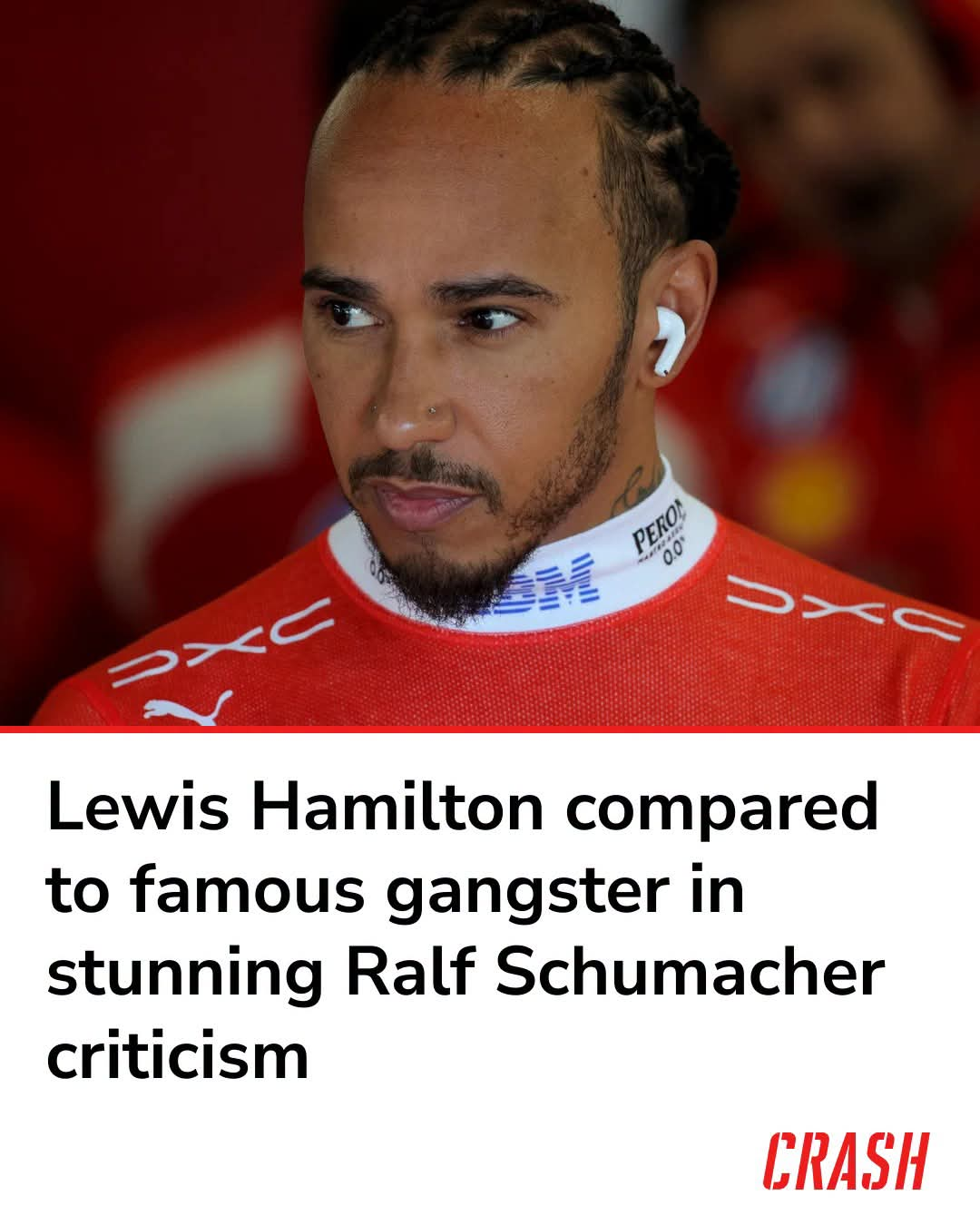
The growing tension inside Ferrari has taken another dramatic turn after a former Formula 1 driver launched a remarkable attack on one of the team’s biggest stars, questioning his behaviour and accusing him of putting personal interests ahead of the legendary Scuderia.
The controversy follows the explosive opening-lap confrontation at the Mexican Grand Prix, where Ferrari’s hopes of securing a potential one-two finish were damaged by a battle between Lewis Hamilton and Charles Leclerc.
Hamilton was furious after losing valuable ground during the incident and made his feelings clear over team radio. However, his response has now attracted criticism from former F1 driver Ralf Schumacher, who believes the seven-time world champion crossed an important line.
Schumacher even compared Hamilton’s post-race behaviour to that of notorious American gangster Al Capone, delivering one of the most controversial assessments of the Ferrari situation since the Mexico City race.
His comments have added another layer to an increasingly uncomfortable situation for team principal Fred Vasseur, who must now find a way to prevent the disagreement from becoming a lasting problem.
RALF SCHUMACHER DELIVERS A STUNNING ATTACK ON HAMILTON
Schumacher was particularly critical of the way Hamilton communicated his frustration during the Mexican Grand Prix.
The former Williams and Toyota driver accepted that the opening-lap battle between the Ferrari teammates was a normal part of competitive racing. He acknowledged that neither driver wanted to surrender position, even if that created the possibility of contact.
His main objection was what happened afterwards.
Schumacher argued that Hamilton’s demand for action against his teammate over the radio was unacceptable, particularly given the importance of protecting Ferrari’s reputation.
He then made the extraordinary Al Capone comparison while discussing Hamilton’s warning that Ferrari had serious problems.
Schumacher said Hamilton was behaving as though he was above the Ferrari brand and acting more like a team principal than a driver.
It was an exceptionally harsh assessment, especially considering Hamilton’s status as one of the most successful drivers in Formula 1 history.
However, Schumacher’s argument raises a wider question about the responsibilities that come with representing a team as important as Ferrari.
Hamilton has every right to express frustration when he believes a teammate has compromised his race. But Schumacher believes there is a difference between demanding accountability and publicly creating the impression that the organisation is falling apart.
WHAT ACTUALLY HAPPENED BETWEEN HAMILTON AND LECLERC IN MEXICO?
The disagreement began almost immediately after the lights went out at the Mexican Grand Prix.
Hamilton started from pole position and was attempting to maintain control of the race. Leclerc, starting alongside him, was equally determined to challenge for the lead.
After failing to find a clear opportunity through the opening complex, Leclerc attempted an aggressive move around the outside at Turn 4.
Both Ferrari drivers went off the track during the confrontation.
Hamilton lost momentum and eventually surrendered second position to Max Verstappen, while Leclerc continued ahead but was subsequently handed a five-second penalty for leaving the track and gaining an advantage.
Verstappen went on to win the race, Hamilton finished second and Leclerc dropped to fourth.
From Ferrari’s perspective, the result represented a significant missed opportunity.
The team had demonstrated enough pace to fight for victory, but the confrontation between its drivers compromised its chances of securing a much stronger result.
Hamilton subsequently argued that the incident had cost Ferrari the win and insisted that serious discussions needed to take place behind closed doors.
His frustration was understandable from a competitive perspective, but Schumacher believes the way he expressed it created an additional problem for the team.
SCHUMACHER SAYS HAMILTON IS PUTTING HIMSELF ABOVE FERRARI
One of Schumacher’s strongest criticisms was his suggestion that Hamilton’s behaviour appeared to place his individual interests above the wider objectives of Ferrari.
He questioned whether the British driver was concentrating on collective success or becoming too focused on situations involving himself.
Schumacher also argued that the rivalry between Hamilton and Leclerc had gone too far in recent races.
Both drivers are established competitors with ambitions of winning, and neither is likely to accept being treated as a permanent number two.
However, Ferrari cannot afford to allow individual battles to repeatedly damage its race results.
Schumacher’s position is that the team needs to establish clear boundaries and ensure both drivers understand that the interests of the Scuderia must come first.
That does not mean Hamilton should remain silent whenever he believes something has gone wrong.
Experienced drivers are expected to challenge decisions, communicate problems and demand improvements from their teams. The important issue is how those concerns are handled and whether they help or damage the organisation.
FRED VASSEUR FACES PRESSURE TO TAKE CONTROL
Schumacher also directed criticism towards Ferrari’s management, insisting that Vasseur needs to take control of the situation.
The former driver described both Hamilton and Leclerc as stubborn and suggested that Ferrari’s leadership must make it clear how the drivers are expected to behave.
His argument is that allowing the rivalry to continue without firm intervention could eventually create a much bigger problem.
Ferrari have already experienced difficult teammate relationships throughout their history. Internal disagreements can become particularly damaging when both drivers are capable of fighting for victories.
Vasseur therefore faces a delicate balancing act.
Hamilton brings enormous experience, commercial value and a championship-winning mentality. Leclerc is an important part of Ferrari’s long-term future and has spent years building his reputation within the organisation.
Neither driver can simply be ignored.
The team principal must find a way to protect both relationships while making it clear that Ferrari’s collective performance cannot repeatedly suffer because of disagreements between its drivers.
Schumacher’s criticism may be controversial, but his central warning is difficult to dismiss: Ferrari need stronger control of the situation.
THE HAMILTON-LECLERC RIVALRY IS BECOMING A MAJOR STORYLINE
When Ferrari announced Hamilton’s arrival, the partnership was expected to become one of the biggest attractions of the modern Formula 1 era.
The combination of a seven-time world champion and one of the most talented drivers of his generation promised enormous potential.
However, having two competitive drivers in the same garage always carries risks.
Hamilton has experienced intense teammate rivalries before, particularly during his time alongside Fernando Alonso at McLaren and Nico Rosberg at Mercedes.
Those experiences demonstrated how quickly disagreements can become damaging when both drivers believe they have a legitimate opportunity to win.
Leclerc is also fiercely competitive and has no reason to surrender his ambitions simply because Hamilton has a more decorated career.
That creates a difficult situation for Ferrari.
The team needs both drivers performing at their best, but it also needs them to recognise when an individual battle could damage a much bigger opportunity.
The Mexican Grand Prix has exposed how difficult that balance can become when victory is within reach.
FERRARI CANNOT AFFORD ANOTHER SELF-INFLICTED DISAPPOINTMENT
One of the most frustrating aspects of the Mexican Grand Prix was that Ferrari appeared to have the performance required to challenge for the victory.
Hamilton had secured pole position, and the car was competitive enough to put the team in a position to fight at the front.
Yet the opening-lap confrontation changed the complexion of the race.
Ferrari’s problem is that technical improvements alone will not solve situations like this.
The team can continue developing its car, improving aerodynamic performance and refining its race strategy, but none of those improvements will guarantee success if its drivers repeatedly compromise each other’s opportunities.
Mercedes has previously demonstrated how important clear instructions can become when teammates are fighting for similar positions.
Ferrari must decide whether it is prepared to introduce firmer rules governing how Hamilton and Leclerc compete against each other.
Such a decision could create resistance, particularly from two drivers who naturally want the freedom to fight for victories.
But allowing the current situation to continue without a clear solution could prove even more expensive.
BRAZILIAN GRAND PRIX COULD REVEAL WHETHER FERRARI HAS LEARNED ITS LESSON
The Brazilian Grand Prix at Interlagos provides Ferrari with an immediate opportunity to move beyond the controversy.
Hamilton and Leclerc will both be determined to deliver a strong result, but the team must ensure that the Mexican incident does not influence their approach to the next race.
Vasseur’s responsibility will be to establish clear expectations before the weekend begins.
If both drivers understand how Ferrari expects them to handle wheel-to-wheel battles, the team can reduce the possibility of another unnecessary confrontation.
However, if the rivalry continues to dominate the headlines, questions about Ferrari’s leadership will become increasingly difficult to avoid.
The Scuderia needs victories, not another round of public disagreements.
WAS RALF SCHUMACHER TOO HARSH ON HAMILTON?
Schumacher’s Al Capone comparison has certainly raised the temperature of the debate, but not everyone will agree with his assessment.
Hamilton’s supporters could argue that a seven-time world champion has earned the right to demand accountability when he believes a teammate has damaged a potential victory.
They could also point out that Hamilton’s comments came in the immediate aftermath of a frustrating incident, when emotions were naturally running high.
On the other hand, critics may agree with Schumacher that Ferrari’s reputation should not become secondary to individual frustrations.
There is also a distinction between Hamilton criticising a racing incident and questioning the wider operation of the team.
The real issue is whether his comments were an attempt to demand necessary improvements or whether they risked making an already uncomfortable situation worse.
What is certain is that Ferrari cannot ignore the disagreement.
Hamilton and Leclerc are both too important to the team’s ambitions for their relationship to deteriorate into a prolonged internal battle.
Schumacher has delivered his verdict, Vasseur has been warned, and the next race will provide another opportunity for Ferrari to show whether it can restore order.
The biggest danger for the Scuderia is no longer simply losing positions to its rivals. It is allowing its own garage to become the source of its biggest setbacks.