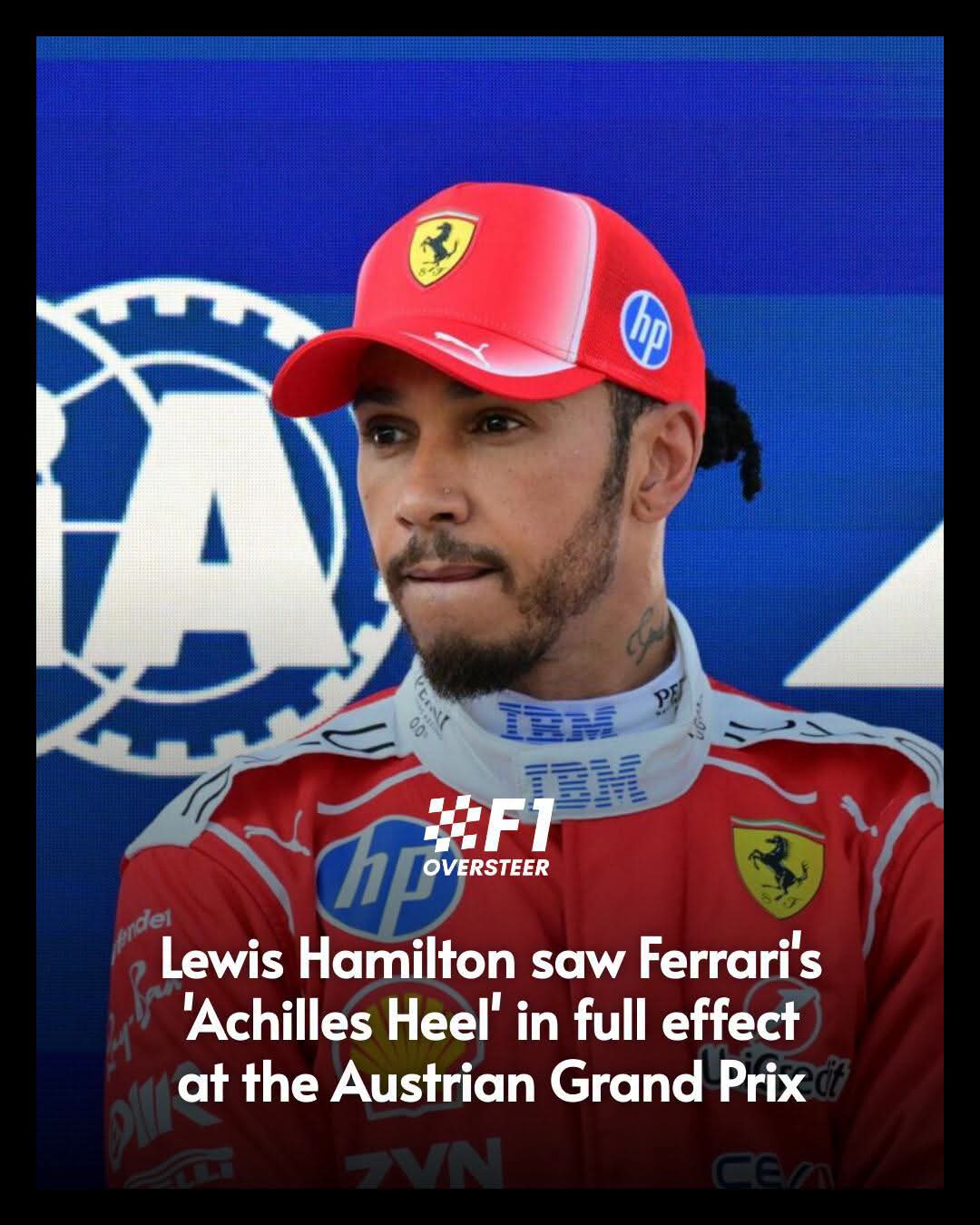
Lewis Hamilton believes Ferrari has taken meaningful steps forward with its latest upgrades, but the seven-time Formula 1 world champion admits one critical weakness continues to prevent the Scuderia from consistently matching Mercedes. Following qualifying for the Austrian Grand Prix, Hamilton described Ferrari’s straight-line performance as the team’s “Achilles’ heel,” warning that the problem is likely to remain a challenge at high-speed circuits unless significant progress is made.
While Ferrari has narrowed the performance gap in several areas, Hamilton’s comments highlight the technical hurdle that could ultimately shape both the Constructors’ Championship and his pursuit of an eighth world title.
FERRARI’S UPGRADES DELIVER IMPROVEMENT BUT NOT THE COMPLETE SOLUTION
Ferrari arrived in Austria optimistic after introducing another package of upgrades aimed at reducing Mercedes’ advantage. Expectations were high following the team’s recent competitive performances, but qualifying exposed that the updates have not solved every weakness.
Hamilton secured a strong third-place starting position, demonstrating that Ferrari remains capable of fighting near the front. However, he acknowledged that the team continues to lose valuable time on the circuit’s long straights, where Mercedes’ superior top speed proved decisive.
The Austrian circuit places enormous emphasis on acceleration and straight-line efficiency, making it one of the toughest venues for any team carrying a speed deficit.
Although Ferrari improved its overall balance, Hamilton admitted the car simply could not match Mercedes whenever maximum speed became the deciding factor.
HAMILTON EXPLAINS WHY HIGH-SPEED TRACKS REMAIN A CONCERN
Speaking after qualifying, Hamilton made it clear that Ferrari had anticipated difficulties before arriving at the Red Bull Ring.
He explained that circuits featuring long straights naturally expose the team’s biggest technical limitation, something that cannot be masked through setup adjustments alone.
Hamilton suggested altitude may also have played a role in amplifying the performance difference, although he stressed that Ferrari’s straight-line weakness has become a recurring trend rather than a one-off issue.
Describing it as the team’s “Achilles’ heel,” he admitted that solving the problem will require more substantial development rather than incremental upgrades.
That honest assessment reflects Ferrari’s awareness that consistent championship success demands excellence across every type of circuit—not just those favouring cornering performance.
MERCEDES CONTINUES TO SET THE BENCHMARK
Austria once again underlined why Mercedes currently leads both world championships.
Even amid the controversy surrounding George Russell’s pole position, Mercedes demonstrated exceptional pace throughout qualifying and maintained its advantage in outright speed.
The Silver Arrows now lead the Constructors’ Championship with 302 points, while Andrea Kimi Antonelli and Russell occupy the top two positions in the Drivers’ standings.
For Ferrari, the challenge extends beyond matching Mercedes over a single lap.
Race pace, tyre management, reliability, and aerodynamic efficiency all remain crucial areas where small differences accumulate into significant championship advantages over the course of a season.
Closing those gaps will be essential if Ferrari hopes to sustain pressure during the remaining rounds.
HAMILTON’S TITLE AMBITIONS DEPEND ON FERRARI’S DEVELOPMENT
Despite Ferrari’s technical shortcomings, Hamilton remains firmly involved in the championship fight.
With 125 points, he sits within striking distance of the leaders and still has ample opportunity to reduce the deficit as the calendar moves toward the second half of the season.
However, every race where Ferrari struggles for straight-line speed risks allowing Mercedes to extend its advantage.
Hamilton has repeatedly demonstrated throughout his career that experience, racecraft, and strategic intelligence can compensate for small performance deficits.
Yet winning a championship ultimately requires a car capable of competing everywhere—from high-downforce street circuits to power-sensitive venues like Austria.
If Ferrari cannot significantly improve its top-speed performance, Hamilton may continue finding himself fighting for podiums rather than victories at several upcoming races.
WHY THE NEXT FEW RACES COULD BE DECISIVE
The upcoming sequence of Grands Prix offers Ferrari both opportunity and risk.
Some circuits are expected to better suit the SF26’s strengths, potentially allowing Hamilton and Charles Leclerc to challenge Mercedes more aggressively. Others may once again expose the straight-line limitations Hamilton highlighted after qualifying.
Ferrari’s engineers now face a critical period of development.
Formula 1 championships are often decided by which team improves fastest during the middle stages of the season, and Hamilton’s comments suggest Ferrari understands exactly where its priorities must lie.
If the Scuderia can unlock more speed without sacrificing its cornering performance, the title race could tighten considerably.
If not, Mercedes may continue building a points cushion that becomes increasingly difficult to overcome.
FERRARI STILL HAS REASONS FOR OPTIMISM
While Hamilton openly acknowledged Ferrari’s biggest weakness, his overall message was far from pessimistic.
The team continues making steady progress, the upgrades have moved the car closer to Mercedes, and Ferrari remains comfortably second in the Constructors’ Championship.
Perhaps most importantly, Hamilton believes the team is moving in the right direction.
The challenge now is transforming gradual improvement into the major breakthrough needed to consistently defeat Mercedes across every type of Formula 1 circuit.
With several races remaining before the championship enters its decisive stages, Ferrari still has time to address its “Achilles’ heel.” Whether it can do so quickly enough may ultimately determine if Hamilton’s quest for an unprecedented eighth world championship remains alive until the final rounds of the 2026 season.