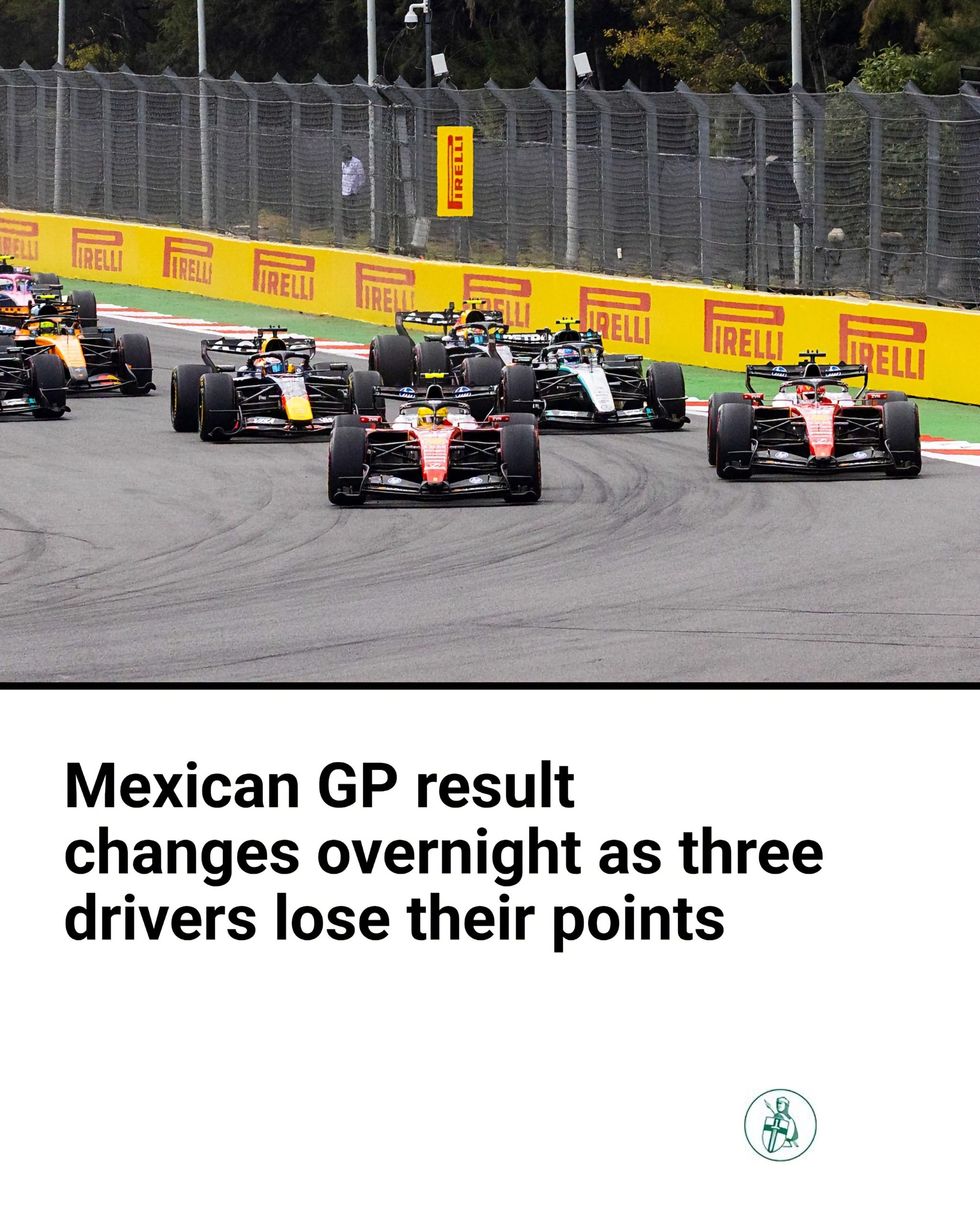
The Mexican Grand Prix has produced another major twist after the FIA stewards issued a series of post-race penalties that dramatically reshaped the final classification. Three drivers who initially finished inside the points-paying positions were pushed down the order, turning what appeared to be a rewarding afternoon into a damaging result for their respective teams.
While Max Verstappen celebrated another victory and Kimi Antonelli secured his historic first Formula 1 world championship with a third-place finish, the biggest post-race consequences came further down the field. Oscar Piastri, Franco Colapinto and Pierre Gasly were all punished, with their penalties removing valuable points from their final results.
The decisions also created unexpected opportunities for Liam Lawson, Gabriel Bortoleto and Ryo Hirakawa, who all benefited from the revised classification. For some teams, the changes transformed the outcome of an already unpredictable race.
OSCAR PIASTRI SUFFERS THE BIGGEST POST-RACE PENALTY
Oscar Piastri was among the biggest losers after the stewards handed him a 10-second time penalty for causing a collision with Racing Bulls driver Arvid Lindblad.
The incident happened late in the race when Piastri attempted to overtake Lindblad around the outside approaching Turn 1.
The two drivers became involved in a wheel-to-wheel battle, but the situation deteriorated as they approached the next corner. Their cars made contact, sending Lindblad into the barriers and out of the race.
Piastri managed to continue, although his McLaren suffered significant damage. He initially crossed the finish line in seventh position, which appeared to provide some relief after the incident.
That result did not survive the stewards’ investigation.
The 10-second penalty dropped the Australian all the way down to 13th in the final classification, leaving him without a single championship point from the Mexican Grand Prix.
For a driver competing in a highly competitive championship, losing an entire points finish because of a post-race decision is a significant setback.
FIA EXPLAINS WHY PIASTRI WAS HELD RESPONSIBLE
Piastri disagreed with the decision, describing the collision as an unfortunate racing incident.
He argued that Lindblad had closed the door late during the approach to Turn 1, forcing him towards the outside of the circuit. Piastri also explained that he was unable to avoid the collision because the two cars became interlocked before he could properly turn into the following corner.
However, the stewards reached a different conclusion.
In their decision, they stated that Piastri was never sufficiently alongside Lindblad to claim the right to the corner.
They also noted that Lindblad defended his position without forcing the McLaren driver off the track, meaning he was not required to provide additional racing room.
The stewards ultimately determined that Piastri could have avoided the collision by moving further to the left after Turn 1, even if that meant leaving the circuit before reaching Turn 2.
That assessment proved decisive.
The incident raises an important question about overtaking standards in Formula 1: how much responsibility should a driver attempting a move carry when the available space disappears?
Piastri believed the circumstances made the collision unavoidable. The stewards believed he had another option.
Their decision has now become one of the most consequential moments of the Mexican Grand Prix.
ALPINE SUFFERS DOUBLE PENALTY DISASTER
Piastri was not the only driver to lose a points finish after the race.
Alpine suffered an equally frustrating outcome after both Franco Colapinto and Pierre Gasly received 10-second penalties for failing to slow sufficiently under yellow flags.
Colapinto had originally finished eighth, while Gasly crossed the line in 10th.
Those results offered Alpine a potentially valuable double-points finish, something that would have represented an important achievement for the team.
Instead, the penalties dropped Colapinto to 15th and Gasly to 17th.
Alpine therefore left Mexico City without any championship points despite having both cars initially finish inside the top 10.
The punishment was particularly frustrating because the team had shown encouraging race pace and appeared capable of securing a much-needed result.
Team executive Flavio Briatore expressed disappointment after the revised classification.
He praised the performance but admitted that the final outcome was frustrating, especially after both drivers had initially finished in points-paying positions.
For a team trying to improve its competitiveness, losing an entire points haul through post-race penalties is a painful outcome.
LIAM LAWSON AND GABRIEL BORTOLETO BENEFIT FROM THE DECISIONS
While three drivers suffered, others enjoyed unexpected promotions.
Liam Lawson was one of the biggest beneficiaries, moving up to seventh place after Piastri’s penalty and the other classification changes.
The Racing Bulls driver has experienced uncertainty surrounding his long-term Formula 1 future, making every strong result particularly important.
Finishing seventh provides valuable points for both Lawson and his team, while strengthening his argument that he remains a useful part of their competitive plans.
Gabriel Bortoleto also moved up the order, inheriting eighth position.
The Brazilian driver therefore secured another opportunity to strengthen his championship position without needing to make an additional overtaking move on track.
These promotions demonstrate how important post-race investigations can be in Formula 1.
A driver may believe the race is finished once the chequered flag falls, but stewards’ decisions can completely change the final order.
ISACK HADJAR SALVAGES POINTS AFTER GEORGE RUSSELL INCIDENT
Isack Hadjar also benefited from the revised classification, eventually securing ninth place and two championship points.
The Racing Bulls driver had endured a difficult afternoon after being spun around following an incident involving George Russell.
The contact disrupted his race and threatened to leave him outside the points.
However, the penalties handed to other drivers helped Hadjar recover a top-10 finish.
Although two points may not completely compensate for the difficulties he experienced, they still represent an important addition to his championship total.
For Racing Bulls, having Lawson and Hadjar both finish inside the top nine after the revised classification provided a welcome boost.
RYO HIRAKAWA SECURES FIRST F1 POINT IN REMARKABLE DEBUT
Perhaps the most surprising beneficiary of the penalties was Ryo Hirakawa.
The Japanese driver initially finished 13th on the road but was promoted to 10th after the post-race decisions.
That promotion gave him a championship point in his first Formula 1 race.
It was a significant achievement for Hirakawa, who found himself competing in the middle of a complicated race involving several experienced drivers and multiple incidents.
Scoring points on a debut weekend is never guaranteed, particularly when driving for a team fighting outside the leading positions.
Although he needed the penalties ahead of him to secure the result, the point still represents a memorable milestone.
It also provides an encouraging moment for a driver who has been working towards an opportunity to demonstrate his ability at the highest level of motorsport.
WHAT THE REVISED MEXICO GP CLASSIFICATION MEANS FOR THE TEAMS
The penalties have created very different consequences across the Formula 1 paddock.
McLaren will be disappointed that Piastri lost his seventh-place finish, especially after the team had already dealt with the damage caused by the collision.
Alpine will be even more frustrated because both Colapinto and Gasly were removed from the points after their yellow-flag infringements.
Racing Bulls, meanwhile, emerged in a stronger position thanks to Lawson’s promotion and Hadjar’s recovery.
For Bortoleto and Hirakawa, the changes provided valuable championship rewards.
The revised order also reinforces how important discipline and decision-making remain in modern Formula 1.
Teams invest enormous resources in car development, race strategy and driver preparation, but a single infringement can undo much of that work.
The consequences are particularly significant in a midfield where a few points can influence championship positions, financial rewards and a team’s assessment of its season.
MAX VERSTAPPEN AND KIMI ANTONELLI REMAIN THE BIG WINNERS
Despite all the changes further down the classification, the top three positions remained untouched.
Verstappen secured victory, Hamilton finished second and Antonelli claimed third place.
For Antonelli, the result was especially historic because it confirmed his status as the youngest Formula 1 world champion in history.
At just 20 years and 68 days old, the Mercedes driver achieved a milestone that will remain part of Formula 1 history for years to come.
Verstappen, meanwhile, continued his impressive run with another victory, taking advantage of Ferrari’s opening-lap problems to secure his third win in the last four Grands Prix.
Hamilton also maintained his second-place finish despite his frustration over the confrontation with Ferrari teammate Charles Leclerc.
The post-race penalties did not change the podium, but they dramatically altered the story behind the remaining points positions.
BRAZIL GRAND PRIX NOW FOLLOWS A MEXICO WEEKEND FULL OF CONSEQUENCES
The revised Mexican Grand Prix classification provides an important backdrop as Formula 1 heads to Interlagos for the Brazilian Grand Prix.
Drivers and teams will be aware that the smallest mistakes can carry significant consequences, particularly when stewards are forced to investigate incidents after the race.
Piastri will want to recover from losing his points finish, while Alpine must find a way to avoid another weekend in which promising performances are undone by penalties.
Lawson, Bortoleto and Hirakawa will also have reasons to build on their improved Mexican results.
For Ferrari, the focus remains on resolving the tensions between Hamilton and Leclerc, while Mercedes arrives with a newly crowned world champion.
The Mexican Grand Prix has already delivered a historic championship moment, a dramatic victory for Verstappen and several controversial incidents.
But the final classification has added another layer of drama.
Three drivers lost valuable positions through penalties, while others received unexpected rewards. It is another reminder that in Formula 1, crossing the finish line does not always mean the race is truly over.