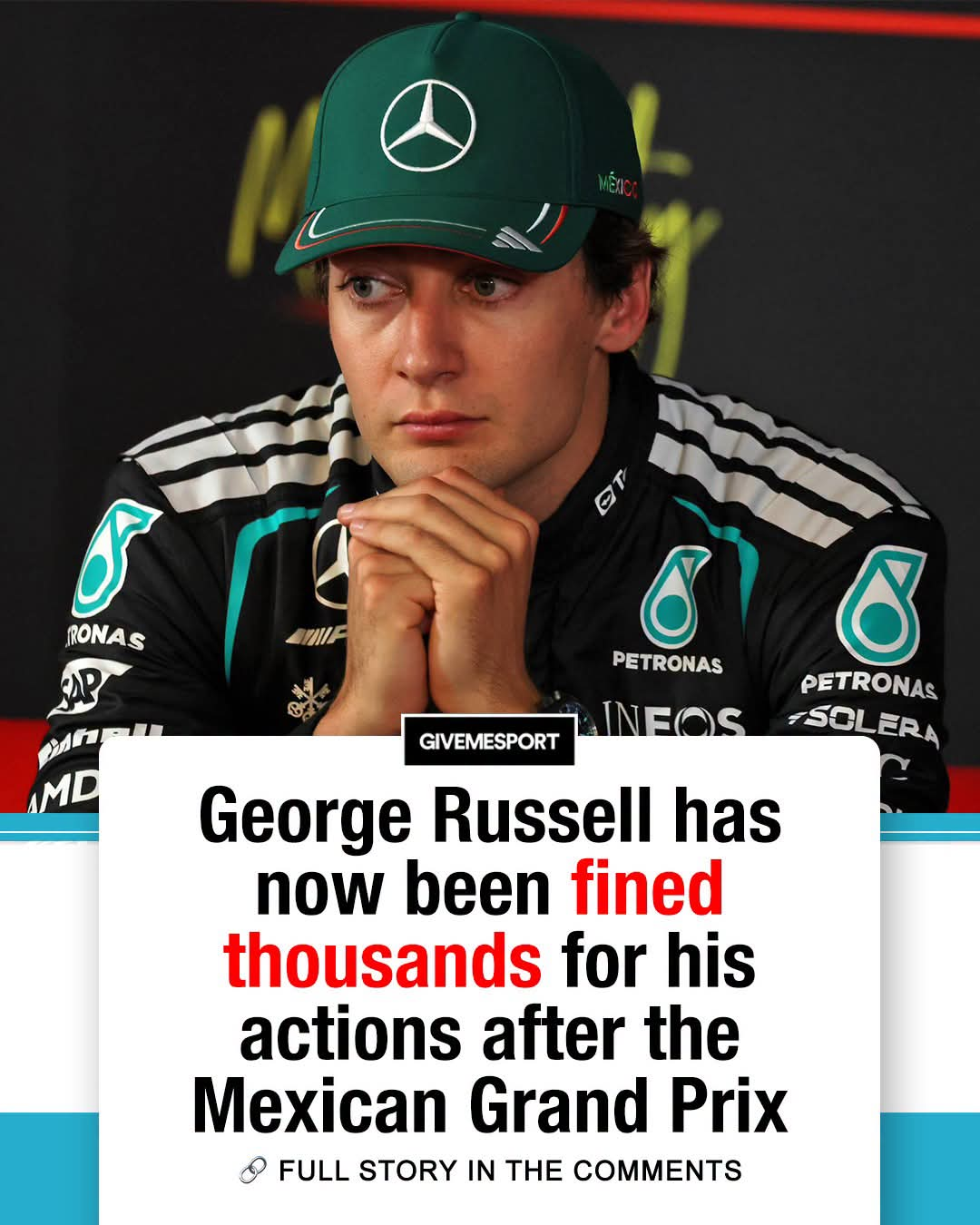
George Russell has been hit with a £4,000 fine following his emotionally difficult Mexican Grand Prix weekend, with the Mercedes driver punished for missing mandatory post-race media duties after suffering another frustrating setback in the 2026 Formula 1 season. Russell’s disappointment in Mexico City was compounded by technical problems, an on-track penalty and the growing reality that his championship ambitions had been overtaken by teammate Kimi Antonelli, who secured the world title in historic fashion. While Mercedes team principal Toto Wolff openly defended Russell’s decision to leave the circuit without completing his media obligations, the FIA’s regulations ultimately meant that the British driver could not escape financial punishment.
The incident has sparked renewed discussion about the balance between Formula 1’s strict media requirements and the emotional pressure experienced by drivers after particularly difficult races. Russell had entered the Mexican Grand Prix with hopes of delivering a strong result from the front row, but his afternoon quickly unravelled following an energy deployment problem that cost him valuable positions. A collision with Isack Hadjar at the Mexican circuit resulted in a 10-second time penalty, leaving Russell classified sixth while Antonelli celebrated another podium finish and the championship that Russell had hoped to challenge for earlier in the campaign. By the time the race ended, the Mercedes driver had little reason to celebrate.
WHY GEORGE RUSSELL WAS FINED AFTER THE MEXICAN GRAND PRIX
Russell’s £4,000 punishment was not connected to his collision with Hadjar or the 10-second penalty he received during the race. Instead, the FIA sanction followed his failure to attend mandatory media duties after the Mexican Grand Prix.
Formula 1 drivers are required to participate in post-race media obligations unless they have received an appropriate exemption or possess a valid reason accepted under the relevant procedures. These requirements are part of the sport’s wider commercial and regulatory structure, ensuring that broadcasters, journalists and media partners receive access to competitors following each Grand Prix.
Russell, however, chose to leave the circuit without completing those obligations after what had been an emotionally exhausting afternoon. His decision was understandable from a personal perspective, particularly given the technical problems that had prevented him from competing for a potential victory, but it still placed him in breach of the mandatory protocol.
The financial punishment demonstrates that the FIA continues to treat media attendance as an important part of a driver’s responsibilities. Even when the sporting outcome is deeply disappointing, competitors are generally expected to fulfil their obligations unless circumstances justify an exception.
For Russell, the fine represented another unwanted development during a season that has repeatedly tested his patience.
TOTO WOLFF DEFENDS RUSSELL AFTER AN EMOTIONAL MEXICO GP
Mercedes team principal Toto Wolff did not attempt to hide his sympathy for Russell following the race. The Austrian admitted that the British driver was devastated by the outcome and suggested that his emotional reaction was entirely understandable given the circumstances.
“I saw George after the race on the FIA scales, and obviously he’s distraught about the situation,” Wolff explained.
The Mercedes boss also praised Russell for immediately congratulating Antonelli after the Italian secured the championship, describing the gesture as a remarkable demonstration of sportsmanship.
“It was a great show of sportsmanship to go and see Kimi.”
That moment was particularly significant because Russell had been one of the drivers expected to challenge for the championship during the 2026 campaign. Instead, he found himself watching his teammate achieve the ultimate prize while dealing with another race in which circumstances had prevented him from maximising the car’s potential.
Wolff’s comments suggested that Russell’s disappointment was much deeper than simply finishing sixth. The Mercedes driver had experienced a race that could have represented an opportunity to recover valuable championship momentum, only for technical problems and a penalty to destroy his hopes.
“For a racing driver, this is a catastrophic moment,” Wolff added.
“And maybe today, the race was a little bit a picture of his season. This was a race for him to win. We had the pace in the car. And we let him down on the first straight. The energy delivery is not what we thought it should be.”
Those remarks effectively placed Mercedes’ technical shortcomings at the centre of Russell’s disappointment, with Wolff acknowledging that the team had failed to provide the performance it expected from its machinery.
MERCEDES TEAM PRINCIPAL QUESTIONS THE FIA’S EXPECTATIONS
Wolff also defended Russell’s decision to skip the media session, making it clear that he would not have expected the British driver to remain at the circuit under such circumstances.
“I’m very much with him at the moment. I’ve been in situations where it’s very, very difficult to cope,” Wolff said.
“So, him not doing the media work, or leaving the track, is absolutely understandable. Him staying would have actually surprised me.”
The comments placed Mercedes’ team principal in a delicate position. On one hand, he acknowledged that the FIA had established mandatory procedures that drivers were expected to follow. On the other, he believed Russell’s emotional condition after the race justified his decision to leave.
Wolff’s defence also raises a wider question about how Formula 1 manages drivers following particularly difficult sporting moments. While media access is essential to the championship’s commercial interests, drivers are also individuals dealing with intense pressure, disappointment and the consequences of potentially career-defining results.
The situation becomes even more complicated when a driver believes that a technical problem has directly cost him a victory or a significant championship opportunity.
Russell’s case may therefore become another example in the ongoing discussion about whether exceptional circumstances should receive greater consideration when drivers struggle emotionally after races.
THREE DNFs AND TECHNICAL PROBLEMS HAVE DESTROYED RUSSELL’S 2026 MOMENTUM
The Mexican Grand Prix incident cannot be viewed in isolation from Russell’s broader 2026 season. The Mercedes driver has endured a frustrating campaign in which mechanical failures, technical difficulties and unexpected setbacks have repeatedly interrupted his progress.
Russell suffered three retirements in Canada, Belgium and Singapore. According to the figures cited in the report, those incidents cost him approximately 43 points based on the positions he held when he retired.
That points loss could have made a substantial difference to his championship prospects, particularly during a season in which Mercedes possessed machinery capable of competing near the front of the grid.
The problems were not limited to outright retirements. Russell also experienced a water leak and anti-stall difficulties in Hungary, alongside power unit problems in Malaysia. Additional issues affected his campaigns in China, Japan and the United States.
The cumulative impact of those incidents has been considerable. Rather than building consistent momentum through strong results, Russell has repeatedly been forced to recover from setbacks that were largely outside his control.
In a championship fight, consistency is often more valuable than occasional brilliance. A driver who finishes every race and regularly collects podiums can outperform a competitor who possesses similar speed but repeatedly loses points through technical failures.
Russell’s 2026 campaign has offered a frustrating demonstration of that reality.
KIMI ANTONELLI’S CHAMPIONSHIP MAKES RUSSELL’S DISAPPOINTMENT EVEN MORE PAINFUL
Perhaps the most difficult aspect of Russell’s Mexican Grand Prix experience was the contrast between his own disappointment and Antonelli’s historic achievement.
The Italian secured the 2026 Formula 1 championship after finishing third in Mexico City, becoming the youngest world champion in the history of the sport at just 20 years old.
His victory also made him the first Italian driver to win the championship in 73 years, creating a moment that will remain part of Formula 1 history.
Russell congratulated Antonelli and his family following the race, demonstrating that his personal disappointment had not prevented him from recognising the significance of his teammate’s achievement.
Nevertheless, the situation creates an uncomfortable reality for Mercedes heading into the final four races of the season.
Antonelli is now the reigning champion, while Russell must confront questions about whether the team can provide him with the reliability and consistency necessary to challenge for victories again.
The relationship between the two drivers will also attract greater attention in 2027. Mercedes will have a young champion whose confidence has been strengthened by an extraordinary breakthrough, alongside a highly experienced teammate who has endured a difficult season and will be determined to reclaim his position among the championship contenders.
That dynamic could become one of the most fascinating storylines surrounding Mercedes in the next campaign.
THE FIA FINE HAS SPARKED A BIGGER DEBATE ABOUT DRIVER MENTAL PRESSURE
Russell’s £4,000 fine may appear relatively small compared with the financial resources available to Formula 1 teams and their drivers, but the circumstances surrounding it have generated a much more significant discussion.
The central question is whether mandatory media obligations should always be enforced in the same manner, particularly when a driver has experienced an emotionally devastating result.
Supporters of strict enforcement argue that Formula 1 drivers are professional athletes operating within a highly commercialised championship. Media appearances are part of their responsibilities, and allowing competitors to skip them whenever they are disappointed could undermine consistency and create difficult precedents.
Others believe that the FIA and Formula 1 should provide greater flexibility when drivers are clearly struggling to cope with the emotional consequences of a race. A technical failure, championship defeat or serious sporting disappointment can create circumstances in which immediate media engagement becomes particularly difficult.
Russell’s situation highlights the challenge of finding a fair balance between those competing interests.
There is also an important distinction between excusing a driver from media duties and permanently abandoning the requirement. A reasonable approach could involve allowing a short delay, arranging alternative media participation or recognising exceptional circumstances without automatically removing the obligation altogether.
Whether Formula 1 will reconsider its approach remains uncertain, but Russell’s experience has once again placed the issue under the spotlight.
GEORGE RUSSELL NOW FACES A CRUCIAL FINAL FOUR RACES
With the championship already decided, Russell’s immediate objective will be to finish the 2026 season strongly and avoid allowing his frustrations to carry into the next campaign.
The remaining races represent an opportunity to demonstrate that his difficulties have not diminished his ability to compete at the highest level. Mercedes will also be under pressure to resolve the technical problems that have repeatedly affected his performances.
For Russell, a strong finish could provide much-needed confidence and help restore the momentum that disappeared during the middle and latter stages of the season.
However, the British driver will need more than improved luck. Mercedes must deliver a reliable package, while Russell himself will be expected to convert competitive opportunities into podium finishes and victories.
The Mexican Grand Prix fine may eventually become a minor footnote in his career, but the disappointment surrounding the weekend reflects a much larger challenge facing the Mercedes star.
After watching Antonelli become the youngest world champion in Formula 1 history, Russell now has to find a way to turn his frustration into motivation.
His championship ambitions may have suffered another setback in Mexico, but the final four races could still provide the foundation for a much stronger return in 2027.
For Mercedes, the priority is clear: give George Russell a car capable of fighting for victories consistently, and ensure that another season of technical setbacks does not leave one of its leading drivers questioning what might have been.